#VibeCheck: The Man's Guide to Supporting Her Cycle Daily
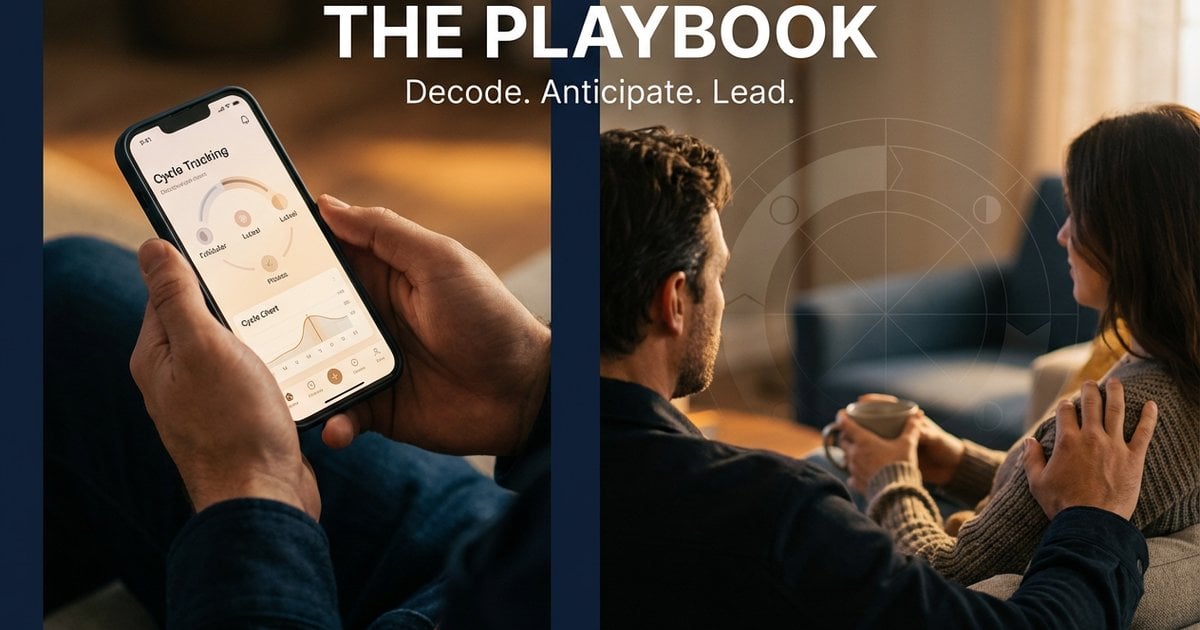
Stop walking on eggshells and master the #vibecheck. Use this playbook to decode her cycle phases, anticipate her needs, and improve communication today.
The Man's Playbook to #VibeCheck: How to Support Her Cycle Without Saying the Wrong Thing
You've been there. Everything's great, you say something completely innocent, and suddenly you're in the middle of an argument you didn't see coming. You're walking on eggshells, second-guessing every word, wondering what changed between yesterday when she laughed at your jokes and today when nothing you do seems right.
Here's what nobody tells you: it's not random. There's an invisible pattern running in the background of your relationship, and once you learn to read it, you'll stop feeling like you're constantly one step behind.
Welcome to the world of cycle awareness. This isn't about "tracking her period" like some weird surveillance project. It's about understanding the biological rhythms that influence her energy, mood, and emotional needs so you can show up as the partner she needs, exactly when she needs it.
Think of it as having the cheat codes to your relationship.
Table of Contents
- The Invisible Relationship Hack
- Decoding the 4 Phases: The Executive Summary
- The "What to Say" vs. "What NOT to Say" Matrix
- Why Data Isn't Enough: The VibeCheck Difference
- The 48-Hour Window: Mastering the Pre-Period Transition
- Frequently Asked Questions
The Invisible Relationship Hack
BLUF: Understanding her hormonal cycle gives you predictive power in your relationship, transforming you from reactive to proactive, from guessing to leading with confidence.
Most guys approach relationships like they're navigating in the dark. You react to whatever comes your way, hoping you don't step on a landmine. But what if you had a map? What if you could anticipate when she'll need space versus connection, when she'll want adventure versus comfort, when she'll need you to solve problems versus just listen?
The hormonal cycle isn't some mysterious force designed to confuse you. It's a predictable pattern that repeats roughly every 28 days, creating distinct phases with recognizable characteristics. Once you understand these phases, you gain something powerful: context.
That argument last week? It probably wasn't about the dishes. Her sudden need for alone time? Not about you. Her unexpected burst of energy and desire for spontaneity? Also biological.
Why This Matters More Than You Think
Research shows that hormone fluctuations affect more than just physical symptoms. They influence:
- Decision-making patterns (she's more likely to take risks during ovulation)
- Communication style (more direct mid-cycle, more nuanced during luteal phase)
- Social needs (craving connection during follicular, preferring intimacy during luteal)
- Physical comfort levels (energy peaks mid-cycle, dips before menstruation)
- Emotional processing (logical problem-solving versus feeling-focused responses)
Understanding these patterns doesn't make you manipulative. It makes you informed. It's the difference between a quarterback who reads the defense and one who just throws blind passes.
The Mental Load Problem
Here's something most guys don't realize: your partner is already tracking all of this. She's aware of how her body feels, how her mood shifts, how her needs change throughout the month. When you learn to recognize these patterns too, you're not creating new work. You're picking up part of the load she's been carrying alone.
Women consistently report that one of the most attractive qualities in a partner is emotional intelligence. Not sensitivity. Not weakness. The ability to read the room, anticipate needs, and respond appropriately. Understanding her cycle is emotional intelligence in action.
Think of it like learning her love language, but with scientific backing. When you understand your partner at this level, you're not just a good boyfriend. You're operating in a different league entirely.
From Defense to Offense
Most relationship advice for men is defensive. Don't say this. Avoid that. Watch out for these triggers. It's exhausting, and it puts you in a reactive position where you're constantly trying not to mess up.
Cycle awareness flips the script. Instead of playing defense, you're running the offense. You're not avoiding mistakes; you're creating wins. You know when to plan that ambitious date night. You understand when to give space without her having to ask. You can predict when she'll need extra support and show up before she has to explain.
This is what separates good partners from exceptional ones. Good partners react well when told what's needed. Exceptional partners already know.
Decoding the 4 Phases: The Executive Summary
BLUF: The menstrual cycle has four distinct phases with predictable characteristics. Master this framework and you'll never be caught off guard by sudden mood shifts or changing needs again.
Stop thinking of her cycle as just "period week" and "not period week." That's like thinking the year only has summer and winter. There are four distinct seasons in the hormonal cycle, each with its own characteristics, challenges, and opportunities.
Here's your tactical briefing:
| Phase | Duration | Vibe | Her Experience | Your Playbook |
|---|---|---|---|---|
| Follicular (Spring) | Days 1-13 | Rising energy, optimism, outward focus | She feels capable, social, ready for new things | Plan adventures, schedule important conversations, try new activities together |
| Ovulation (Summer) | Days 14-16 | Peak confidence, high libido, magnetic energy | She feels powerful, attractive, deeply connected | Deep conversations, plan romantic dates, she's most receptive to physical intimacy |
| Luteal (Autumn) | Days 17-28 | Turning inward, sensitive, detail-oriented | She notices everything, needs validation more, can feel overwhelmed | Lead with empathy, validate feelings, reduce decision burden, small gestures matter more |
| Menstrual (Winter) | Days 1-7 | Low energy, introspective, physically uncomfortable | She needs rest, comfort, minimal demands | Be her comfort person, take tasks off her plate, physical touch without expectation |
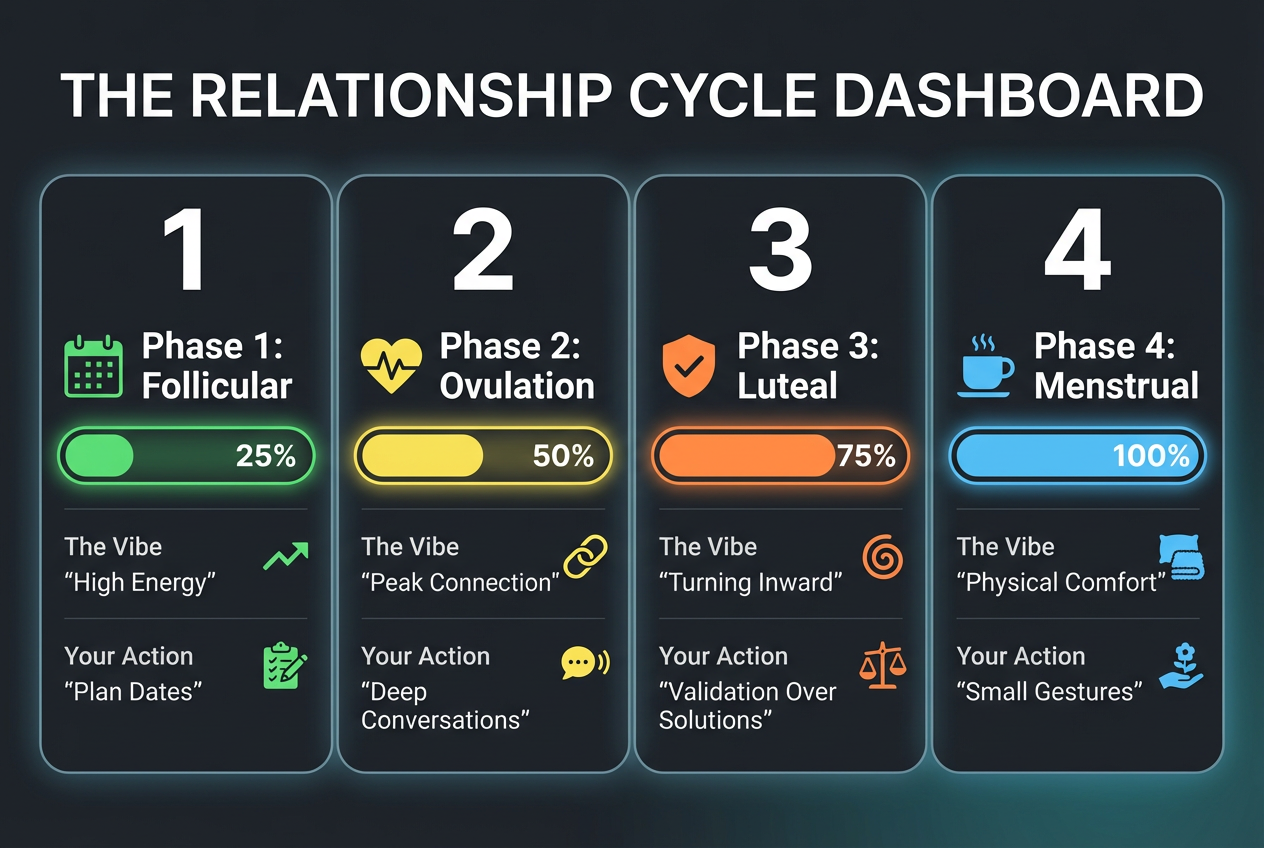 This executive summary breaks down the four cycle phases into actionable intelligence, allowing you to transition from guessing to lead with confidence.
Follicular Phase: The Launch Window
This is when estrogen starts climbing from its lowest point. Think of this phase as her internal battery recharging. She's coming out of the low-energy menstrual phase and everything starts looking possible again.
What's happening biologically: Rising estrogen levels boost serotonin and dopamine (the feel-good chemicals). Her body is literally preparing for potential pregnancy, which means ramping up energy, optimism, and social motivation.
What this means for you: This is your window for the big stuff. Want to plan a weekend trip? Bring up something you've been nervous about? Try that new restaurant across town? Do it now. She's got the bandwidth, and she's more likely to say yes to spontaneous plans.
Common mistakes guys make: Not recognizing this opportunity window. You get comfortable with lower-key activities during her menstrual phase, and you forget to ramp things back up. She starts feeling like the relationship is stagnating, and you're confused because you thought you were being considerate.
Ovulation: Peak Performance
Right in the middle of her cycle, she experiences a surge in luteinizing hormone that triggers ovulation. This is when biology pulls out all the stops.
What's happening biologically: This is peak fertility, so evolution has designed this window to make her most attractive and most attracted. Testosterone peaks (yes, women have testosterone too), which drives confidence and libido. Studies show women make more direct eye contact, speak with more vocal inflection, and even walk differently during this phase.
What this means for you: This is when she feels most like herself. She's confident, she knows what she wants, and she's most likely to initiate intimacy. This is also when communication is clearest because she's less likely to hint and more likely to state directly.
The opportunity: This is your window for deep connection. She's most receptive to physical intimacy, but also to emotional intimacy. This is when to have those vulnerable conversations about the future, your feelings, where you see the relationship going. Her defenses are down in the best way.
Luteal Phase: The Danger Zone (If You're Unprepared)
This is the longest phase and the one most guys completely misread. After ovulation, if pregnancy doesn't occur, progesterone rises to prepare the uterine lining, then both progesterone and estrogen crash right before menstruation.
What's happening biologically: Progesterone is like a sedative. It creates a "nesting" instinct but also makes her more sensitive to everything. As both hormones drop in the second half of this phase, serotonin drops too. She notices details more. Small things feel bigger. Her threshold for frustration lowers.
What this means for you: This isn't the week to leave dishes in the sink "just for a minute" or forget to text back for three hours. Her radar is on high sensitivity. Things that didn't bother her last week suddenly do. This isn't her being difficult; her brain is literally processing information differently.
The shift in needs: During follicular and ovulation, she wanted to take on the world. Now she wants to pull back. She needs validation more and solutions less. When she vents about work, she doesn't want your five-point plan to fix it. She wants to hear "That sounds really frustrating" and feel understood.
Learn more about what causes mood swings during period and how to distinguish between hormonal sensitivity and genuine relationship issues.
Menstrual Phase: Winter Rest
This is when the uterine lining sheds, and it's physically uncomfortable in ways guys often underestimate. Imagine having a muscle cramp in your abdomen that won't stop for several days, combined with fatigue that makes simple tasks feel overwhelming.
What's happening biologically: Both estrogen and progesterone are at their lowest. This means low energy, potential physical pain, and a strong need for rest and comfort. Some women experience mild symptoms; others are significantly impacted.
What this means for you: This is when small gestures carry enormous weight. Taking out the trash without being asked. Bringing her favorite snacks. Asking "What can I take off your plate today?" These aren't grand romantic gestures, but they hit different during this phase.
The intimacy shift: Physical intimacy might be off the table (or not, depending on her preferences), but emotional intimacy becomes even more important. This is when being present matters more than being impressive. Just existing in the same space without demands can be exactly what she needs.
Understanding how to support your partner during her period transforms you from someone who survives this phase to someone who actually helps.
The "What to Say" vs. "What NOT to Say" Matrix
BLUF: The words you choose can either validate her experience or completely invalidate it. This framework shows you exactly what works and what backfires across every phase.
Here's where most guys fail. They say something that sounds perfectly reasonable to them and get a response that seems completely out of proportion. The problem isn't what you're trying to communicate. It's how you're saying it and when.
Context is everything. The same sentence that lands perfectly during her follicular phase can blow up in your face during the luteal phase. Not because she's being unreasonable, but because her emotional needs are different.
 Small shifts in your communication can prevent unnecessary friction. Use these high-value phrases to validate her experience and build trust instantly.
The Universal Rules
Before we get into phase-specific guidance, here are the phrases you should eliminate from your vocabulary entirely, regardless of what phase she's in:
NEVER say:
- "Are you on your period?" (Even if you're 100% sure. Especially if you're 100% sure.)
- "You're being crazy/irrational/emotional." (This dismisses her entire experience.)
- "It's not that big of a deal." (You don't get to decide what's a big deal for her.)
- "Calm down." (Has this ever, in the history of humanity, helped someone calm down?)
- "Other girls don't act like this." (Comparison is relationship poison.)
These phrases share a common problem: they invalidate her experience. They communicate that how she feels is wrong, excessive, or unreasonable. Even if you think her reaction is disproportionate, saying so makes you the enemy.
Follicular Phase Communication
During this phase, she's got bandwidth and energy. Communication can be more direct and solution-focused.
What works:
- "Want to try that new hiking trail this weekend?"
- "I've been thinking about our summer plans. Can we talk through some options?"
- "That sounds frustrating. What do you think would help?"
- "I love when you're fired up about stuff like this."
What backfires:
- Being too cautious or tentative. She doesn't need you to walk on eggshells right now.
- Assuming she needs extra support. She's feeling capable; let her be.
- Dismissing her enthusiasm. If she's excited about something, match that energy.
Ovulation Phase Communication
This is when she's most confident and direct. Communication is clearest because she's likely to say exactly what she means.
What works:
- Direct expressions of attraction: "You look incredible."
- Vulnerability: "I've been thinking about us and where we're headed."
- Matching her energy: If she's feeling bold, be bold back.
- Clear intentions: "I want to spend tonight just focusing on you."
What backfires:
- Being too passive or indirect. She's giving you clear signals; don't miss them.
- Treating her like she's fragile. She's at peak confidence; honor that.
- Overanalyzing. This is when to trust your instincts and be present.
Luteal Phase Communication (The Critical Window)
This is where most guys need the most help. Her needs have shifted, and what worked two weeks ago doesn't work now. Learn more about progesterone effects on mood to understand what's driving these changes.
What works:
- "That sounds really hard. I'm here."
- "I noticed you've been dealing with a lot lately. What can I take off your plate?"
- "You're not overreacting. This would frustrate me too."
- "Want me to just listen, or do you want my thoughts?"
- "I grabbed your favorite snacks on the way home."
What backfires:
- Jumping to solutions: "Have you tried..." or "What if you just..."
- Minimizing: "It'll be fine" or "Don't stress about it."
- Making it about you: "I had a tough day too."
- Asking her to explain her feelings logically. She might not be able to, and that's okay.
- Forgotten commitments hitting differently. That thing you said you'd do last week? It's going to matter more now.
Menstrual Phase Communication
She's physically uncomfortable and emotionally raw. This is not the time for difficult conversations or big asks.
What works:
- "I'm running to the store. What do you need?"
- "Want me to handle dinner tonight?"
- "Is there anything that would make you more comfortable?"
- "I'm here if you need anything, and I'm here if you just want quiet company."
- Simple physical affection without expectation: a forehead kiss, holding her hand, a long hug.
What backfires:
- Asking her to do things that require physical energy.
- Bringing up problems or tensions. Table it.
- Making physical demands.
- Acting put out by her low energy. She can tell.
- Asking "When will you feel better?" Puts pressure on her to perform.
The Art of the Check-In
Across all phases, one skill matters more than anything else: the quality check-in. Not the casual "How are you?" that everyone reflexively answers with "Fine." The real one.
Try these instead:
- "On a scale of 1-10, how's your energy today?"
- "What's taking up the most mental space for you right now?"
- "Is today an 'I need space' day or an 'I need you close' day?"
- "Anything I should know about how you're feeling today?"
These questions do something important: they acknowledge that her state varies and that you're paying attention. They give her permission to be honest without having to initiate the conversation.
For more science-backed strategies, check out these communication tips for couples that go beyond just cycle awareness.
Why Data Isn't Enough: The VibeCheck Difference
BLUF: Knowing when her period starts is useful. Knowing what specific support she needs today based on her unique patterns, relationship context, and current life stressors is game-changing.
Most period tracking apps give you data. VibeCheck gives you intelligence.
Here's the problem with traditional period trackers: they tell you facts without interpretation. "Her period starts in 5 days." Okay, great. What does that mean for you? What should you do with that information? How does that change your approach today versus yesterday?
That's like knowing there's a storm coming but not knowing if you need an umbrella or a bunker.
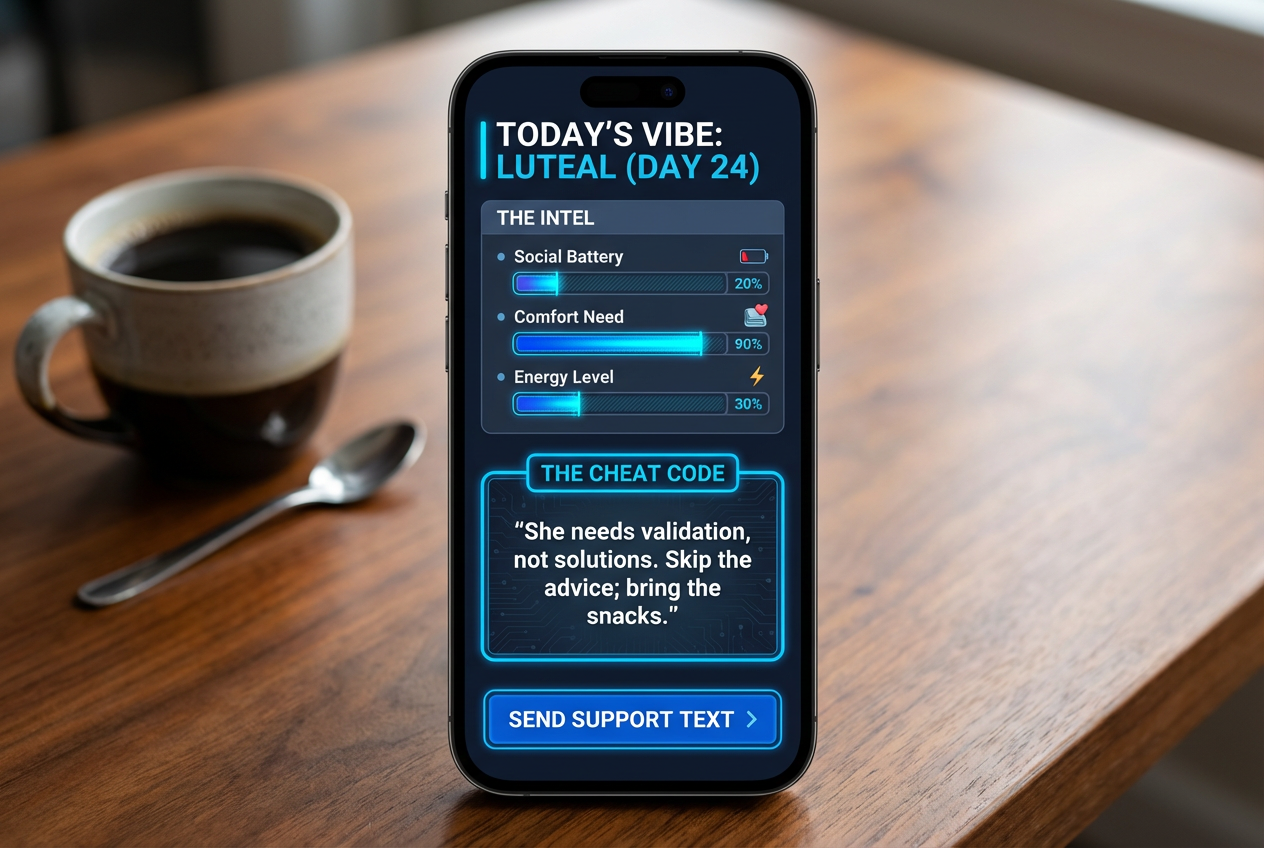 Beyond simple tracking, the VibeCheck approach provides a daily strategic briefing, giving you the exact 'cheat codes' needed to navigate the day successfully.
The Translation Layer
Think about weather apps. They don't just tell you the temperature. They tell you what it feels like, what to wear, whether you need an umbrella. They translate raw data into actionable intelligence.
That's what VibeCheck does for cycle awareness. It takes the biological facts and translates them into relationship strategy.
Instead of: "Day 23 of cycle (luteal phase)"
You get: "She's likely to need more validation today. Small gestures carry extra weight. Not a good day for difficult conversations. Great day to take something off her plate without being asked."
See the difference? One is information. The other is guidance.
The Personalization Problem
Here's what generic period trackers miss: every woman is different. Some women have textbook 28-day cycles. Others are 25 days or 32 days or vary by several days month to month. Some women get irritable in the luteal phase. Others get sad. Some get both. Some barely notice.
Your girlfriend might get ravenously hungry a few days before her period, craving specific foods. Understanding if progesterone makes you hungry helps you anticipate this need. Another woman might lose her appetite completely.
Generic tracking apps don't account for this variation. They give you population averages, not personal insights. It's like using a map of an average city to navigate the specific city you're in. Close enough to be confusing, not accurate enough to be useful.
Beyond the Biological
Here's what most cycle-tracking approaches completely miss: hormones don't exist in a vacuum. Yes, her progesterone is elevated during the luteal phase. But you know what else matters? Whether she's stressed at work. Whether her family is going through something. Whether you two had an argument last week that didn't get fully resolved.
The most sophisticated cycle awareness in the world means nothing if it doesn't account for life context.
A woman in her follicular phase (theoretically high energy, ready for adventure) who just found out her job is being eliminated isn't going to respond the way the biology predicts. The hormones are pushing one direction, but life circumstances are pushing another.
This is where relationship intelligence apps like VibeCheck diverge from pure period trackers. They layer biological awareness with relationship context with personal history with current life circumstances.
The Male-Designed Interface Problem
Most period trackers were designed by women, for women. Which makes sense, since women are the primary users. But this creates a problem when men try to use them to be supportive partners.
The interface speaks a language optimized for the person experiencing the cycle, not the person trying to support them. It's clinical. It's data-heavy. It assumes knowledge of terminology and symptom patterns that most guys simply don't have.
Using Flo or Clue as a supportive partner feels like trying to read your girlfriend's medical charts. Sure, the information is there, but you need a translator.
Apps designed specifically for period tracking for partners flip this model. They translate female biology into male-friendly action items. Not because men are dumb, but because the communication needs to match the audience.
The Daily Briefing Model
The most effective approach to cycle awareness for men isn't a calendar with dots and symptoms. It's a daily strategic briefing that answers specific questions:
- Where is she right now? (What phase, what's happening biologically)
- What is she likely experiencing? (Physical and emotional patterns)
- What does she need from you today? (Specific actions and approaches)
- What should you avoid today? (Potential landmines and timing issues)
- What's the outlook for the next few days? (What's coming so you can prepare)
This isn't about control or prediction. It's about being prepared. It's the difference between a quarterback who's seen the opponent's game film and one who shows up cold.
Why Traditional Couples Apps Miss the Mark
There's another category of apps trying to solve this problem: couples apps that include period tracking as a feature. Apps like Paired, Lasting, or Love Nudge that try to do everything from date night ideas to conflict resolution to cycle awareness.
The problem with the all-in-one approach is that it treats cycle awareness as just another relationship feature, like daily questions or love language quizzes. It's not. Understanding her hormonal patterns is fundamental to every other aspect of your relationship.
It's the difference between an app that occasionally reminds you about her period and a system that fundamentally changes how you understand her daily experience.
For a detailed comparison, check out this breakdown of the best period trackers for men that explains what actually works and what's just marketing.
The Privacy Question
One concern guys often have: "Isn't this invasive? Am I tracking her without her knowing?"
Valid question. Here's the answer: this only works with her consent and ideally her involvement. The best implementation is when both partners understand what's happening. She shares her patterns (either through her own tracking or through your shared awareness), and you use that information to be a better partner.
This isn't surveillance. It's shared understanding. The difference is massive.
When done right, cycle awareness takes mental load off her plate. She no longer has to explain why she's feeling what she's feeling or ask for what she needs. You're already there.
The ROI of Better Intelligence
Let's be practical about this. What's the actual return on investment of using a sophisticated cycle awareness tool versus just winging it or using basic period calendar?
Reduced conflict: When you understand that her irritability is progesterone-driven, you take things less personally. You respond with empathy instead of defensiveness. Arguments that would have spiraled get defused before they start.
Better timing: You stop proposing ambitious weekend plans right before her period. You stop initiating difficult conversations during her luteal phase. You recognize windows of opportunity and act on them.
Increased intimacy: When she feels deeply understood without having to explain herself, intimacy deepens. The emotional safety that comes from being truly known is powerful.
Mental load reduction: She doesn't have to manage your awareness of her state. You're already tracking it. This is huge.
Relationship satisfaction: Studies consistently show that perceived partner responsiveness (the feeling that your partner understands and cares about your needs) is one of the strongest predictors of relationship satisfaction. Cycle awareness supercharges responsiveness.
The VibeCheck App was built specifically to bridge the gap between raw data and actionable relationship strategy, designed from the ground up for men who want to be exceptional partners.
The 48-Hour Window: Mastering the Pre-Period Transition
BLUF: The 48 hours before her period begins are the highest-stakes window in the entire cycle. Master this transition and you'll prevent 80% of cycle-related relationship friction.
If you learn nothing else from this guide, learn this: the transition from late luteal phase to menstruation is where relationships either shine or strain.
This is the moment when both estrogen and progesterone crash simultaneously. Her body is essentially withdrawing from two powerful hormones at once. Think of it like coming down from a caffeine high and a sugar high at the same time, but it lasts for days instead of hours.
What's Happening Biologically
Around days 26-28 of an average cycle, hormone levels drop sharply. This sudden withdrawal causes:
- Serotonin decrease: This is your brain's primary mood stabilizer. When it drops, emotional regulation becomes harder.
- Prostaglandin release: These are inflammatory compounds that cause physical pain and discomfort.
- Water retention: Bloating and physical discomfort peak.
- Sleep disruption: Progesterone affects sleep quality, so she might be exhausted even if she slept eight hours.
- Increased pain sensitivity: Her actual pain threshold lowers. Things hurt more.
It's not all in her head. Her body is experiencing a significant physiological event.
The Warning Signs
You can't always know exactly when her period will start (cycles vary, stress can delay periods, etc.), but you can recognize the signs that you're in the high-stakes window:
- Increased sensitivity to minor issues: Things that normally wouldn't bother her suddenly do.
- Lower frustration threshold: She's quicker to irritation.
- Physical discomfort: Mentioning feeling bloated, crampy, or "off."
- Desire for comfort foods: Specific cravings for chocolate, salt, carbs.
- Lower social energy: Canceling plans, preferring to stay in.
- More emotional expression: Crying at commercials, feeling things more intensely.
- Need for reassurance: Asking if you're mad, if everything's okay, seeking validation.
If you're seeing three or more of these, you're probably in the 48-hour window.
The Strategy: Prevent, Don't React
Most guys go into reactive mode during this window. They wait for something to go wrong, then try to fix it. That's playing from behind.
The better strategy is preventive. Assume she needs extra support before she asks for it. Make the environment as low-friction as possible before tension has a chance to build.
Practical tactics:
Reduce decision burden: Don't ask "What do you want for dinner?" Say "I'm thinking of ordering from that Thai place you like. The usual?"
Take initiative on chores: Handle things without being asked. The mental relief of not having to delegate tasks is enormous.
Create comfort proactively: Have her preferred pain reliever stocked. Keep a heating pad accessible. Stock comfort foods.
Minimize social demands: If you have plans with friends, offer an easy out. "No pressure if you'd rather stay in tonight."
Increase small touches: Random forehead kisses, hand-holding while watching TV, back rubs without sexual expectation.
Validate preemptively: "You've been handling a lot lately. You're doing great."
Buffer external stress: If something stressful is on the calendar, offer to handle it or postpone it if possible.
What to Avoid Like the Plague
During this 48-hour window, certain behaviors are relationship kryptonite:
- Starting difficult conversations: "We need to talk about..." can wait.
- Criticism of any kind: Even constructive feedback lands wrong right now.
- Expecting enthusiasm: She's not going to be excited about your new idea for weekend plans.
- Physical distance: This is not the time to have a guys' night out unless she explicitly encourages it.
- Forgotten promises: Anything you said you'd do becomes exponentially more important.
- Comparison: Any mention of other people's relationships, other women, past relationships.
The Secret Weapon: Anticipatory Empathy
Here's the move that separates good partners from exceptional ones: anticipatory empathy. This is when you acknowledge what's coming before it arrives.
Example: "Hey, I know the next few days might be rough. I'm here for whatever you need, and I've got you on the practical stuff. You focus on taking care of yourself."
This does several things:
- Shows you're paying attention
- Removes pressure for her to perform or explain
- Communicates that you're on her team
- Preemptively addresses any guilt she might feel about needing support
When Things Go Wrong Anyway
Even with perfect execution, things can still get tense during this window. Hormones are powerful, and sometimes conflict happens despite your best efforts.
If you find yourself in an argument during the pre-period window:
Do:
- Keep your voice calm and level
- Validate before defending: "I hear you" before "But actually..."
- Take breaks if things escalate: "I need a few minutes to process this"
- Apologize for your part, even if you think it's minor
- Remember this will pass; don't make permanent decisions based on temporary tension
Don't:
- Bring up her cycle as an explanation for her feelings
- Dismiss her concerns as hormone-driven
- Get defensive or match elevated emotion
- Bring up past conflicts or keep score
- Walk away without explanation
The Recovery Play
If things did get rocky during the 48-hour window, don't just pretend it didn't happen once her period starts. Acknowledge it, but with the right framing:
"I know the last couple days were tough. I want you to know I don't hold any of that against you, and I'm sorry for [specific thing you could have done better]. We're good."
This gives closure without dwelling on it or making her feel bad about how she acted when she was hormonally compromised.
Why This Window Matters Most
Think about it from a pure efficiency standpoint. The follicular and ovulation phases largely take care of themselves. She's got energy, mood is stable, communication is clear. You could be a mediocre partner during these phases and things would probably be fine.
But the pre-period window? That's where partnerships are tested. That's where your understanding, your patience, your proactive support actually matter.
Master this 48-hour window, and you're not just avoiding problems. You're building deep trust. She learns that you're reliable when things are hard, not just when they're easy.
That's the foundation of a relationship that lasts.
Frequently Asked Questions
What is a #vibecheck in a relationship context?
A #vibecheck in a relationship isn't about judging your partner or "checking if she's in a good mood." It's about assessing where she is in her hormonal cycle and understanding how that influences her emotional and physical state. Think of it as situational awareness that helps you show up as the partner she needs right now, not the partner you were yesterday or will be next week. Learn more about what a vibe check really means in modern relationships.
How do I start tracking my partner's cycle without making it weird?
Start with a conversation. Frame it as wanting to be a better partner: "I've been learning about how hormonal cycles affect energy and mood, and I want to understand what you experience so I can be more supportive. Would you be open to sharing where you are in your cycle so I can be more in tune with what you need?"
Most women respond positively to this because it shows you care enough to learn. You can use a simple calendar, a shared app, or a tool designed specifically for partners like the VibeCheck relationship insights app. The key is transparency and consent.
Does this work for women with irregular cycles?
Yes, but it requires more attention to patterns and symptoms rather than strict calendar tracking. Women with irregular cycles still experience the four phases, they just don't occur on a predictable schedule. Focus on recognizing the signs and symptoms of each phase rather than counting days. Over time, you'll learn her specific patterns even if they're not textbook regular. If she's experiencing very irregular cycles or severe symptoms, encourage her to speak with a healthcare provider, as conditions like PCOS or thyroid issues might need attention.
What if my partner doesn't want me tracking her cycle?
Respect that boundary. Some women feel uncomfortable with the idea of their partner monitoring their cycle, and that's valid. You can still apply cycle awareness principles by paying attention to her cues without formal tracking. Watch for energy levels, communication style, physical comfort, and adjust your approach accordingly. The goal isn't to track for the sake of tracking; it's to be responsive to her needs. If she's telling you directly what she needs, you don't need cycle tracking to be a good partner.
How do birth control pills affect cycle awareness?
Hormonal birth control fundamentally changes the hormonal pattern by suppressing ovulation and providing synthetic hormones at steady levels. Women on the pill don't experience the natural hormone fluctuations of a regular cycle. However, many still experience the "placebo week" or "period week" symptoms, and some notice mood or energy patterns even on synthetic hormones. The strategies in this guide still apply, but you'll need to learn her specific patterns rather than relying on biological phase predictions.
What's the difference between VibeCheck and Flo for Partners?
Flo is a comprehensive period tracker designed primarily for women, with a partner feature added on. It excels at detailed tracking, medical accuracy, and fertility awareness. VibeCheck is built from the ground up for men who want to support their partners, focusing on translating cycle data into actionable relationship advice. Think of Flo as a medical tool with relationship features; VibeCheck as a relationship tool with cycle awareness. For a detailed comparison, check out VibeCheck vs Flo.
Can understanding her cycle help with intimacy and connection?
Absolutely. Physical intimacy often varies significantly across the cycle due to hormonal influences on libido. Understanding when she's most likely to desire intimacy (often around ovulation) versus when she might need physical comfort without sexual pressure (often during menstruation) helps you read her needs better. Beyond physical intimacy, knowing when she's most receptive to deep emotional conversations versus when she needs lighter connection helps you time important relationship moments better. This isn't about manipulation; it's about optimizing moments when you're both most available to connect deeply.
What if I make mistakes or get it wrong sometimes?
You will. That's part of learning. No guide or app can predict every individual variation or account for every life circumstance. The goal isn't perfection; it's improvement. If you mess up, acknowledge it: "I should have realized you needed space instead of pushing for plans. I'm still learning." The effort matters more than flawless execution. Most women are incredibly forgiving of mistakes made in good faith while you're actively trying to understand and support them.
Is cycle awareness just an excuse for bad behavior?
No, and this is important. Understanding that hormonal fluctuations influence mood doesn't mean accepting disrespectful behavior. There's a difference between "She's irritable because progesterone is dropping, so I'll give her space and not take it personally" and "She can treat me however she wants because hormones." Healthy relationships still require respect, boundaries, and healthy communication patterns. Cycle awareness is a tool for empathy and support, not a free pass for either partner to avoid accountability. If conflicts are severe regardless of cycle phase, that's a relationship issue, not a hormonal one, and might need professional support.
The Bottom Line
Understanding your partner's hormonal cycle isn't about becoming her therapist, her doctor, or her tracking device. It's about becoming fluent in a language her body speaks every month, whether you're paying attention or not.
Most guys go through their entire relationships reacting to patterns they never learn to predict. They feel confused when she's upset, defensive when she's irritable, and disconnected when she pulls away. All because they're missing the biological context that would make everything make sense.
You don't have to be that guy.
The science is clear. The patterns are real. The tools exist. The only question is whether you care enough to learn them.
Start small. Notice one phase. Master one transition. Build the awareness gradually, and watch how your entire relationship dynamic shifts when you stop guessing and start knowing.
Because at the end of the day, being a great partner isn't about grand gestures or expensive gifts or always knowing the right thing to say. It's about showing up consistently, understanding deeply, and being reliable when it matters most.
That's what separating the men from the boys in modern relationships. And it starts with paying attention to the #vibecheck.
Tags

Related Articles
Continue reading to deepen your understanding

How to Support Your Girlfriend Through Luteal Phase Fatigue
Is your partner suddenly exhausted and irritable before her period? Understand the biology behind her fatigue and learn tactical ways to provide real support during the luteal phase.

When Your Girlfriend Needs Attention During the Follicular Phase: A Tactical Guide for Partners
If your girlfriend is seeking more connection lately, it isn’t a problem—it is biological. Discover how her follicular phase affects her social drive and exactly when she needs your presence.

Your Girlfriend Is Withdrawn During Ovulation? What It Actually Means and How to Respond
Is your girlfriend suddenly distant mid-cycle? This guide covers the biological causes of ovulation withdrawal and how to support her with an invisible framework.

When Your Girlfriend Is Sensitive to Criticism During the Luteal Phase: The Partner’s Science-Based Action Guide
Does your partner react intensely to feedback right before her period? Understand the biology behind luteal phase rejection sensitivity and learn how to communicate effectively.

How to Give Your Girlfriend Reassurance During the Follicular Phase: A Partner’s Tactical Guide
Is your girlfriend feeling vulnerable after her period? Learn why the early follicular phase causes emotional lows and how you can provide the specific reassurance she needs to feel secure.

Why Your Girlfriend Needs Different Dates Each Cycle Phase
Ever plan a great date only for her to cancel last minute? Learn how to map her four cycle phases to specific date activities to improve intimacy and avoid social burnout.

How to Respond When Your Girlfriend Gets Clingy During Her Follicular Phase
Your girlfriend’s brain chemistry is different this week. Rising estrogen levels cause social drive to peak. Here is how to respond to her need for connection effectively.

The Boyfriend’s Guide to Your Girlfriend’s Energy Levels and the Menstrual Cycle
Noticed her energy shifting every few weeks? Stop guessing and start supporting. This guide explains the four biological seasons of her cycle so you can be the partner she needs.