How to Comfort Your Girlfriend During Hormonal Anxiety Naturally

Help your partner navigate her luteal phase with biological understanding and actionable care. This guide offers natural remedies and partner scripts to ease hormonal anxiety effectively.
How to Comfort Your Girlfriend During Hormonal Anxiety Naturally
When your girlfriend suddenly shifts from relaxed to on-edge - when her texts get shorter, she seems irritable over small things, or she's overwhelmed by worries that didn't exist yesterday - it's not a relationship crisis. It's likely hormonal anxiety.
And if you're reading this, you've probably felt the helplessness that comes with watching someone you care about struggle while having no idea how to help without making it worse.
This guide is built for male partners who want to understand what's happening biologically, what actually helps (and what makes things worse), and how to prepare so next month isn't this hard.
Table of Contents
- What Is Hormonal Anxiety and When Does It Happen?
- Why Does Hormonal Anxiety Happen? The Biology Explained
- The Difference Between PMS and PMDD: When It's More Than Just Mood Swings
- The Immediate Support Kit: Natural Remedies That Actually Work
- The Partner's Script: What to Say (and What Not to Say)
- Tactical Care: The Logistical Support Framework
- Long-Term Strategy: Tracking and Communication
- When to Call a Professional
- Frequently Asked Questions
What Is Hormonal Anxiety and When Does It Happen?
Hormonal anxiety is intense emotional distress triggered by fluctuations in estrogen and progesterone during the menstrual cycle. It's not "being dramatic" or "overreacting" - it's a neurobiological response to chemical changes in the brain.
Here's the critical timing insight most men miss: hormonal anxiety typically peaks 5 to 10 days before menstruation begins, not during the period itself. This window is called the luteal phase, and understanding it is everything.
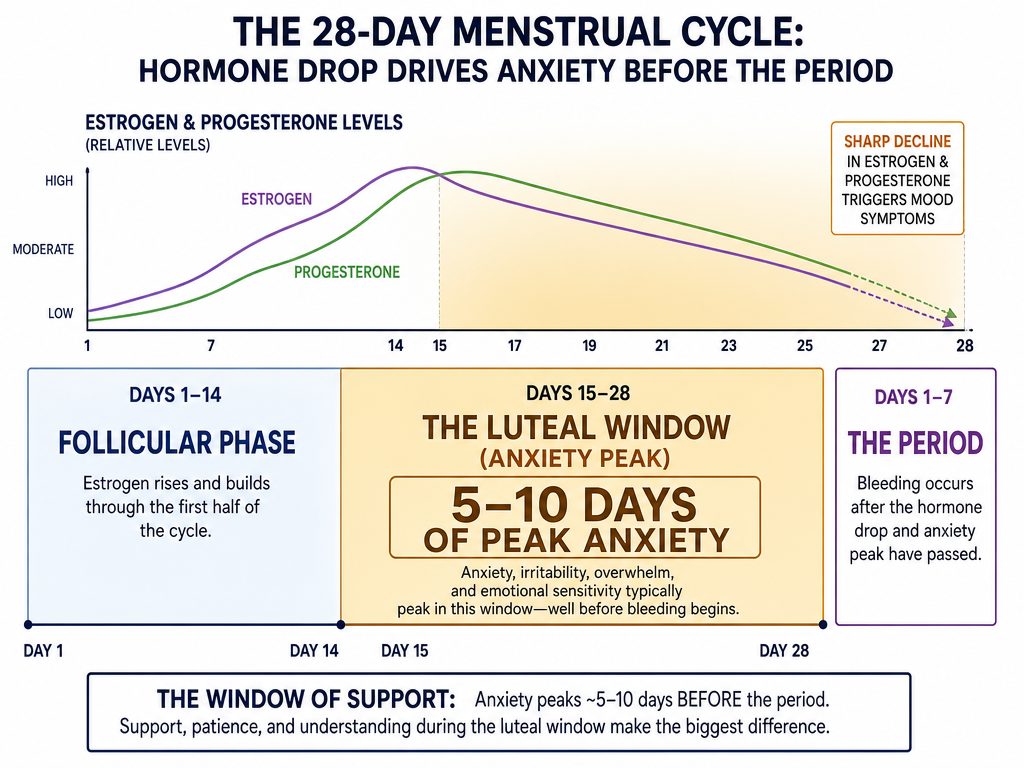 Understanding the Luteal Window is critical; hormonal anxiety typically peaks 5 to 10 days before menstruation begins, driven by a sharp drop in estrogen and progesterone levels.
After ovulation, the luteal phase begins: progesterone rises to help prepare the uterine lining for a possible pregnancy. If pregnancy doesn't happen, both progesterone and estrogen drop sharply before the next period. This hormonal crash is when anxiety, irritability, and emotional sensitivity spike.
VibeCheck App
Download Free on iOS →Many women notice PMS-like symptoms in this phase - mood shifts, breast tenderness, bloating, acne, and appetite changes - though not everyone does. When these symptoms are severe enough to disrupt daily life or strain relationships, it may be PMDD rather than standard PMS.
Why Does Hormonal Anxiety Happen? The Biology Explained
Estrogen affects many body systems, including brain function and the ability to focus, and levels are highest in the days leading up to ovulation. When estrogen drops sharply in the luteal phase, it takes mood-regulating brain chemicals like serotonin with it.
Think of it this way: estrogen acts like a thermostat for emotional regulation. When it crashes, the brain's ability to manage stress and anxiety drops with it. This isn't a character flaw - it's chemistry.
The progesterone crash compounds the issue. Progesterone has a calming, almost sedative effect on the brain. When it plummets, many women experience heightened anxiety, restlessness, and even panic-like symptoms.
Your girlfriend isn't choosing to feel this way. Her brain is literally operating with different neurochemical levels than it was two weeks ago.
The Difference Between PMS and PMDD: When It's More Than Just Mood Swings
Understanding PMS
PMS (premenstrual syndrome) is very common: as many as 3 in 4 women report experiencing PMS symptoms at some point in their life, though severity varies widely. Symptoms - which can include mood swings, irritability, bloating, breast tenderness, and fatigue - typically show up one to two weeks before a period and resolve within a few days after it starts.
Roughly half of people who menstruate report having at least one PMS symptom, but only about 1 in 5 have symptoms severe enough to disrupt their daily life. That more disruptive tier is a meaningfully different experience than "typical" PMS.
When It's PMDD
PMDD (premenstrual dysphoric disorder) is a real, clinically recognized condition - it's listed in the DSM-5 as a depressive disorder, not something people are "making up" or simply failing to cope with. It affects roughly 1 in 10 people who menstruate.
PMDD is a more severe, sometimes disabling extension of PMS. Both happen on a similar timeline (about 7-10 days before a period) and can share physical symptoms like bloating and fatigue, but PMDD specifically involves extreme mood symptoms - such as marked irritability, anxiety, or hopelessness - intense enough to disrupt daily life and strain relationships.
The stakes are real: married or cohabiting women with PMDD have a 21% increased risk of relationship disruption over 9 years. This isn't because partners don't care - it's because they don't know how to help.
If your girlfriend's anxiety feels overwhelming, unpredictable, or is affecting her ability to work or function, she may need professional evaluation for PMDD. More on that below.
The Immediate Support Kit: Natural Remedies That Actually Work
When hormonal anxiety hits, you want to do something. Here's what the research actually supports.
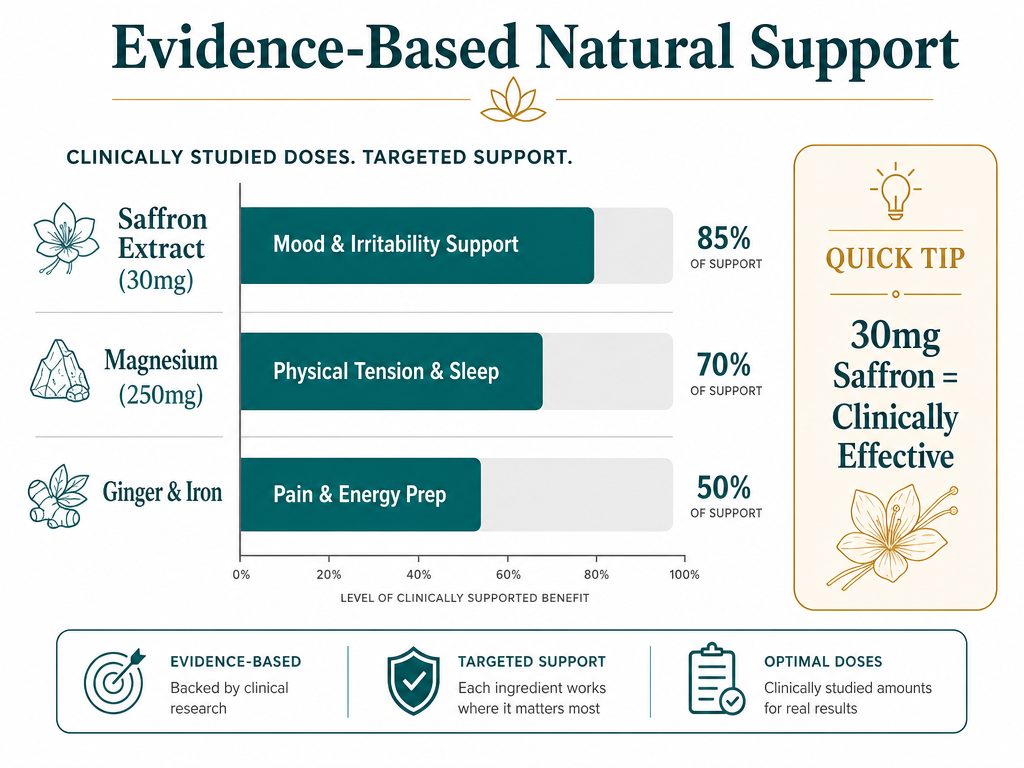 Scientific research supports specific natural interventions, such as 30mg of Saffron daily for mood regulation and 250mg of Magnesium to alleviate physical tension and improve sleep quality.
Saffron: The Science-Backed Mood Stabilizer
Clinical trials show 30mg/day of Saffron extract can significantly alleviate PMS/PMDD mood symptoms. In controlled studies, Saffron performed comparably to SSRIs for mild-to-moderate mood disturbances - without a prescription.
Look for a standardized Saffron supplement (typically labeled as "Saffron extract 30mg"). She can take it daily throughout the cycle, but it's particularly helpful if started a week before symptoms typically begin.
Important: Saffron is a supportive natural option, not a clinical replacement for prescribed medication. If she's already on an antidepressant, she should consult her doctor before adding Saffron.
Magnesium: Physical and Mental Tension Relief
250mg of Magnesium daily is linked to reduced physical PMS symptoms and muscle relaxation. Magnesium also supports better sleep, which is often disrupted during the luteal phase.
Magnesium glycinate is the most bioavailable form and least likely to cause digestive upset. She can take it in the evening to help with both physical tension and restlessness.
The Anti-Inflammatory Diet Approach
Sugar cravings during the luteal phase are biological - progesterone drives appetite changes. Don't judge them, and don't try to police her food choices.
That said, some dietary adjustments can help:
- Ginger (fresh or in tea) has mild anti-inflammatory properties and can help with both physical pain and nausea
- Iron-rich foods (leafy greens, red meat, lentils) help prepare the body for menstruation
- Complex carbohydrates (sweet potatoes, oats, quinoa) help stabilize serotonin levels
The goal isn't restriction - it's addition. Offer to cook or bring home foods that support her biology without making her feel like she's doing something wrong by eating what she craves.
The Partner's Script: What to Say (and What Not to Say)
This is where most well-meaning men accidentally make things worse. The instinct to "fix" the problem is wired into us, but when a partner is struggling emotionally, responding with genuine empathy - listening without judgment, focusing on their feelings rather than debating facts, and validating that their reaction makes sense - tends to help more than trying to "fix" the problem or offer silver linings.
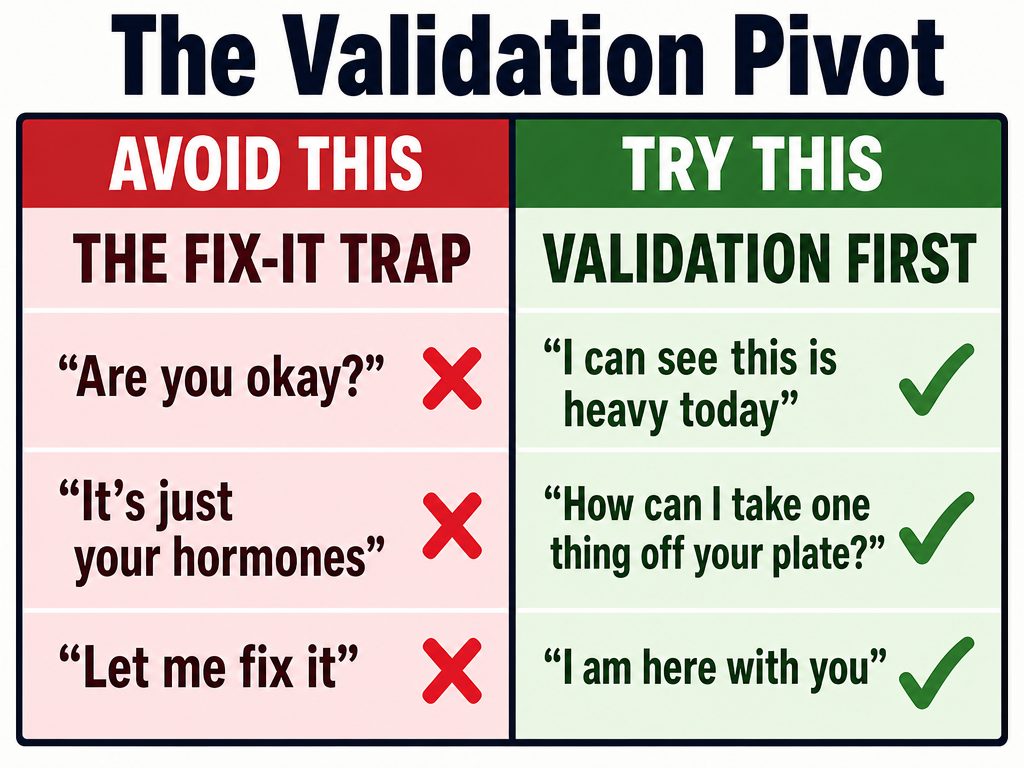 Switching from 'fixing' to 'validating' prevents accidental escalation. Using supportive scripts helps your partner feel heard rather than judged during intense neurobiological shifts.
The Fix-It Trap (What Not to Say)
- "Are you okay?" (She's clearly not, and this feels dismissive)
- "Calm down." (Never works, ever)
- "Is it your period?" (Even if you're right, this invalidates her feelings)
- "You're overreacting." (You just made it worse)
- "It's not that big of a deal." (To her brain right now, it absolutely is)
Validation-First Scripts (What Actually Helps)
- "I can see this is really heavy today. How can I take one thing off your plate?"
- "That sounds really hard. I'm here if you want to talk or if you just need quiet."
- "I don't need you to have it all figured out right now. Just tell me what would help."
- "I know you're dealing with a lot internally. I'm not going anywhere."
- "Would it help if I handled [specific task] tonight?"
The pattern: acknowledge her reality, offer concrete help, don't try to logic her out of her feelings.
If you want to understand more about reading her emotional state and knowing when she needs space versus connection, check out our guide on signs your girlfriend needs space.
Tactical Care: The Logistical Support Framework
Here's the truth: during peak hormonal anxiety, the best thing you can do is reduce her cognitive and physical load.
The 5-Day Warning System
A "normal" cycle varies a lot between women - menstrual bleeding can start anywhere from every 24 to every 38 days. There is no single universal 28-day cycle, so exact day-by-day predictions for any specific woman should be treated as approximate.
That said, tracking your own (or a partner's, with her participation) symptoms and mood changes across the cycle for a few months is a legitimate, medically endorsed way to identify real patterns and timing - rather than assuming based on stereotypes or a single cycle.
Use a shared tracker (Flo, Clue, or a dedicated period tracker for couples) to identify when the "Anxiety Window" typically starts. This isn't about surveillance - it's about preparation.
When you know the luteal phase is approaching, you can:
- Front-load difficult conversations to the week before
- Clear your schedule so you're more available
- Stock the fridge with her preferred comfort foods
- Plan low-stress activities instead of high-intensity social events
Domestic Load Takeover
During the hardest days, take over as many household tasks as you can. This means:
- All cooking and meal planning
- All laundry and cleaning
- All errands and logistics
- Any childcare or pet care responsibilities
She didn't ask for this biology. You stepping up during this window isn't "being nice" - it's being a partner who understands that her bandwidth is temporarily reduced through no fault of her own.
For more tactical approaches to supporting her through different phases, see our partner's guide to luteal phase support.
The Touch Question
Some women crave physical affection during hormonal anxiety. Others find touch overstimulating or irritating.
Ask directly: "Would a hug help right now, or would you rather have space?"
Respect the answer without taking it personally. Her need for touch fluctuates with her hormones, not her feelings about you.
Long-Term Strategy: Tracking and Communication
One crisis managed well is good. A system that prevents the crisis altogether is better.
Build a Monthly Check-In Rhythm
Lifestyle approaches that can help ease PMS symptoms include regular aerobic exercise, smaller/more frequent meals, less salt/caffeine/alcohol, adequate sleep, and stress-reduction practices like deep breathing or yoga. A partner who understands these and is patient/supportive around them (rather than dismissive of symptoms) is aligning with medically recommended self-care.
Once per cycle (ideally during her follicular phase, when energy and mood are typically higher), have a calm conversation:
- "How did last month feel to you?"
- "What worked when I [specific action you took]?"
- "What do you wish I'd done differently?"
- "Is there anything new you want to try for symptom management?"
This isn't about fixing her - it's about collaborative problem-solving when her brain chemistry isn't working against her.
Establish Code Words
Sometimes she doesn't want to explain that her anxiety is hormonal. Establish a simple signal:
- "I'm in the red zone today."
- "Storm week incoming."
- "My brain is lying to me right now."
These aren't excuses - they're context. When you hear the code, you know to switch into high-support mode without her having to justify or explain.
If you're interested in understanding the broader pattern of how her cycle affects energy and attention throughout the month, read our partner's field guide to the attention bandwidth cycle.
When to Call a Professional
Some situations go beyond natural remedies and partner support.
Red Flags That Require Medical Attention
- Suicidal ideation or self-harm thoughts
- Anxiety so severe she can't work, leave the house, or function daily
- Physical symptoms that interfere with basic activities (severe pain, bleeding lasting more than 7 days, etc.)
- Relationship violence or patterns of extreme rage
- Symptoms that don't improve at all once menstruation starts
If any of these apply, she needs to see a healthcare provider who specializes in reproductive mental health. PMDD is treatable - with therapy, medication, or both - but it requires professional intervention.
Finding the Right Provider
Not all doctors take PMDD seriously. If her concerns are dismissed, she should:
- Ask for a referral to a gynecologist or psychiatrist who specializes in reproductive mental health
- Bring a symptom diary showing the cyclical pattern
- Explicitly ask, "Could this be PMDD?" rather than waiting for the provider to suggest it
You can support this process by offering to attend appointments (if she wants you there) and helping track symptoms in advance.
For more context on when PMS crosses into PMDD territory, see how to comfort your girlfriend during PMS.
Frequently Asked Questions
How to stop hormonal anxiety?
You can't "stop" hormonal anxiety entirely - it's driven by neurochemical changes in the brain tied to the menstrual cycle. But you can reduce its severity through a combination of natural supplements (Saffron, Magnesium), lifestyle adjustments (regular exercise, adequate sleep, stress reduction), and in severe cases, medical treatment like SSRIs or hormonal birth control. Clinical trials show 30mg/day of Saffron extract can significantly alleviate PMS/PMDD mood symptoms, and 250mg of Magnesium daily is linked to reduced physical PMS symptoms and muscle relaxation. The most effective approach combines multiple strategies rather than relying on a single fix.
How to handle girlfriend mood swings during period?
The first step is understanding that mood swings typically peak before the period, not during it - the support window for anxiety starts 5-10 days before bleeding. Handle mood swings by validating her emotions rather than trying to fix them, taking over household tasks to reduce her cognitive load, and asking directly what she needs rather than guessing. Avoid phrases like "Are you okay?" or "Calm down," which tend to escalate conflict. Instead, use validation-first scripts: "I can see this is really heavy today. How can I take one thing off your plate?" The goal is to be a stabilizing presence, not a problem-solver.
How to comfort your girlfriend when she's anxious?
When your girlfriend is anxious due to hormonal changes, comfort her by offering validation, reducing her workload, and being physically present without overwhelming her. Ask, "Would a hug help right now, or would you rather have space?" and respect her answer. Provide concrete support - cook dinner, handle errands, create a quiet environment - rather than abstract reassurances. Don't try to talk her out of her feelings or offer logic-based solutions during peak anxiety. When a partner is struggling emotionally, responding with genuine empathy - listening without judgment and validating that their reaction makes sense - tends to help more than trying to "fix" the problem. Sometimes the best thing you can do is simply be there and take things off her plate.
Which hormone causes anxiety in females?
Anxiety during the menstrual cycle is caused by the sharp drop in both estrogen and progesterone during the luteal phase (the 7-10 days before menstruation). Estrogen affects many body systems, including brain function, and when it crashes, mood-regulating chemicals like serotonin drop with it. Progesterone also has a calming effect on the brain, so when it plummets, many women experience heightened anxiety and restlessness. It's not one hormone acting alone - it's the withdrawal from both that creates the neurochemical conditions for anxiety. This is why symptoms typically peak in the late luteal phase and resolve shortly after menstruation begins, when hormone levels stabilize.
How does a man deal with a woman with PMDD?
Dealing with PMDD as a partner requires understanding that this is a clinically recognized condition, not a character flaw or something she can "get over." PMDD affects roughly 1 in 10 people who menstruate and married or cohabiting women with PMDD have a 21% increased risk of relationship disruption over 9 years. Support her by encouraging professional treatment (therapy, medication, or both), tracking her cycle so you can anticipate difficult periods, taking over household responsibilities during peak symptom days, and learning validation-based communication rather than dismissive responses. PMDD is treatable, but it requires medical intervention - your role is to be a supportive partner while she gets the help she needs, not to try to cure it yourself.
How to deal with PMS anxiety?
Deal with PMS anxiety by combining natural remedies, practical support, and validation-based communication. Saffron (30mg daily) and Magnesium (250mg daily) are both supported by clinical research for reducing PMS mood symptoms. Lifestyle approaches that can help include regular aerobic exercise, smaller/more frequent meals, adequate sleep, and stress-reduction practices like deep breathing or yoga. As a partner, reduce her cognitive load by taking over household tasks during the 5-day window before her period, validate her emotions without trying to fix them, and track her cycle so you can prepare rather than react. PMS anxiety is temporary and cyclical - understanding the pattern makes it manageable.
Can low estrogen cause severe anxiety?
Yes, low estrogen can contribute to severe anxiety because estrogen affects brain function and the ability to focus. When estrogen levels drop sharply - such as in the late luteal phase, postpartum, or during perimenopause - mood-regulating neurotransmitters like serotonin also decline. However, medical sources describe this brain effect in general terms and don't specify an exact mechanism for how estrogen affects day-to-day mood. If your girlfriend is experiencing severe anxiety that doesn't follow a clear menstrual pattern or doesn't improve once her period starts, she should see a healthcare provider. Severe, persistent anxiety may indicate a broader hormonal imbalance or a mental health condition that requires medical treatment beyond cycle support.
What does hormonal anxiety feel like?
Hormonal anxiety often feels like a sudden, overwhelming sense of unease or dread that doesn't have a clear external cause. Women describe it as intrusive worry, restlessness, irritability, racing thoughts, physical tension, and sometimes panic-like symptoms (rapid heartbeat, shallow breathing, difficulty concentrating). Unlike generalized anxiety, hormonal anxiety follows a predictable monthly pattern - it typically worsens in the 7-10 days before menstruation and improves significantly once the period starts. Many women also report feeling "not like themselves" - as if their brain is actively working against them. The key distinguishing feature is the cyclical timing: if anxiety spikes in the luteal phase and resolves after bleeding begins, it's likely hormone-driven.
Bottom line: Hormonal anxiety is biology, not drama. Understanding the luteal phase, using evidence-backed natural remedies, and switching from "fixing" to "validating" will make you a better partner - and might help protect your relationship from the strains that hormonal conditions can create.
If you want a system that tracks her cycle and gives you daily guidance on how to support her, check out VibeCheck - the relationship app built specifically for men who want to stop guessing and start understanding.
Tags

Related Articles
Continue reading to deepen your understanding

How to Understand Your Girlfriend’s Social Battery and Hormones
Does your girlfriend suddenly cancel plans or seem withdrawn? This guide explains how her cycle impacts her energy so you can support her like a pro.

How Your Girlfriend’s Emotional Needs Change During Her Cycle
Does your girlfriend’s mood seem unpredictable? Learn how her emotional needs shift on a biological loop and how to support her through every phase of her cycle.

What to Buy When Your Girlfriend Has Hormone Cravings: A Support Guide
Stop wondering what to pick up at the store. This guide explains the science behind cycle cravings and provides a specific list of foods and comfort items she needs.

Your Girlfriend’s Mood Shifts Throughout the Month, Explained
Ever wonder why her energy and moods change so drastically each week? Understand the four hormonal phases and how to be the partner she needs during every stage of her cycle.

How to Support Your Girlfriend When She’s Crying Because of Hormones
Watching her cry when hormones hit can feel overwhelming. Learn the biological why behind the tears and use these proven scripts to provide the support she actually needs right now.

How to Help Your Girlfriend with Hormonal Mood Swings Without Arguing
Understand her cycle and learn tactical scripts to handle tension. This guide shows you how to support her through hormonal shifts without getting into unnecessary fights.

When to Feed Your Girlfriend: Understanding Hangry Hormones
Does your girlfriend get irritable when she hasn’t eaten? It’s not just in her head. Learn why hormones cause hanger and the specific times her body needs more fuel.

The Boyfriend’s Guide to Supporting Your Partner Through PMS
If your partner is suddenly irritable and exhausted, it’s biology, not you. Learn about the luteal phase and how to provide meaningful support without walking on eggshells.