When Your Girlfriend Needs Encouragement: A Partner’s Guide to the Hormonal Cycle

Stop guessing why your girlfriend’s mood shifts. Learn how her 28-day hormonal cycle dictates when she needs rest, affirmation, or validation to feel supported.
When Your Girlfriend Needs Encouragement: A Partner's Guide to the Hormonal Cycle
Your girlfriend's mood and energy don't shift randomly. There's a biological weather system running on a 28-day loop, and understanding it is the difference between walking on eggshells and being the partner she actually needs.
This guide explains how hormonal changes during the menstrual cycle affect when she needs different types of encouragement, what those needs look like, and how you can meet them without guessing.
Table of Contents
- What Is the Menstrual Cycle and Why Does It Matter for Encouragement?
- The Four Phases: A Framework for Understanding Her Needs
- Phase 1: The Menstrual Phase (Winter) - When She Needs Rest and Space
- Phase 2: The Follicular Phase (Spring) - When She Needs Affirmation
- Phase 3: Ovulation (Summer) - When She Needs Connection
- Phase 4: The Luteal Phase (Fall) - When She Needs Validation
- How to Identify Which Phase She's In
- The Encouragement vs. Support Distinction
- What If Her Symptoms Are Severe?
- Frequently Asked Questions
What Is the Menstrual Cycle and Why Does It Matter for Encouragement?
The menstrual cycle is not just about bleeding. It's a four-phase biological system that changes brain chemistry, energy levels, and stress tolerance throughout the month.
The cycle has four phases: menstrual (bleeding, roughly day 1-5), follicular (day 1 through ovulation, estrogen rising), ovulation (around day 14 in a 28-day cycle, triggered by a surge in luteinizing hormone), and luteal (after ovulation to the next period, progesterone rising then falling). The follicular and menstrual phases overlap.
Here's the critical part: a "normal" cycle varies significantly between women. Menstrual bleeding can start anywhere from every 24 to every 38 days and last up to 8 days. There is no universal 28-day cycle, so exact day-by-day predictions for any specific woman should be treated as approximate.
Understanding this variability matters because the type of encouragement she needs depends on where she is in her unique cycle. What lands perfectly during one phase can feel tone-deaf or even irritating during another.
VibeCheck App
Download Free on iOS →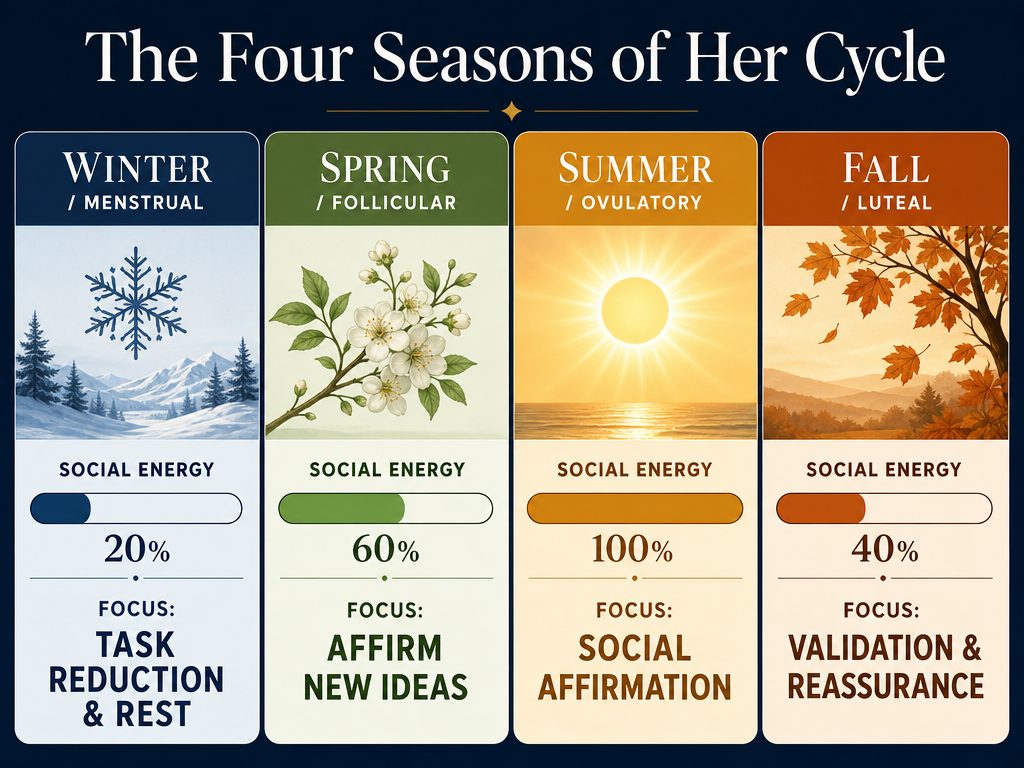
The Four Phases: A Framework for Understanding Her Needs
Think of the cycle as four seasons, each with its own biological weather and corresponding emotional needs.
Winter (Menstrual Phase): Low energy, high need for rest. Encouragement here means reducing her decision load and creating space for recovery.
Spring (Follicular Phase): Rising energy, growing confidence. Encouragement means affirming her ideas and matching her momentum.
Summer (Ovulation): Peak energy, heightened social connection. Encouragement means direct compliments and quality time.
Fall (Luteal Phase): Declining energy, increased stress sensitivity. Encouragement means validation first, problem-solving never.
Each phase requires a different script. Using the wrong one is like showing up with a pep talk when she needs silence.
Phase 1: The Menstrual Phase (Winter) - When She Needs Rest and Space
During the follicular phase, estrogen rises as an egg-containing follicle develops in the ovary, but during menstruation itself, both estrogen and progesterone are at their lowest. This hormonal drop creates the physical symptoms most people associate with periods: cramping, fatigue, bloating, and headaches.
What she needs during this phase is not motivational speeches or suggestions to power through. She needs executive function offloaded.
Encouragement That Works:
- "I've handled dinner and the dishes. Just rest."
- "I cleared your schedule for Saturday. You don't need to decide anything."
- "I picked up your favorite tea and a heating pad. They're on the counter."
What Doesn't Work:
- "You'll feel better if you get some exercise."
- "It's not that bad, right?"
- "What do you want for dinner?" (This is still a decision she has to make.)
The goal here is unprompted action. When a partner is struggling emotionally, responding with genuine empathy - listening without judgment, focusing on their feelings rather than debating facts, and validating that their reaction makes sense - tends to help more than trying to "fix" the problem or offer silver linings.
Observable Behavioral Cues:
- Pulling out of social plans last minute
- Increased sensitivity to noise or mess
- Preference for loose clothing
- More time in bed or on the couch
If she's canceling plans, it's not flakiness. Her body is literally redirecting energy to manage inflammation and tissue shedding. Respect the biological priority.
For more on this phase, see our guide on how to help your girlfriend during the menstruation phase.
Phase 2: The Follicular Phase (Spring) - When She Needs Affirmation
During the follicular phase, estrogen rises as an egg-containing follicle develops in the ovary; this rising estrogen also thickens the uterine lining. Near the end of this phase, high estrogen triggers a surge in luteinizing hormone (LH), which sets off ovulation.
Estrogen affects many body systems, including brain function and the ability to focus, and levels are highest in the days leading up to ovulation. This is when she's most likely to start new projects, make plans, or suggest ambitious ideas.
What she needs during this phase is affirmation that her momentum is valid.
Encouragement That Works:
- "That's a great idea. How can I help make it happen?"
- "I love how motivated you've been lately."
- "Yes, let's do that. When were you thinking?"
What Doesn't Work:
- "Are you sure you have time for that?"
- "Let's think about that later."
- "That sounds complicated."
The follicular phase is the "Yes" window. Her brain is chemically primed to take on challenges and seek novelty. Affirming her energy rather than dampening it builds trust that you're paying attention to her rhythm.
Observable Behavioral Cues:
- Planning trips or events
- Starting new hobbies or routines
- More social engagement
- Increased interest in appearance or style changes
If she's suddenly reorganizing the apartment or researching a new side project, she's in her biological spring. Support the expansion.
Learn more about this phase in our follicular phase symptoms guide.
Phase 3: Ovulation (Summer) - When She Needs Connection
Ovulation is when a surge in luteinizing hormone (LH) causes the ovary to release an egg, typically around day 14 of a 28-day cycle. In the days just before ovulation, cervical mucus becomes clear and slippery, which is the most fertile window of the cycle.
This is her biological peak. Energy is high, social confidence is high, and stress tolerance is at its best.
Around ovulation, many women notice symptoms such as increased sex drive, mild pelvic or abdominal pain, tender breasts, bloating, and mood changes - but these vary a lot person to person, and not everyone notices them.
What she needs during this phase is direct, confident connection.
Encouragement That Works:
- "You looked incredible at that event."
- "I'm really proud of how you handled that situation."
- "Let's go out tonight. I want to show you off."
What Doesn't Work:
- Staying home when she wants to go out
- Passive agreement ("Yeah, if you want to")
- Underreacting to her excitement
Ovulation is when she's most receptive to compliments about her presence, intelligence, and social impact. This is not the time for low-energy Netflix nights unless she explicitly asks for them.
Observable Behavioral Cues:
- Increased interest in sex
- More frequent texting or communication
- Dressing up more
- Suggesting group plans or social events
If she's initiating plans with friends or dressing up for casual errands, she's in her biological summer. Match her energy.
For more on navigating this phase, read our support girlfriend during ovulation guide.
Phase 4: The Luteal Phase (Fall) - When She Needs Validation
After ovulation, the luteal phase begins: progesterone rises to help prepare the uterine lining for a possible pregnancy. If pregnancy doesn't happen, both progesterone and estrogen drop before the next period. Many women notice PMS-like symptoms in this phase - mood shifts, breast tenderness, bloating, acne, and appetite changes - though not everyone does.
This is the phase where most relationship friction happens. The hormonal drop creates a neurochemical shift that reduces stress tolerance and increases sensitivity to perceived criticism.
PMS (premenstrual syndrome) is very common: as many as 3 in 4 women report experiencing PMS symptoms at some point in their life, though severity varies widely. Symptoms - which can include mood swings, irritability, bloating, breast tenderness, and fatigue - typically show up one to two weeks before a period and resolve within a few days after it starts.
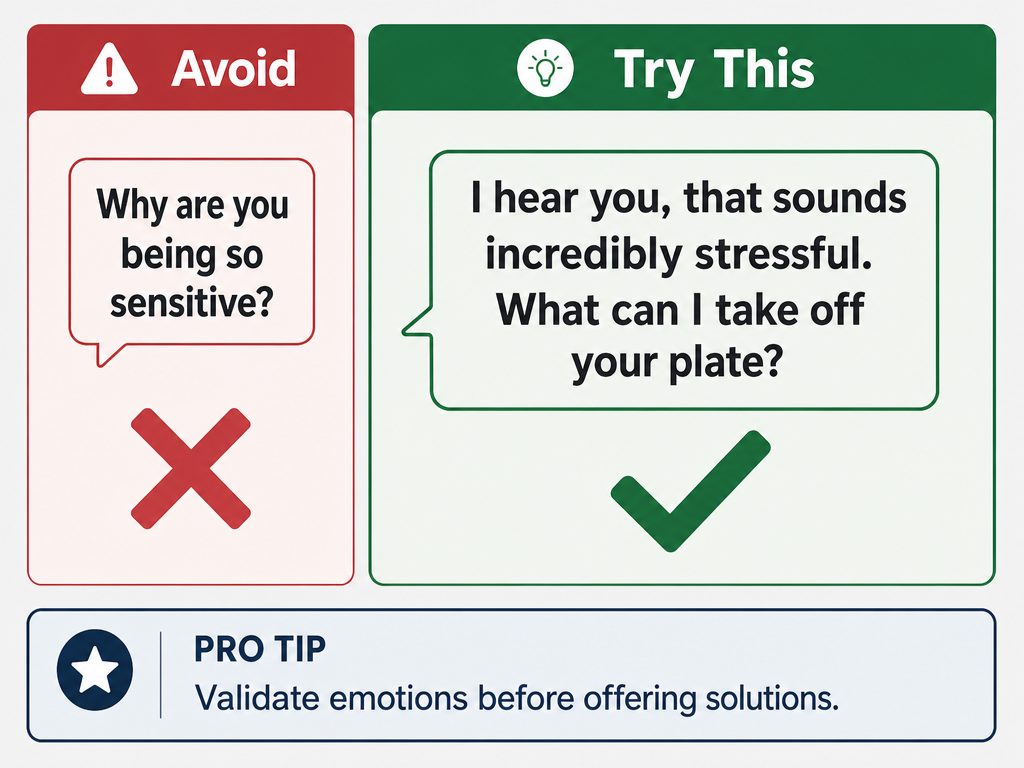
What she needs during this phase is not cheerleading or problem-solving. She needs validation that her feelings make sense, even if the trigger seems minor to you.
Encouragement That Works:
- "I hear you. That sounds really stressful."
- "You're not overreacting. That would frustrate me too."
- "What would help right now - space or company?"
What Doesn't Work:
- "You're being really sensitive."
- "Is this about your period?"
- "Just try to relax."
The luteal phase is when responding with genuine empathy - listening without judgment, focusing on their feelings rather than debating facts, and validating that their reaction makes sense - becomes critical. Feeling understood, not corrected, is what tends to defuse tension.
Observable Behavioral Cues:
- Withdrawing from social plans
- Increased irritability at minor inconveniences
- Decision fatigue ("I don't know" to simple questions)
- Sudden emotional reactions to small triggers
If she's snapping at you for leaving a dish in the sink when it didn't bother her last week, she's not being irrational. Her brain's stress threshold has chemically lowered. The dish is the same. Her capacity to deal with it is not.
For a complete tactical breakdown of this phase, see our luteal phase support guide.
How to Identify Which Phase She's In
You don't need to ask "Are you on your period?" to understand her cycle. You can learn to read behavioral cues.
Tracking Methods:
Ask her to share her cycle tracker with you. Apps like Clue and Flo have partner-sharing features. VibeCheck goes further by giving you a daily mission based on her current phase.
Track symptoms in a shared calendar. Tracking your own (or a partner's, with her participation) symptoms and mood changes across the cycle for a few months is a legitimate, medically endorsed way to identify real patterns and timing - rather than assuming based on stereotypes or a single cycle.
Learn her specific tells. Does she get a headache two days before her period? Does she start reorganizing the kitchen during her follicular phase? Individual patterns are more reliable than generic timelines.
Physical Signs by Phase:
- Menstrual: Visible bleeding, cramping, low energy
- Follicular: Clear skin, rising energy, more social activity
- Ovulation: Increased libido, mid-cycle spotting (some women), mild one-sided abdominal pain
- Luteal: Bloating, breast tenderness, skin breakouts, mood sensitivity
Mittelschmerz - one-sided lower abdominal pain around the time of ovulation - is a real, documented phenomenon, not something imagined. It's generally harmless, usually lasts minutes to a couple of days, and typically doesn't require medical treatment.
If she mentions sharp pain on one side mid-cycle, she's likely ovulating.
For more on identifying phases, read our guide on how to tell which cycle phase your girlfriend is in.
The Encouragement vs. Support Distinction
Most relationship advice focuses on support - doing the dishes, buying chocolate, running a bath. That's logistics. Encouragement is verbal and emotional.
Support = taking action to reduce her physical or logistical burden.
Encouragement = verbal affirmation that validates her experience and reinforces that you understand what she's going through.
Both matter, but encouragement is what makes her feel seen rather than just managed.
Examples of Encouragement Across Phases:
| Phase | Support (Action) | Encouragement (Words) |
|---|---|---|
| Menstrual | Handle dinner and cleanup | "You don't need to do anything today. I've got it." |
| Follicular | Help research her new project | "I love seeing you this motivated. What's next?" |
| Ovulation | Plan a social outing | "You were amazing tonight. I'm proud to be with you." |
| Luteal | Give her space when she's irritable | "I know this week is hard. You're handling it well." |
The words matter as much as the actions. She needs to know you're not just tolerating her cycle - you're actively working with it.
What If Her Symptoms Are Severe?
Not all cycle-related symptoms are "normal." There's a difference between PMS and conditions that require medical attention.
Roughly half of people who menstruate report having at least one PMS symptom, but only about 1 in 5 have symptoms severe enough to disrupt their daily life. That more disruptive tier is a meaningfully different experience than "typical" PMS.
PMDD (premenstrual dysphoric disorder) is a real, clinically recognized condition - it's listed in the DSM-5 as a depressive disorder, not something people are "making up" or simply failing to cope with. It affects roughly 1 in 10 people who menstruate.
PMDD is a more severe, sometimes disabling extension of PMS. Both happen on a similar timeline (about 7-10 days before a period) and can share physical symptoms like bloating and fatigue, but PMDD specifically involves extreme mood symptoms - such as marked irritability, anxiety, or hopelessness - intense enough to disrupt daily life and strain relationships.
When to Encourage Her to See a Doctor:
If she's experiencing any of the following, it's time to talk about medical consultation:
- Mood symptoms (depression, anxiety, rage) that interfere with work or relationships
- Physical pain that isn't managed by over-the-counter medication
- Periods that last longer than 7 days
- Bleeding heavy enough to soak through a pad or tampon in less than 2 hours
- Blood clots larger than 1 inch
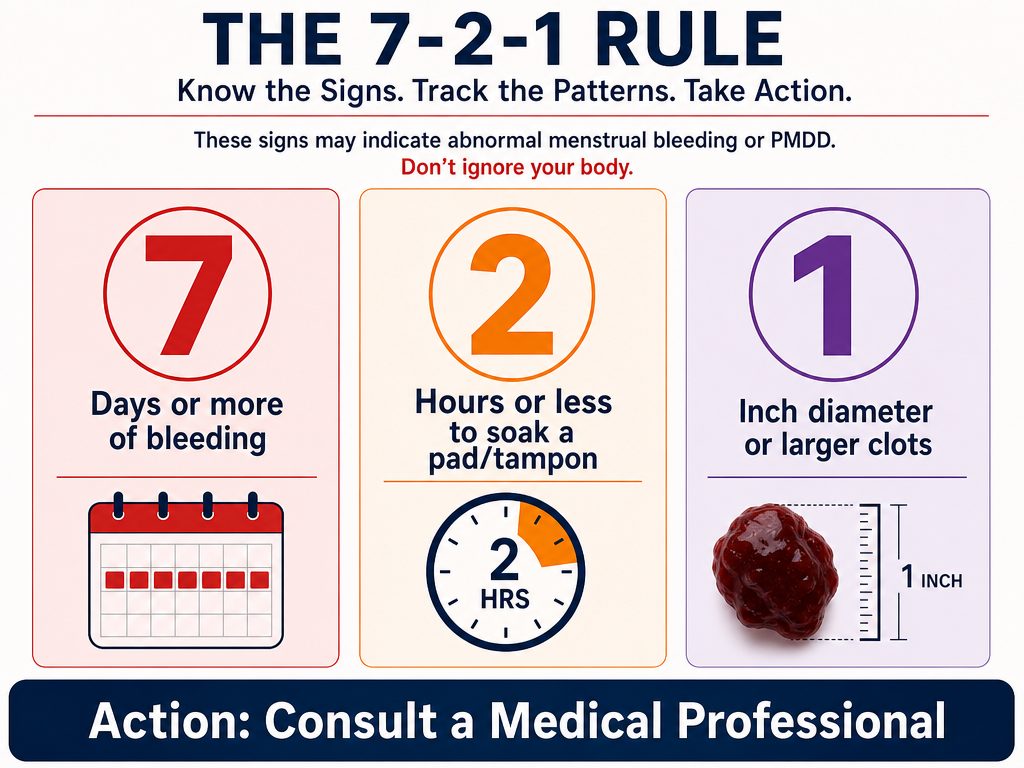
This framework - sometimes called the 7-2-1 rule - is a useful clinical guideline for identifying abnormal menstrual health, though it's not an official diagnostic standard. It helps partners recognize when symptoms have crossed from "uncomfortable" to "medically concerning."
You can be her medical advocate by noticing patterns she might dismiss as normal. If she's missing work or canceling plans every month, that's not something to push through.
For more on supporting her through severe symptoms, read our guide on how to comfort your girlfriend during PMS.
Frequently Asked Questions
How do I comfort my girlfriend on her period over text?
Keep it simple and avoid asking her to make decisions. Text her things like "I'm picking up dinner on my way home. No need to think about it" or "I grabbed your heating pad and left it on the couch." Avoid asking "What can I do?" - that's still a decision she has to make. Just do the thing.
If you're long-distance, send a delivery (food, tea, a heating pad) with a note that says "You don't need to respond. Just rest."
How do I support my girlfriend during the luteal phase?
The luteal phase is about validation, not problem-solving. When she's upset, start with "I hear you. That sounds really hard" before offering any solutions. Give her space if she asks for it. Don't take irritability personally - her brain's stress threshold has chemically lowered.
Practical support: handle household tasks without being asked, keep snacks she likes in the house, and don't suggest high-energy social plans unless she initiates them.
For a complete breakdown, see our luteal phase support guide.
Do serotonin levels drop during the luteal phase?
Research suggests that there is general research support for hormone-linked differences in mood and energy across the cycle - energy tends to be lower during the period and can build through the follicular phase toward ovulation, with PMS-type symptoms more likely in the luteal phase. Medical sources describe mood shifts during this phase in general terms, but they don't specify an exact percentage or mechanism for how serotonin changes day to day.
What matters for you: her mood shifts aren't "in her head." There's a biological cause, even if the exact neurotransmitter percentages vary person to person.
What to say to a girlfriend during her period?
Validation, not motivation. Say things like:
- "You're not overreacting. That sounds painful."
- "I've got everything handled. Just rest."
- "What would help - space or company?"
Avoid saying:
- "It's not that bad."
- "You'll feel better if you [insert advice]."
- "Are you sure it's not just stress?"
She doesn't need you to fix it. She needs you to acknowledge it's real.
How to be a good boyfriend during luteal phase?
The luteal phase is when most relationship conflict happens because her stress tolerance drops. Be a good boyfriend by:
- Not taking irritability personally
- Handling tasks without being asked
- Validating her feelings before offering solutions
- Giving her space when she pulls away
- Avoiding big conversations or criticism during this window
Think of it as emotional weather. You can't change it, but you can adjust your behavior to it.
For more strategies, read our boyfriend's guide to the luteal phase.
Why do I not like my partner during the luteal phase?
If you're feeling more friction during her luteal phase, it's likely because her stress threshold has lowered and she's reacting to things that didn't bother her before. That doesn't mean she's being irrational - it means her brain is chemically less equipped to handle minor annoyances.
The solution is not to wait it out. It's to adjust your behavior during this window: avoid criticism, don't leave tasks half-done, and give her space if she asks for it. The goal is to reduce the number of small stressors she has to manage when her capacity to manage them is lowest.
How to increase serotonin levels during the luteal phase?
While you can't control her brain chemistry, you can support lifestyle habits that help stabilize mood during the luteal phase. Lifestyle approaches that can help ease PMS symptoms include regular aerobic exercise, smaller/more frequent meals, less salt/caffeine/alcohol, adequate sleep, and stress-reduction practices like deep breathing or yoga.
As a partner, you can support these by:
- Suggesting (not insisting on) a walk together
- Keeping high-protein snacks and herbal tea in the house
- Handling evening tasks so she can go to bed earlier
- Not scheduling high-stress plans during this window
Ginger has been shown in clinical research to effectively reduce menstrual pain, and saffron has clinical evidence supporting its ability to improve both physical pain and mood symptoms in the luteal phase. If she's interested in natural support, these are evidence-backed options.
Tags

Related Articles
Continue reading to deepen your understanding

How to Understand Your Girlfriend’s Social Battery and Hormones
Does your girlfriend suddenly cancel plans or seem withdrawn? This guide explains how her cycle impacts her energy so you can support her like a pro.

How Your Girlfriend’s Emotional Needs Change During Her Cycle
Does your girlfriend’s mood seem unpredictable? Learn how her emotional needs shift on a biological loop and how to support her through every phase of her cycle.

What to Buy When Your Girlfriend Has Hormone Cravings: A Support Guide
Stop wondering what to pick up at the store. This guide explains the science behind cycle cravings and provides a specific list of foods and comfort items she needs.

Your Girlfriend’s Mood Shifts Throughout the Month, Explained
Ever wonder why her energy and moods change so drastically each week? Understand the four hormonal phases and how to be the partner she needs during every stage of her cycle.

How to Support Your Girlfriend When She’s Crying Because of Hormones
Watching her cry when hormones hit can feel overwhelming. Learn the biological why behind the tears and use these proven scripts to provide the support she actually needs right now.

How to Help Your Girlfriend with Hormonal Mood Swings Without Arguing
Understand her cycle and learn tactical scripts to handle tension. This guide shows you how to support her through hormonal shifts without getting into unnecessary fights.

When to Feed Your Girlfriend: Understanding Hangry Hormones
Does your girlfriend get irritable when she hasn’t eaten? It’s not just in her head. Learn why hormones cause hanger and the specific times her body needs more fuel.

The Boyfriend’s Guide to Supporting Your Partner Through PMS
If your partner is suddenly irritable and exhausted, it’s biology, not you. Learn about the luteal phase and how to provide meaningful support without walking on eggshells.