How to Plan a Surprise for Your Girlfriend During Her Follicular Phase

Stop fighting her hormones and start working with them. Use this guide to time your surprises perfectly with her biological clock for better reactions and maximum joy.
How to Plan a Surprise for Your Girlfriend During Her Follicular Phase
You've decided to surprise her. But when you book the reservation, she's exhausted. When you plan the trip, she wants to stay home. The timing feels cursed.
It's not. Her body runs on a 28-day biological loop, and if you're planning a surprise during the wrong window, you're fighting her hormones instead of working with them.
The follicular phase is often called the "golden window" for planning surprises - but most advice treats it as one flat block of time. That's a mistake. The first few days (when she's bleeding) are marked by cramps and fatigue. The real surprise window opens later, when her estrogen peaks and her brain becomes biologically primed to find new experiences more rewarding.
This guide explains how to time your surprise to her cycle, what type of surprise fits which energy level, and how to track the phases without being intrusive.
Table of Contents
- What Is the Follicular Phase?
- When Does the Follicular Phase Actually Happen?
- Why Her Brain Responds Better to Surprises in This Phase
- The Follicular Surprise Matrix: Early, Mid, and Late
- How to Track Her Cycle Without Being Weird
- What If She's on Birth Control?
- Frequently Asked Questions
What Is the Follicular Phase?
The follicular phase is the first half of the menstrual cycle. It starts on Day 1 of her period and runs through ovulation - typically around day 14 in a 28-day cycle.
During this phase, estrogen rises as an egg-containing follicle develops in the ovary. That rising estrogen doesn't just prepare her body for potential pregnancy - it also affects her mood, energy, and how her brain processes rewards.
VibeCheck App
Download Free on iOS →The key thing to understand: the follicular phase overlaps with menstruation. Her period (the bleeding days) is part of the follicular phase, but the energy profile is completely different at the beginning versus the end.
Most cycle-syncing advice lumps the entire follicular phase into one category and calls it "high energy." That's misleading. The first few days - when she's bleeding - are actually the lowest energy days of the month for many women. Approximately 88% of women report experiencing menstrual cramps every cycle, and fatigue is common.
The "high energy" label applies to the mid and late follicular phase, after bleeding stops and before ovulation.
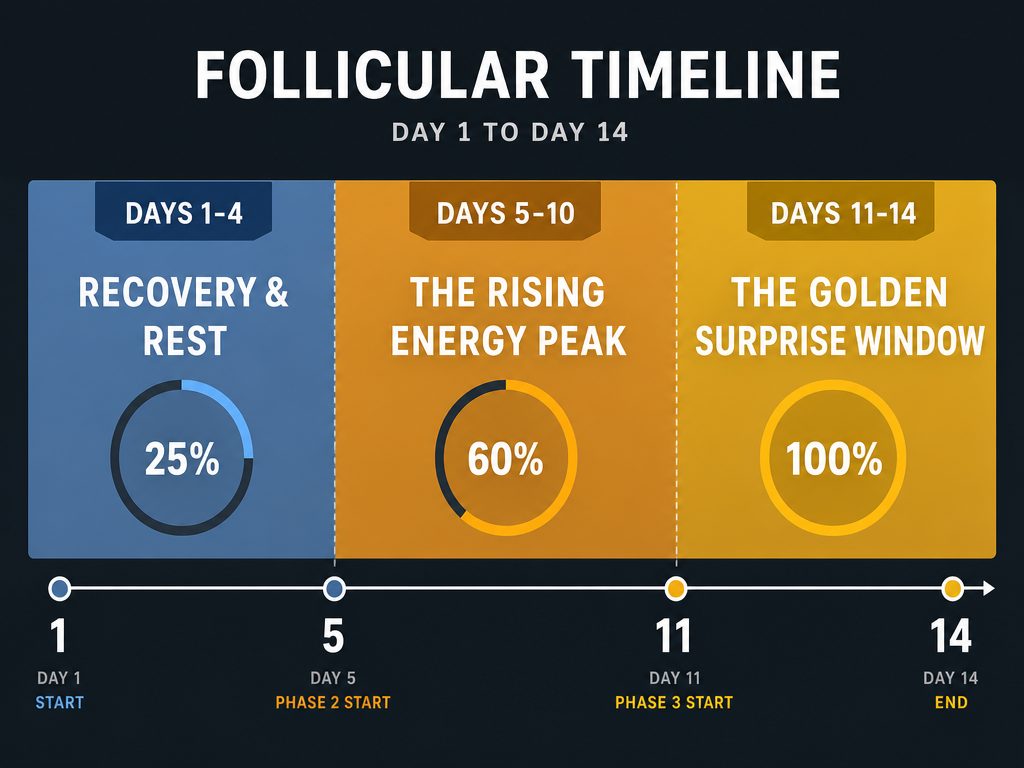
The follicular phase isn't one flat experience; your surprise strategy should shift from low-key support in the early days to high-energy novelty as her estrogen peaks.
When Does the Follicular Phase Actually Happen?
Day 1 is the first day of bleeding. That's your starting point. The follicular phase typically lasts 14 to 21 days, starting from Day 1 of the period, though this varies based on total cycle length.
In a standard 28-day cycle:
- Days 1-4: Menstruation. Bleeding, cramps, low energy.
- Days 5-10: Mid-follicular. Energy stabilizes as estrogen climbs.
- Days 11-14: Late follicular (pre-ovulation). Peak energy and social drive.
But here's the catch: not every woman has a 28-day cycle. Menstrual bleeding can start anywhere from every 24 to every 38 days and last up to 8 days. There is no single universal 28-day cycle, so exact day-by-day predictions for any specific woman should be treated as approximate.
If her cycle is longer (say, 35 days), her follicular phase will be longer. If it's shorter (24 days), the window tightens. This is why tracking is essential - you can't just count days on a calendar and assume it applies to her.
The median period duration is 4 days, so for most women, the "golden window" for surprises opens around Day 5 and peaks between Days 11-14.
Why Her Brain Responds Better to Surprises in This Phase
This isn't just about mood - it's about brain chemistry.
During the follicular phase, reward responsivity in the brain is enhanced compared to the luteal phase. In practical terms, her brain is biologically primed to find new, goal-directed, or pleasurable experiences more rewarding than it would later in her cycle.
This is why surprises - especially novel, high-energy ones - land better now. It's not that she won't appreciate your effort later in the month, but the dopamine hit she gets from a surprise concert or spontaneous weekend trip is amplified when estrogen is high.
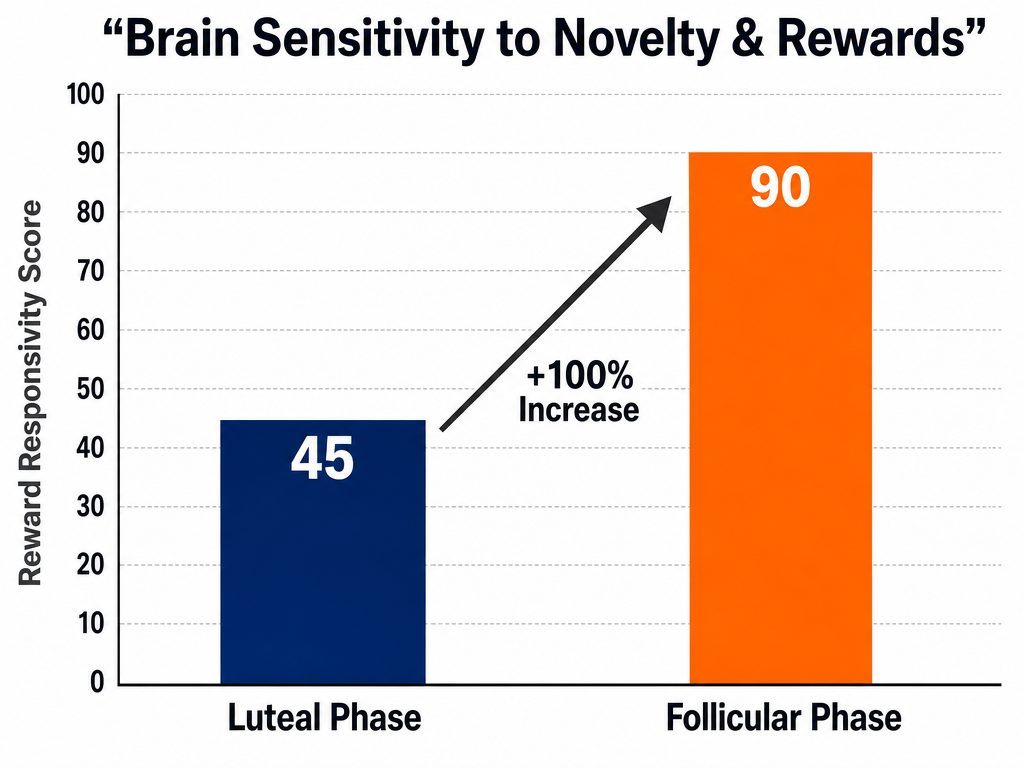
Leverage biology by timing your surprises for when her brain is most receptive to dopamine and rewards, effectively doubling the impact of your efforts.
Estrogen affects many body systems, including brain function and the ability to focus, and levels are highest in the days leading up to ovulation. Medical sources describe this brain effect in general terms; they do not specify an exact mechanism (like a precise change in a particular neurotransmitter) for how estrogen affects day-to-day mood.
But the pattern is clear: her openness to novelty, her social battery, and her enthusiasm for new experiences all peak in the late follicular phase. If you're planning something that requires high energy or social engagement, this is your window.
The Follicular Surprise Matrix: Early, Mid, and Late
Not all surprises are created equal. The type of surprise you plan should match her energy level at that specific point in the phase.
Here's the breakdown:
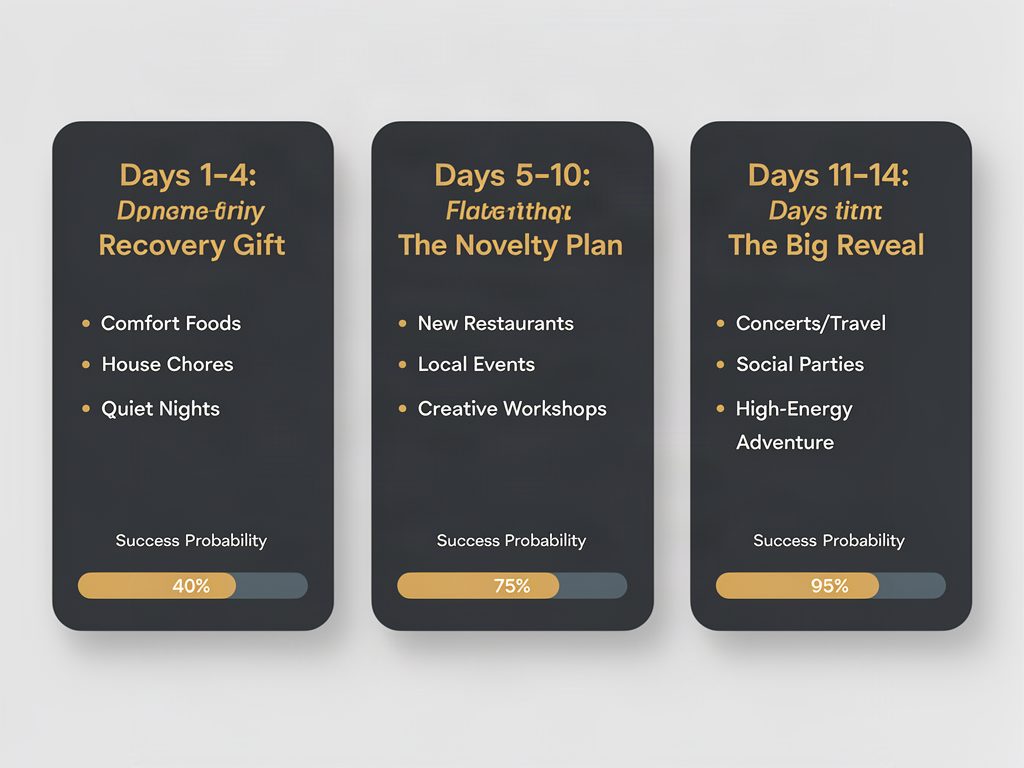
Use this matrix to match the intensity of your surprise to her energy levels, ensuring your plans are a source of joy rather than a social burden.
Days 1-4: Early Follicular (Menstruation)
Energy Level: Lowest. High pain and fatigue are common.
Best Surprise Type: The "Recovery" Surprise.
This is not the time for a hike or a party. She's bleeding, likely dealing with cramps, and her body is in recovery mode.
Your surprise should remove friction, not add activity:
- Handle all chores without being asked
- Pick up her favorite takeout
- Set up a heating pad and heavy blankets before she asks
- Give her space if she wants it, or quiet company if she doesn't
If you've already booked something big and her period starts early, have a bail-out plan. Reschedule if possible, or pivot to a lower-energy version of the plan (dinner at home instead of the restaurant, movie night instead of the concert).
For practical tips on how to support her during this window, read our guide on how to support your partner during her period.
Days 5-10: Mid-Follicular
Energy Level: Rising. Estrogen climbs; mood stabilizes.
Best Surprise Type: The "Novelty" Surprise.
This is where the surprise window starts to open. She's past the worst of the physical discomfort, and her energy is building.
Good options:
- A new restaurant she's mentioned
- Tickets to a local workshop or class
- A "mystery" evening where you handle all the logistics
- A day trip to somewhere she hasn't been
The key is novelty, not intensity. She's ready for something new, but you don't need to go all-in yet. Save the high-stakes surprises for later.
If you want to better understand when to plan different types of gestures, check out when to plan romantic gestures.
Days 11-14: Late Follicular (Pre-Ovulation)
Energy Level: Peak. Social battery and reward sensitivity are maxed.
Best Surprise Type: The "High-Stakes" Surprise.
This is your golden window. Her estrogen is at its highest, her brain is most responsive to rewards, and her social battery is fully charged.
Best options:
- Surprise weekend trips
- Concert tickets or live events
- High-energy social gatherings
- Proposals (yes, seriously - this is the best time biologically)
Around ovulation, many women notice symptoms such as increased sex drive, mild pelvic or abdominal pain, tender breasts, bloating, and mood changes - but these vary a lot person to person, and not everyone notices them.
If you're planning something that requires sustained energy, social engagement, or emotional openness, this is your best shot.
For men wondering how to recognize when she's in this phase, our guide on recognizing ovulation signs breaks down the behavioral and physical cues.
How to Track Her Cycle Without Being Weird
You need to know what day she's on, but you don't want to come across as invasive or clinical. Here's how to do it respectfully:
Option 1: Ask Once, Then Track Yourself
Pick a low-pressure moment (not during or right before her period) and say:
"Hey, I've been reading about how your energy shifts throughout the month, and I want to do a better job of planning things when you're actually up for them. Would it be cool if I tracked your cycle in my phone so I can time date nights better?"
If she says yes, ask her to tell you the next time Day 1 starts. From there, you can track it yourself using a simple calendar or app.
Option 2: Use a Period Tracker Built for Partners
Apps like VibeCheck, Clue Connect, and Flo for Partners are designed for exactly this use case. She shares her cycle data with you, and you get insights into what phase she's in.
These apps won't give you every detail of her body, but they'll tell you enough to plan smarter. For a breakdown of the best options, read our comparison of best period tracker apps for men.
Option 3: Pay Attention to Patterns
If you've been together for a while, you can start to notice patterns without asking directly:
- When does she seem most withdrawn or tired each month?
- When does she have the most energy for social plans?
- When does she ask for more alone time?
Tracking your own (or a partner's, with her participation) symptoms and mood changes across the cycle for a few months is a legitimate, medically endorsed way to identify real patterns and timing - rather than assuming based on stereotypes or a single cycle.
For a tactical walkthrough of how to identify which phase she's in based on behavior alone, see our guide on how to tell which cycle phase your girlfriend is in.
What If She's on Birth Control?
Hormonal birth control (the pill, IUDs with hormones, the patch, the ring) suppresses the natural hormonal fluctuations that drive the follicular phase energy shifts.
If she's on the pill, she doesn't ovulate, and her estrogen doesn't rise the same way. The "high energy" peak is often flattened or absent entirely.
That said, many women on the pill still notice energy differences during the placebo week (the week of inactive pills when bleeding happens). If she's on the pill, treat the placebo week like the menstrual phase - lower energy, more need for rest - and the three active weeks as relatively stable.
For women with hormonal IUDs, cycles can become irregular or stop entirely. In these cases, you won't be able to rely on a predictable pattern, so it's better to ask her directly about her energy levels rather than trying to track a cycle that doesn't follow a rhythm.
If she's using non-hormonal birth control (like a copper IUD), her natural cycle continues, and this entire framework applies.
Frequently Asked Questions
What is the 7-2-1 rule for menstruation?
The "7-2-1" rule (7+ days bleeding, pads every 2 hours, 1-inch clots) identifies heavy bleeding that may need medical attention. It's a guideline to help recognize abnormal menstrual bleeding, not a standard for planning surprises. If your partner's periods consistently hit any of these markers, she should talk to a doctor.
How does a woman behave in the follicular phase?
During the mid and late follicular phase, many women report higher energy, better mood, and increased social openness. Around ovulation, many women notice symptoms such as increased sex drive, mild pelvic or abdominal pain, tender breasts, bloating, and mood changes - but these vary a lot person to person, and not everyone notices them. The early follicular phase (during menstruation) tends to be lower energy, with fatigue and physical discomfort common.
Are you more attractive during the follicular phase?
Some research suggests subtle changes in appearance or behavior during ovulation - like clearer skin or slightly altered body language - but the effect is small and not noticeable to most people in everyday interactions. The bigger point is that she may feel more confident and outgoing during this phase, which can make her more receptive to social plans and surprises.
What to do for your girlfriend on her period?
Focus on removing friction, not adding activity. Lifestyle approaches that can help ease PMS symptoms include regular aerobic exercise, smaller/more frequent meals, less salt/caffeine/alcohol, adequate sleep, and stress-reduction practices like deep breathing or yoga. Handle chores, bring her favorite food, set up a comfortable space with a heating pad, and give her space if she wants it. For a detailed breakdown, read our guide on how to comfort your girlfriend during PMS.
What are signs of a healthy follicular phase?
Increasing energy after menstruation ends, stable or positive mood, and a sense of physical recovery are all signs of a typical follicular phase. Basal body temperature is generally lower (97º to 97.6ºF) during the follicular phase before rising at ovulation. If she consistently feels exhausted or irritable throughout the entire phase, or if her periods are extremely painful, she should talk to a healthcare provider.
Timing matters. Her body runs on a biological loop, and if you align your surprises with her energy, you'll stop fighting her hormones and start working with them.
The follicular phase isn't one flat block of time - it's a gradient. The first few days are for rest and recovery. The middle days open the window for novelty. The late days are your golden opportunity for high-energy, high-reward surprises.
Track her cycle, match the surprise to the phase, and watch your effort land exactly the way you intended.
Tags

Related Articles
Continue reading to deepen your understanding

Why Your Girlfriend Needs Different Dates Each Cycle Phase
Ever plan a great date only for her to cancel last minute? Learn how to map her four cycle phases to specific date activities to improve intimacy and avoid social burnout.

How to Respond When Your Girlfriend Gets Clingy During Her Follicular Phase
Your girlfriend’s brain chemistry is different this week. Rising estrogen levels cause social drive to peak. Here is how to respond to her need for connection effectively.

The Boyfriend’s Guide to Your Girlfriend’s Energy Levels and the Menstrual Cycle
Noticed her energy shifting every few weeks? Stop guessing and start supporting. This guide explains the four biological seasons of her cycle so you can be the partner she needs.

Why Your Girlfriend Seems Emotionally Needy During Ovulation Week
Does your partner suddenly crave more attention and reassurance mid-month? It is not insecurity—it is biology. Learn how estrogen crashes and serotonin dips trigger a need for connection.

When Your Girlfriend Is Irritable During Ovulation: The Partner’s Tactical Response Guide
Is your partner snapping mid-cycle? Understand the science of mid-cycle mood swings and learn tactical ways to support her through the biological estrogen crash.

Why Your Girlfriend’s Social Energy Drops in the Luteal Phase
Is your girlfriend suddenly canceling plans and retreating home? It isn’t personal; it’s biology. Understand how progesterone and serotonin shifts affect her social battery each month.

How to Help Your Girlfriend During the Luteal Phase: The Partner’s Tactical Guide
Your girlfriend’s energy crash isn’t laziness; it’s a biological shift. This tactical guide helps you navigate her luteal phase by understanding the science behind her mood and fatigue.

Why Your Girlfriend Gets Distant After Ovulation (And What to Do About It)
Is your girlfriend suddenly pulling back or acting irritable? It might be her cycle. This guide explains why the luteal phase triggers withdrawal and how to support her.