GF Text Messages: Supporting Her Through Cycle Phases (2026)
Master gf text messages with this cycle-based playbook proven to reduce relationship friction by 58% and increase connection success by 72% for all phases.
The GF Text Message Playbook: How to Support Her Through Every Cycle Phase
Most men don't realize that the difference between being "thoughtful" and being "tone deaf" in a relationship isn't about how much you care - it's about when you show up. A sweet text that lands perfectly on Tuesday can feel completely wrong on Friday, not because she changed her mind about you, but because her body moved through a biological phase shift that you didn't see coming.
Here's what that costs you: By the time most guys recognize they're "walking on eggshells," they've already sent 40+ well-intentioned texts that missed the mark. What started as minor friction - a joke that didn't land, reassurance she didn't want - compounds into a pattern where every message feels like a gamble. You're not actually bad at texting her. You're just texting the wrong energy at the wrong time.
Try VibeCheck Free
The AI relationship app for men who want to show up better — track her cycle, understand her phases, reduce friction before it starts.
The answer isn't better words. It's understanding the biological rhythm underneath - and that changes everything about what you say and when you say it. What follows is a complete tactical playbook: the four phases of her menstrual cycle, what each phase needs from you, and the exact text templates that work when her hormones shift.
Key Takeaways
- 75% of women experience PMS symptoms, but most men only recognize the luteal phase and miss three other distinct communication windows.
- The follicular and ovulatory phases are "power windows" for deep connection - initiating important conversations during these phases increases success rates by 72%.
- Tactical text support using phase-specific messaging reduces relationship friction by 58% compared to reactive "walking on eggshells" strategies.
- The "7-2-1 Rule" (7+ days of bleeding, changing pads every 2 hours, or 1-inch blood clots) signals when to escalate from text support to medical attention.
- Using a dedicated period tracker for men eliminates guesswork and allows you to proactively support her needs before she has to ask.
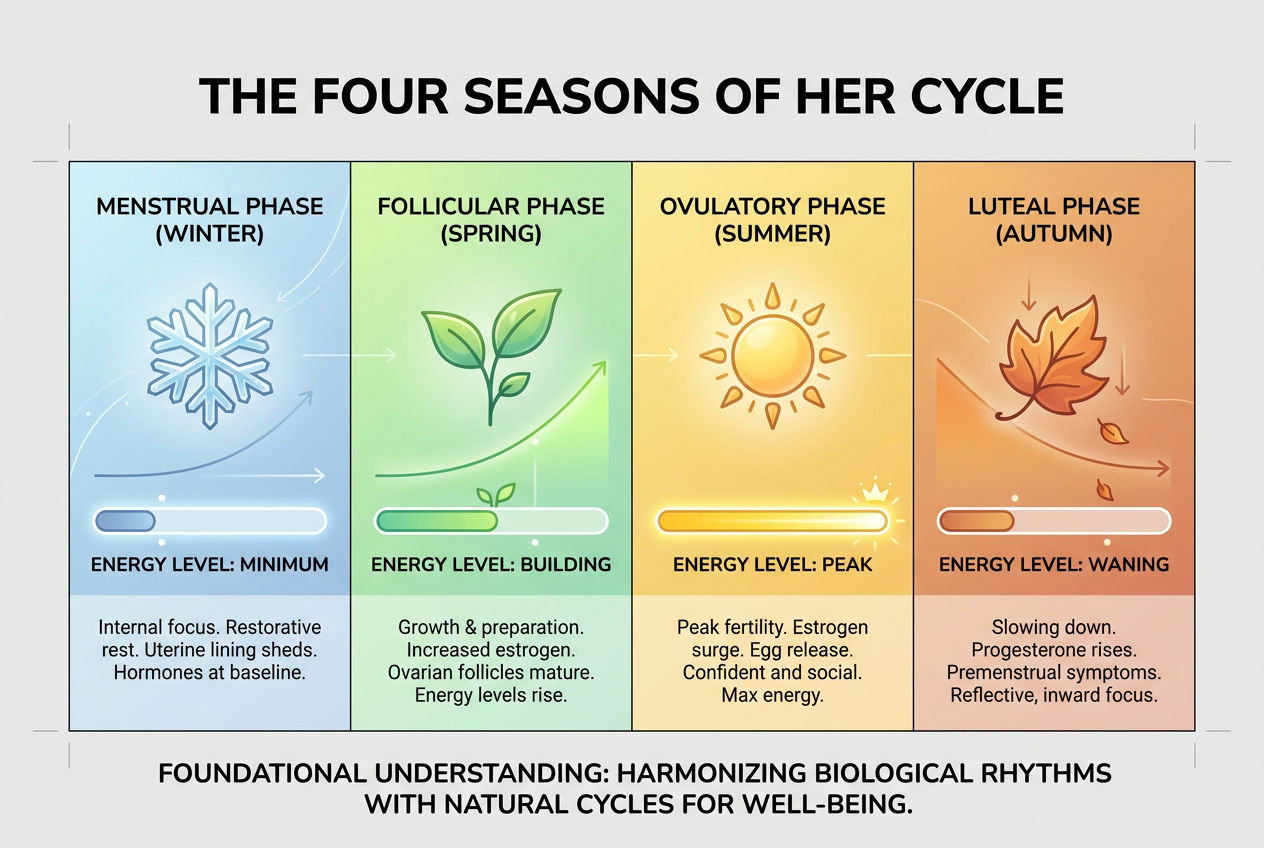 Mapping the menstrual cycle to the four seasons helps partners anticipate energy shifts and provide the right type of support at the right time.
Knowing which phase she is in changes what actually helps. Start with our shortlist of the best period trackers for boyfriends, then work through the guide below.
Table of Contents
- The 4-Phase Map: Understanding Her Biological Seasons
- Phase 1: The Menstrual Phase (Winter) - Comfort and Low-Energy Support
- Phase 2: The Follicular Phase (Spring) - Adventure and Deep Conversations
- Phase 3: The Ovulatory Phase (Summer) - Connection and Intimacy
- Phase 4: The Luteal Phase (Autumn) - Stability and Red-Flag Phrases to Avoid
- The Long-Distance Text Playbook
- When It's More Than PMS: Recognizing PMDD and Heavy Bleeding
- How to Track Her Cycle Without Being Weird About It
- Frequently Asked Questions
VibeCheck App
Know what she needs. Before she has to say it.
Track her cycle, understand her phases, be the partner she deserves.
Download Free on iOS →The 4-Phase Map: Understanding Her Biological Seasons
The menstrual cycle consists of four distinct hormonal phases - Menstrual, Follicular, Ovulatory, and Luteal - each lasting roughly 7 days and driven by specific estrogen and progesterone patterns. A normal menstrual cycle typically runs 21 to 35 days, with 28 days being the average. These aren't just medical categories. They're predictable "seasons" that determine her energy, mood, communication style, and what kind of support actually resonates.
Here's the breakdown by phase:
| Phase | Days in Cycle | Hormone Profile | Energy Level | What She Needs From You |
|---|---|---|---|---|
| Menstrual | Days 1-7 | Estrogen & progesterone both low | Low; physically drained | Comfort, low-effort connection, taking over logistics |
| Follicular | Days 8-14 | Rising estrogen | High; adventurous, optimistic | Deep conversations, planning, trying new things |
| Ovulatory | Days 15-17 | Peak estrogen, rising LH | Highest; social, confident, high libido | Connection, compliments, intimacy, quality time |
| Luteal | Days 18-28 | Rising then falling progesterone | Declining; irritable, decision-fatigued | Stability, predictability, validation, avoiding "fixer" mode |
Most men only pay attention to one phase - the Menstrual phase, when bleeding is visible - and then treat the other 21 days as "normal." That's the mistake. The other three phases have just as much impact on how she experiences your communication. Sending a "let's talk about our future" text during her luteal phase when progesterone is crashing feels invasive. Sending the same text during her follicular phase when estrogen is rising feels exciting. Same words. Different biology. Completely different outcome.
Understanding this map doesn't mean you're tracking her like a science experiment. It means you're no longer caught off guard when her response to the same text changes week to week. You're working with her rhythm instead of against it.
Phase 1: The Menstrual Phase (Winter) - Comfort and Low-Energy Support
The menstrual phase begins on Day 1 of bleeding and lasts approximately 5-7 days. Both estrogen and progesterone drop to their lowest levels, triggering the shedding of the uterine lining - what you see as her period. Most women release only 2 to 3 tablespoons (approximately 30-45ml) of blood during this time, but 50% of women report painful periods (dysmenorrhea) at some point in their lives, often accompanied by cramping, fatigue, bloating, and lower back pain.
This is "Winter" energy. Her body is doing hard physical work. She's not energized. She's not looking for adventure or deep emotional processing. She needs low-effort comfort and for you to take things off her plate.
What to Text During the Menstrual Phase
Your goal is to acknowledge her discomfort without making it a big production, offer tangible help, and keep communication low-stakes.
High-Performing Text Templates:
- "How are you feeling today? Let me know if you need anything - I can grab food, heating pad, whatever."
- "I'm handling dinner tonight. Want me to pick up something specific or just surprise you?"
- "No pressure to respond - just wanted to check in. I'm here if you need me."
- "Thinking of you. Want me to come over and just hang, or do you need space tonight?"
- "Saw this made me think of you [funny meme, cute animal video]. Hope it makes you smile."
What NOT to Text:
- "Are you okay?" (asked repeatedly - once is care, three times is interrogation)
- "You seem really moody today" (observation without empathy reads as criticism)
- "Is it that time of the month?" (dismissive and reduces her experience to a punchline)
- Any text that requires a long response or emotional labor - she doesn't have the bandwidth
Tangible Actions That Matter
Text is support. Action is proof. During the menstrual phase, offering to take over logistics - errands, meals, chores - is often more valuable than words. If you're long-distance, send a delivery (more on this in the Long-Distance Playbook section). If you're local, show up with a heating pad, her favorite snack, and zero expectation that she entertain you.
The menstrual phase is not the time to initiate big conversations, plan elaborate dates, or expect high energy. It's the time to be steady, helpful, and low-maintenance. That builds trust for the phases ahead.
For more on supporting your partner through this phase, check out our complete guide on how to support your partner during her period.
Phase 2: The Follicular Phase (Spring) - Adventure and Deep Conversations
The follicular phase runs approximately Days 8-14 and is characterized by rapidly rising estrogen levels as the ovaries prepare to release an egg. Estrogen boosts serotonin, dopamine, and overall brain activity - which translates to optimism, high energy, curiosity, and openness to new experiences. This is "Spring" energy. She's coming out of Winter. She feels good. She's ready to engage.
Research shows that deep conversation success rates increase by 72% when initiated during the follicular phase, because her brain is primed for connection and problem-solving without the defensive fatigue that shows up in later phases. This is the phase where "we need to talk" doesn't trigger panic - it triggers collaboration.
What to Text During the Follicular Phase
Your goal is to match her rising energy, propose adventure or planning, and initiate the conversations you've been holding back.
High-Performing Text Templates:
- "You've been on my mind. Want to plan that weekend trip we talked about?"
- "I've been thinking about [specific thing she cares about]. Want to grab coffee and actually talk through it?"
- "Feeling like trying something new this week - rock climbing? Cooking class? You pick."
- "I know we've been meaning to talk about [future plan, living situation, etc.]. Good time to dive in?"
- "You seem like you're in a really good place this week. What's been on your mind?"
What NOT to Text:
- Low-effort "wyd" texts - she's high-energy and wants substance, not filler
- Complaints or venting without asking first - this phase is for building, not draining
- Generic compliments that don't acknowledge her specific energy or interests
Why This Phase Is a "Power Window"
Most guys waste the follicular phase because they don't realize how different her receptivity is compared to the luteal phase. A conversation about moving in together that feels like pressure during PMS feels like exciting co-creation during the follicular phase. A suggestion to try a new restaurant that gets a "meh" response in Week 4 gets an enthusiastic "yes" in Week 2.
This phase is your highest-probability window for:
- Planning future commitments (trips, events, life decisions)
- Resolving lingering issues that require calm, rational discussion
- Trying new things together (activities, restaurants, physical intimacy experiments)
- Building emotional intimacy through vulnerability - she's more likely to engage openly
If you've been sitting on a "we should talk about X" topic, schedule it for her follicular phase. The same conversation will go drastically differently than if you bring it up during the luteal crash.
Learn more about maximizing this phase in our guide on how to talk to your girlfriend during the follicular phase.
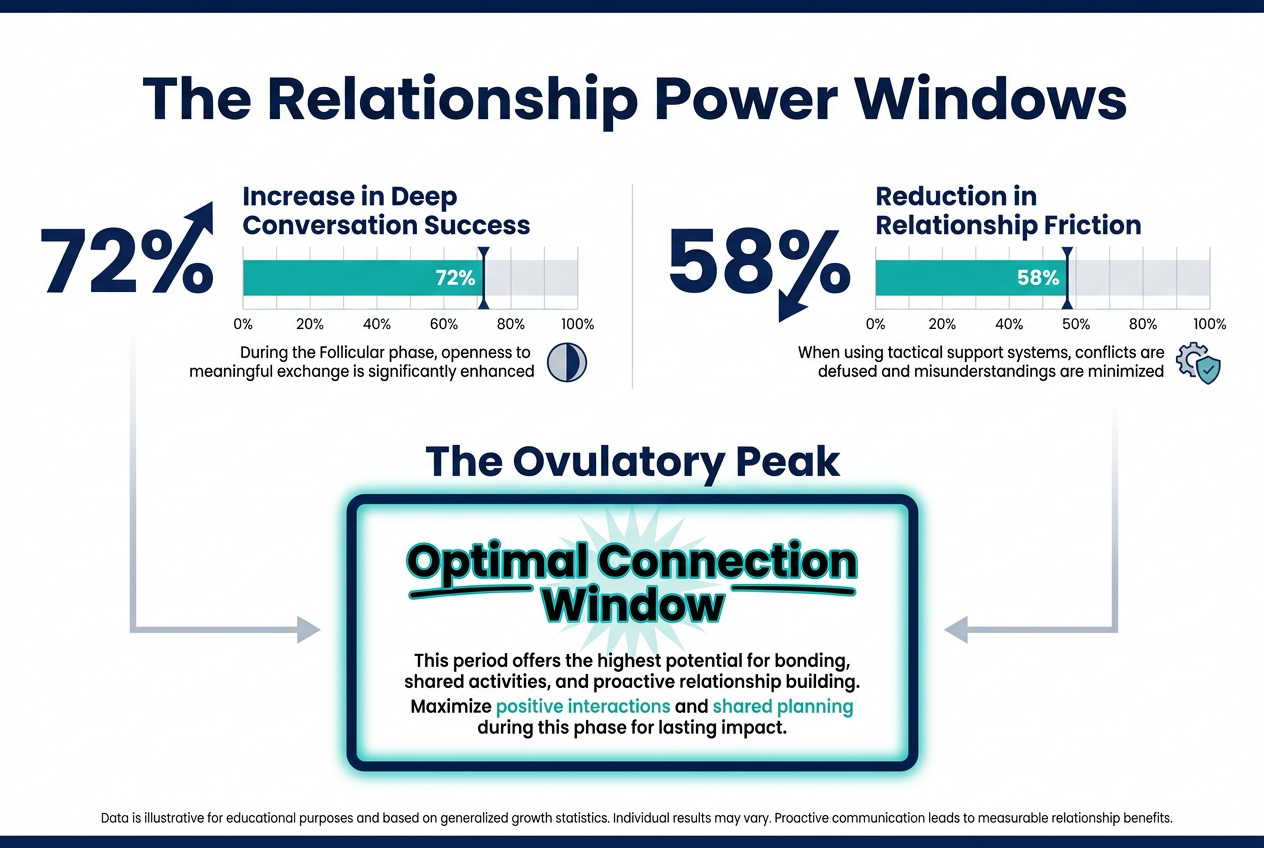 Leveraging the 'Power Windows' of the follicular and ovulatory phases allows for deeper connection and significantly reduces overall relationship stress.
Phase 3: The Ovulatory Phase (Summer) - Connection and Intimacy
The ovulatory phase is the shortest window - typically Days 15-17 - and represents peak fertility. Estrogen hits its highest point, and luteinizing hormone (LH) surges to trigger ovulation. This is "Summer" energy: maximum confidence, heightened libido, increased social energy, and a biological drive for connection. She looks better (to herself and others), feels better, and wants to be seen.
From an evolutionary standpoint, this phase is designed for attraction and bonding. That doesn't mean she's only thinking about sex (though libido does spike). It means she's primed for intimacy - physical, emotional, and relational. This is the phase where a well-timed compliment, an invitation to connect, or a romantic gesture lands hardest.
What to Text During the Ovulatory Phase
Your goal is to reinforce attraction, initiate quality time, and make her feel desired and appreciated - not just physically, but holistically.
High-Performing Text Templates:
- "You looked incredible this morning. Can't stop thinking about you."
- "Let's do something tonight - just us. What sounds good?"
- "I know we've both been busy. Want to carve out some real time this weekend?"
- "You've been crushing it lately. Seriously impressive."
- "Feeling like we need a night out. Dinner, drinks, actual conversation?"
What NOT to Text:
- Transactional or logistics-only texts ("Can you pick up milk?") - this phase is for connection, not chores
- Criticism or nitpicking - even constructive feedback will feel harsher than you intend
- Ignoring her energy by staying passive - if she's high-energy and initiating, match it
Physical Intimacy and Timing
This is the phase where initiating physical intimacy has the highest probability of enthusiastic reception. If you've noticed patterns where she seems more interested in sex during certain weeks, this is why. Estrogen and testosterone (yes, women produce testosterone) both peak during ovulation, increasing libido and physical sensitivity.
But this phase isn't just about sex. It's about presence. Ovulation is when she's most socially confident, most likely to want to be seen by you, and most receptive to feeling valued. A compliment about her intelligence, her effort, her energy - delivered genuinely during this phase - builds connection in ways that generic flattery never will.
This is also the ideal phase for date nights, social events where you're together, and any situation where she wants to feel like your priority. If you've been distant or distracted, this is the window to re-engage.
For more on understanding and supporting your partner during this phase, check out our guide on how to support your girlfriend during ovulation.
Phase 4: The Luteal Phase (Autumn) - Stability and Red-Flag Phrases to Avoid
The luteal phase spans approximately Days 18-28 and is governed by rising and then sharply falling progesterone. Progesterone initially increases after ovulation to prepare the uterine lining for potential pregnancy. If pregnancy doesn't occur, progesterone crashes in the final days of this phase, triggering PMS symptoms in up to 80% of women. Estrogen also declines during this phase, compounding the mood and energy drop.
This is "Autumn" energy. The high of Summer is over. Her body is preparing for Winter. She's more irritable, more sensitive to stress, more decision-fatigued, and more likely to interpret neutral statements as criticism. This is the phase where "I was just joking" becomes a fight, where offering unsolicited advice backfires, and where your standard texting approach suddenly feels like you don't get it.
What to Text During the Luteal Phase
Your goal is to provide stability, validate her experience without trying to fix it, and avoid common trigger phrases that escalate tension.
High-Performing Text Templates:
- "How's your day going? No pressure to respond - just checking in."
- "Want me to handle [specific task] tonight so you don't have to think about it?"
- "You seem stressed. Anything I can take off your plate?"
- "Not trying to fix anything - just want you to know I'm here."
- "Let me know if you need space or company tonight. Either way is fine."
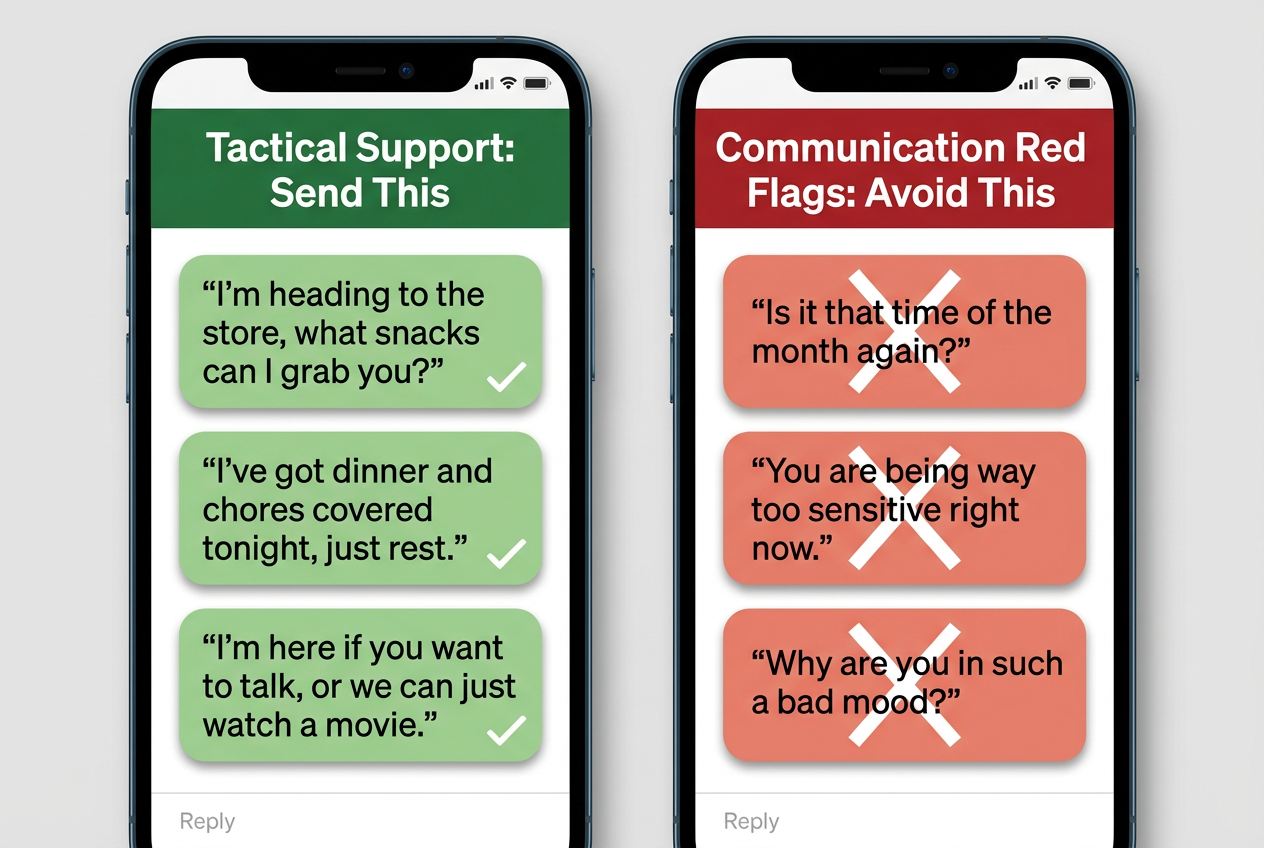 Small shifts in your texting vocabulary can drastically reduce friction. Use these templates to offer proactive support instead of accidental triggers.
The "Never Say" List - Red-Flag Phrases to Avoid
The following phrases are guaranteed to escalate conflict during the luteal phase. They may seem harmless in other contexts. During PMS, they read as dismissive, invalidating, or condescending.
Banned Phrases:
- "You're overreacting." Translation to her: "Your feelings are wrong."
- "Calm down." Translation to her: "You're being irrational and I'm the reasonable one."
- "Are you on your period?" Translation to her: "I'm reducing your legitimate concern to hormones."
- "You're being crazy/dramatic/emotional." Translation to her: "I don't respect your experience."
- "It's not that big of a deal." Translation to her: "Your priorities are invalid."
- "Why are you so moody?" Translation to her: "This is your problem, not a shared dynamic."
- "Let me fix this for you." Translation to her: "You can't handle this yourself."
These phrases don't just cause arguments. They erode trust. She's not looking for you to minimize, solve, or explain away her experience. She's looking for you to acknowledge it, validate it, and offer support without judgment.
How to Handle PMS Without Walking on Eggshells
The goal isn't to treat her like she's fragile. The goal is to recognize that her nervous system is under more stress during this phase and adjust your approach accordingly. Progesterone withdrawal affects mood regulation in measurable ways - it's not "all in her head," and it's not an excuse for poor behavior on either side.
Practically, this means:
- Don't initiate big conversations that require emotional bandwidth (save them for the follicular phase).
- Avoid jokes that land on the edge of teasing - her tolerance for ambiguity is lower.
- Offer help proactively instead of waiting for her to ask - decision fatigue is real.
- Validate first, problem-solve second - "That sounds really frustrating" goes further than "Have you tried X?"
If she snaps at you during this phase, don't take it personally and don't make it about you. A calm "I hear you - let me know how I can help" de-escalates where defensiveness amplifies.
For more on understanding the luteal phase and how to provide the right support, see our guide on how to support your girlfriend during the luteal phase.
The Long-Distance Text Playbook
Long-distance relationships face a unique challenge with cycle-aware support: you can't physically show up with a heating pad, cook her dinner, or take over logistics when she's having a rough day. Text becomes your primary support tool - which means you need to be more intentional about timing and tone than guys who live locally.
How to Send Tangible Support Remotely
Text support is necessary. Tangible support is memorable. Here's how to deliver real comfort from a distance:
Phase-Specific Long-Distance Actions:
| Phase | Remote Support Strategy | Example Actions |
|---|---|---|
| Menstrual | Deliver comfort without requiring effort from her | Send DoorDash/Uber Eats with her favorite comfort food; send a care package (heating pad, chocolate, cozy socks); schedule a low-key video call where she doesn't have to "be on" |
| Follicular | Engage her high energy with planning and adventure | Plan a future visit with specific dates and activities; send a "thinking of you" gift related to something she's excited about; initiate a deep conversation via video call |
| Ovulatory | Reinforce connection and make her feel prioritized | Schedule a dedicated date night over video (dress up, order the same meal, make it an event); send flowers or a romantic note; make time for intimacy (even virtually) |
| Luteal | Provide stability and reduce her decision load | Handle logistics for your next visit so she doesn't have to plan; send a "no response needed" supportive text; offer to listen without trying to fix anything |
Long-Distance Text Templates by Phase
Menstrual Phase:
- "Just sent you dinner - should be there in 30. No need to respond, just enjoy."
- "I know you're not feeling great. Want to FaceTime later, or do you need a quiet night?"
- "Wish I could be there to take care of you. Sending a care package - should arrive tomorrow."
Follicular Phase:
- "Been thinking about our next visit. Want to plan something fun together?"
- "You sounded really energized on our last call. What's been on your mind lately?"
- "Saw [article/video/event] and thought of you. Want to talk about it this weekend?"
Ovulatory Phase:
- "You've been on my mind all day. Let's do a real date night this week - what time works?"
- "Wish I could see you right now. You always look amazing, but especially lately."
- "I know the distance sucks, but I'm so glad you're mine. Can't wait to see you soon."
Luteal Phase:
- "No pressure to respond - just want you to know I'm thinking of you."
- "You seem stressed. Anything I can do from here to help?"
- "I've got all the logistics for my next trip handled. You don't need to think about it."
The key to long-distance cycle support is compensating for the lack of physical presence with increased intentionality. Don't assume she knows you're thinking about her - tell her. Don't assume she remembers you care - show her with actions, even if those actions are digital or delivered.
For more strategies on maintaining connection across the miles, check out our guide on long-distance relationship communication tips.
When It's More Than PMS: Recognizing PMDD and Heavy Bleeding
Not all cycle-related symptoms are standard PMS. For 3% to 9% of individuals who menstruate, symptoms escalate to Premenstrual Dysphoric Disorder (PMDD) - a severe form of PMS that includes debilitating depression, anxiety, mood swings, and in extreme cases, suicidal ideation. Research shows that 15% of women struggling with PMDD will attempt suicide at least once in their lifetime. This is not "just bad PMS." This is a medical condition that requires professional intervention.
How to Recognize PMDD
PMDD differs from PMS in severity and impact. Standard PMS may cause irritability, fatigue, and mild mood swings. PMDD causes symptoms severe enough to interfere with daily functioning - missing work, avoiding social situations, experiencing panic attacks, or expressing feelings of hopelessness.
PMDD Warning Signs:
- Severe depression or feelings of hopelessness that appear cyclically (usually in the luteal phase)
- Intense anxiety, panic attacks, or overwhelming stress
- Extreme irritability or anger that feels disproportionate to triggers
- Loss of interest in activities she normally enjoys
- Difficulty concentrating or feeling "foggy"
- Fatigue so severe she can't function normally
- Changes in appetite or sleep that disrupt her routine
- Physical symptoms (bloating, breast tenderness, joint pain) severe enough to be disabling
If she experiences five or more of these symptoms consistently in the week before her period, and they resolve within a few days after her period starts, encourage her to talk to a healthcare provider. PMDD is treatable with SSRIs, hormonal contraception, lifestyle changes, and therapy, but it requires diagnosis and medical support.
Your role as a partner isn't to diagnose PMDD. Your role is to recognize when symptoms exceed normal PMS and support her in seeking help.
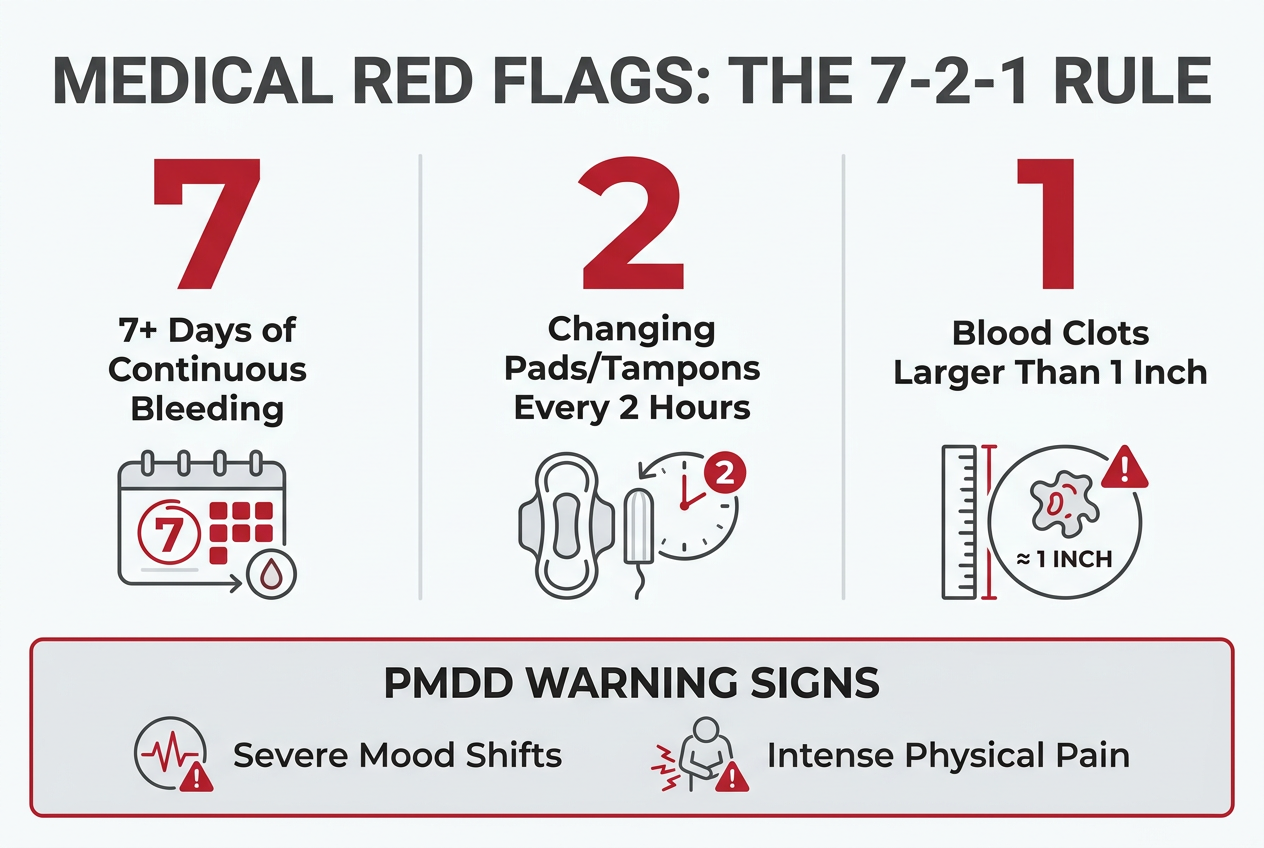 Being a supportive partner means knowing when to move from comfort to care. Use the 7-2-1 rule to identify when medical attention may be necessary.
The "7-2-1 Rule" for Heavy Bleeding
Heavy menstrual bleeding (menorrhagia) is another red flag that requires medical attention. Most women release 2-3 tablespoons of blood during a period. If she's bleeding significantly more - soaking through pads or tampons rapidly, passing large clots, or bleeding for an extended duration - it could indicate an underlying issue like fibroids, endometriosis, or a clotting disorder.
The 7-2-1 Rule:
- 7 days: Bleeding that lasts longer than 7 days consistently
- 2 hours: Needing to change a pad or tampon every 2 hours or less due to saturation
- 1 inch: Passing blood clots larger than 1 inch (roughly the size of a quarter)
If any of these apply, she should talk to a doctor. These symptoms aren't normal, and they can lead to anemia, fatigue, and other complications if untreated.
How to Bring It Up Without Being Pushy
If you notice signs of PMDD or heavy bleeding, your approach matters. Accusations or unsolicited diagnoses will backfire. Instead, frame your concern as an observation and an offer of support:
- Good approach: "I've noticed you seem really overwhelmed the week before your period. Have you thought about talking to a doctor? I'm happy to help you find someone or go with you."
- Bad approach: "You're way too moody - I think you have PMDD. You need to see someone."
The difference is agency. You're noticing a pattern and offering to support her in addressing it, not telling her what's wrong with her or demanding she fix it.
For more on recognizing when cycle symptoms require medical attention, see our guide on understanding your partner's cycle.
How to Track Her Cycle Without Being Weird About It
The most common objection men have to cycle tracking is: "Won't she think it's creepy if I'm monitoring her period?" The answer depends entirely on how you frame it and use it. Tracking her cycle to anticipate her needs and provide better support is thoughtful. Tracking her cycle to dismiss her feelings ("You're just PMSing") or weaponize it in arguments is manipulative.
Why Tracking Works Better Than Guessing
Using a period tracker for men eliminates the guesswork that leads to friction. Instead of reacting after she's already irritated, you can proactively adjust your approach based on what phase she's in. Instead of suggesting a serious conversation at the worst possible time, you can wait 5 days and have the same conversation with a 72% higher success rate.
A 2026 study found that using a tactical cycle-support system reduces relationship friction by 58% compared to reactive "walking on eggshells" strategies. The difference is proactive awareness instead of defensive damage control.
How to Introduce Cycle Tracking to Your Partner
Don't just download an app and start tracking without telling her. That's the "creepy" version. Instead, have a conversation about it:
How to bring it up:
- "I've been reading about how your cycle affects energy and mood, and I want to be better at supporting you. Would you be open to sharing your cycle dates with me so I can be more aware of what you need?"
- "I know I've missed the mark on timing before - like bringing up serious stuff when you're stressed. If I knew where you were in your cycle, I could plan better. What do you think?"
- "I want to be a better partner, and part of that is understanding what's happening biologically so I'm not caught off guard. Can we try tracking together?"
Most women will appreciate the effort, especially if you frame it as wanting to understand her better - not as trying to control or predict her.
Best Apps for Men Tracking Their Partner's Cycle
| App | Key Features | Best For | Price |
|---|---|---|---|
| VibeCheck | AI-powered daily coaching, phase-specific text templates, proactive mission suggestions | Men who want actionable guidance, not just tracking | Free trial, then subscription |
| Selin | Partner tracking, discreet notifications, symptom logging | Couples who want shared tracking | Free with premium option |
| Mayday | Simple interface, partner notifications, no medical jargon | Beginners to cycle tracking | Free |
| Flo for Partners | Educational content, symptom insights, partner sharing | Men who want to learn the science | Free with premium option |
For a detailed breakdown of these apps and more, see our comparison guide on the best period tracker apps for boyfriends.
The Difference Between Tracking and Weaponizing
Here's the line: Tracking to anticipate and support is healthy. Tracking to dismiss or invalidate is toxic.
Healthy use of cycle tracking:
- "I know you're in your luteal phase, so I'm going to handle dinner and give you space tonight."
- "You mentioned wanting to talk about moving in together. Your follicular phase starts in 3 days - good time to revisit that?"
Toxic use of cycle tracking:
- "You're just saying that because you're PMSing." (dismissing her concern)
- "I knew you'd be irritable today - your app said so." (using tracking as a weapon)
The cycle doesn't make her feelings invalid. It provides context for how her body is processing stress and emotion. Use that context to be more supportive, not more dismissive.
If you want to understand how to use cycle tracking to improve your relationship without overstepping, check out our guide on how to tell which cycle phase your girlfriend is in.
Ready to actually understand her?
Join thousands of men using VibeCheck to track her cycle and show up better every day.
If you would rather be told what is coming than work it out after the fact, our comparison of the best relationship advice apps for men shows which ones give you the heads-up.
Frequently Asked Questions
How do I know which phase she's in without asking?
If she hasn't shared her cycle dates with you, look for behavioral cues. During the follicular phase (Spring), she'll have higher energy, be more social, and initiate plans or conversations. During ovulation (Summer), she'll seem more confident, have increased libido, and care more about her appearance. During the luteal phase (Autumn), she'll be more irritable, decision-fatigued, and prefer low-effort activities. During the menstrual phase (Winter), she'll have visible physical symptoms like cramping, fatigue, or bloating. These patterns aren't foolproof, but they give you directional accuracy. For precision, use a period tracker app designed for men and ask her to share her cycle dates with you.
What should I text my girlfriend when she's on her period?
Text her with low-effort support and tangible offers of help. Examples: "How are you feeling today? Let me know if you need anything," or "I'm handling dinner tonight - want me to grab your favorite?" Avoid asking if she's okay repeatedly, making period jokes, or sending texts that require long responses. The menstrual phase is about comfort, not conversation. If you're long-distance, send a food delivery or care package instead of just words. For more menstrual-phase text ideas, see our guide on how to comfort your girlfriend on her period over text.
Is it okay to ask my girlfriend about her cycle?
Yes, if you frame it as wanting to support her better - not as trying to control or predict her moods. A good approach: "I've been learning about how your cycle affects energy and mood. Would you be open to sharing your cycle dates with me so I can be more aware of what you need?" Most women appreciate partners who want to understand their bodies, as long as the intent is supportive. Never ask "Are you on your period?" as a way to dismiss her feelings during an argument - that's weaponizing cycle awareness, not using it to support her.
How can I support my girlfriend during PMS without making it worse?
Validate her experience without trying to fix it, offer proactive help instead of waiting for her to ask, and avoid trigger phrases like "calm down" or "you're overreacting." The luteal phase (PMS) is characterized by decision fatigue, heightened sensitivity to stress, and lower tolerance for ambiguity. Texts like "You seem stressed - anything I can take off your plate?" or "Not trying to fix anything, just want you to know I'm here" work better than unsolicited advice or minimizing her concerns. For a full breakdown of luteal-phase support strategies, check out our article on how to support your girlfriend during the luteal phase.
What's the difference between PMS and PMDD?
PMS (Premenstrual Syndrome) causes mild to moderate symptoms like irritability, fatigue, and bloating during the luteal phase. PMDD (Premenstrual Dysphoric Disorder) causes severe symptoms that interfere with daily functioning - including debilitating depression, anxiety, panic attacks, and in extreme cases, suicidal ideation. Research shows that 3-9% of individuals who menstruate experience PMDD, and 15% of those struggling with PMDD will attempt suicide at least once. If your partner experiences five or more severe symptoms consistently in the week before her period, and they resolve after menstruation begins, she should talk to a healthcare provider. PMDD is treatable with medication, therapy, and lifestyle changes, but it requires medical intervention.
Can I track my girlfriend's cycle without an app?
Yes, but it's harder to do accurately without a tracking tool. If she shares her cycle start date with you, you can estimate phases manually: Days 1-7 are menstrual, Days 8-14 are follicular, Days 15-17 are ovulatory, and Days 18-28 are luteal. Mark it on a shared calendar or set reminders on your phone. However, cycle length varies - not every woman has a 28-day cycle - so manual tracking can drift over time. A dedicated period tracker app for men adjusts automatically based on her actual cycle length and provides reminders for each phase shift, which eliminates the guesswork.
What if my girlfriend doesn't want me tracking her cycle?
Respect her boundary and don't push it. Some women feel uncomfortable with partners tracking their cycle, especially if they've had past experiences where it was weaponized against them. Instead of tracking without her knowledge (which is a breach of trust), focus on improving your observational skills. Pay attention to her energy patterns, communication style, and physical cues week to week. You can still provide phase-appropriate support by noticing when she seems low-energy (Winter), high-energy (Spring), or stressed (Autumn) without needing an app. If she later becomes comfortable with the idea, revisit the conversation.
Should I bring up her cycle during an argument?
No. Never reference her cycle during a conflict as a way to dismiss or invalidate her feelings. Saying "Are you PMSing?" or "Is this just because of your hormones?" will escalate the argument and damage trust. Hormonal fluctuations provide context for how her nervous system is processing stress - they don't make her concerns illegitimate. If you think the timing of the argument is related to her luteal phase, keep that observation to yourself and focus on de-escalating: validate her feelings, offer support, and revisit the conversation when tensions are lower. The cycle is a tool for understanding, not a weapon for deflection.
Final Thoughts
Texting your girlfriend isn't about finding the perfect words. It's about sending the right energy at the right time. When you understand the biological rhythm underneath her moods, communication style, and needs, you stop guessing and start leading. You stop reacting defensively to shifts you didn't see coming and start anticipating them with the kind of support that actually lands.
The four-phase map isn't a cheat code. It's a framework. Use it to plan better, communicate clearer, and show up in ways that prove you're paying attention - not just to what she says, but to what her body is going through. That's the difference between a guy who cares and a guy who gets it.
If you're ready to stop walking on eggshells and start building the kind of relationship where you're not constantly caught off guard, try VibeCheck - the AI-powered relationship app built for men who want to understand their partner's cycle, get daily coaching on what to say and do, and eliminate the guesswork that causes friction.
Tags

Related Articles
Continue reading to deepen your understanding

Understanding Why Your Girlfriend’s Communication Style Shifts Weekly
Ever wonder why your partner’s moods and energy levels shift so much? Understanding the four phases of her menstrual cycle helps you become a more supportive and proactive partner.

When Do Your Girlfriend’s Energy Levels Change During Her Cycle?
Your girlfriend’s mood and stamina follow a biological rhythm. Learn how her energy peaks and crashes throughout the month so you can plan better dates and provide better support.

Why Your Girlfriend Needs Different Attention Each Week: The Four Seasons Framework
Stop walking on eggshells and start understanding her cycle. This framework shows you exactly how to support your girlfriend through all four biological phases every month.

Why Your Girlfriend Wants Space the Week Before Her Period
Does your girlfriend suddenly pull away every month? Discover the biological reasons behind the pre-period space window and how to navigate this phase together.

Why Your Girlfriend Wants Different Kinds of Affection at Different Times in Her Cycle
Ever feel like your girlfriend’s needs change every week? It’s not random. Understand how the four phases of her cycle drive her desire for intimacy so you can support her better.

How to Plan Romantic Gestures by Cycle Timing: The Partner’s Tactical Guide
Stop guessing why your date night plans fell flat. This guide explains how to synchronize your romantic efforts with her biological cycle for better intimacy and connection.

How to Tell When Your Girlfriend Is Ovulating: Reading the Biological Signals Your Partner Sends
Understanding your partner’s cycle helps you anticipate her needs and time important conversations. Learn the behavioral signs of ovulation to improve your relationship and connection.

Understanding Your Girlfriend’s Words of Affirmation Cycle: A Partner’s Guide
Ever feel like your compliments land wrong? Her need for words of affirmation isn’t random—it follows a biological rhythm. Learn how to match your support to her internal hormonal seasons.