When Your Girlfriend Goes Distant During the Luteal Phase: The Partner’s Tactical Guide

Does your girlfriend pull away or go quiet right before her period? Understand the biological reason for her withdrawal and how you can support her without making it worse.
When Your Girlfriend Goes Distant During the Luteal Phase: The Partner's Tactical Guide
You've noticed a pattern. For a week or so before her period, your girlfriend becomes emotionally unavailable. She's not angry, not picking fights - she's just not there. She responds with one-word texts, cancels plans, needs to be alone. You're left wondering if you did something wrong, if she's losing interest, or if this is just how relationships are now.
Here's what's actually happening: her body is experiencing a sharp drop in progesterone and serotonin during the luteal phase, the stretch of time between ovulation and her next period. This isn't a relationship problem - it's a biological event. And once you understand the mechanics, you can stop walking on eggshells and start providing the exact support she needs.
Table of Contents
- What the Luteal Phase Actually Is
- Why She Pulls Away: The Biological Mechanism
- Can the Luteal Phase Cause Feelings of Sadness?
- The Relationship Audit: Love vs. Satisfaction
- How to Treat Your Girlfriend During the Luteal Phase
- The Red Zone Rules: What Not to Do
- Is It Common to Break Up During the Luteal Phase?
- How to Help a Partner with PMDD
- Frequently Asked Questions
What the Luteal Phase Actually Is
The luteal phase is the biological window between ovulation and the start of her next period - roughly the last two weeks of her cycle. After ovulation, the luteal phase begins: progesterone rises to help prepare the uterine lining for a possible pregnancy. If pregnancy doesn't happen, both progesterone and estrogen drop sharply in the days before menstruation.
This isn't a universal 28-day cycle with the same timing for every woman. A "normal" cycle varies considerably between women - menstrual bleeding can start anywhere from every 24 to every 38 days. But the pattern holds: rising progesterone after ovulation, then a crash before the period.
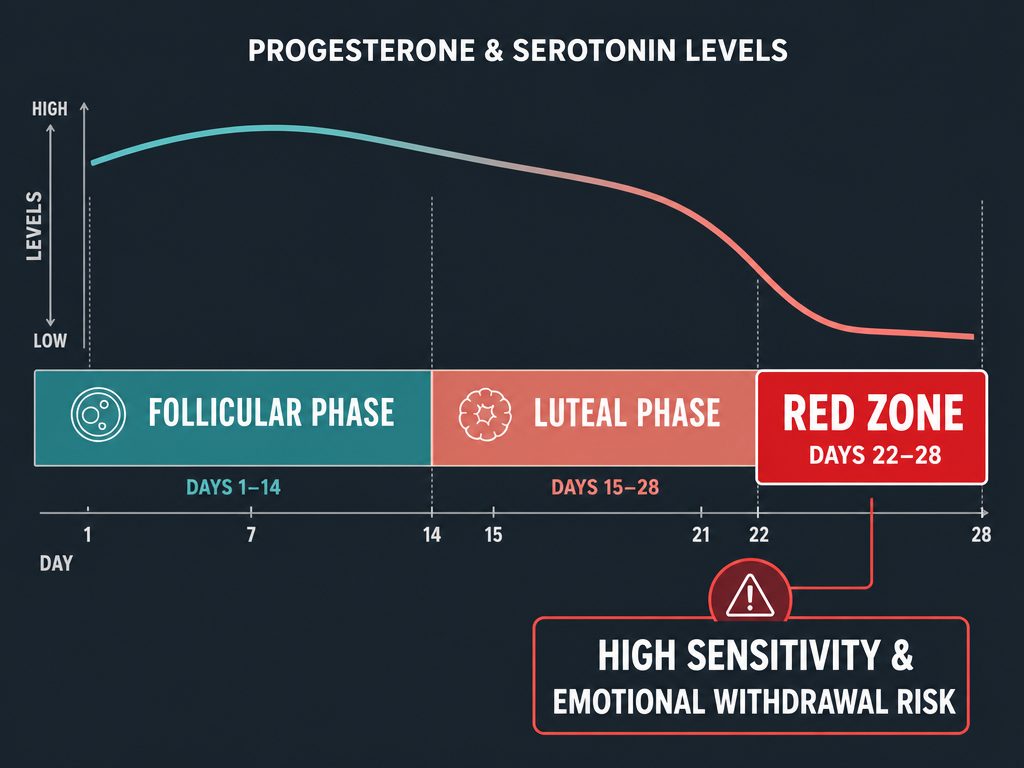
Understanding the 'Red Zone' (Days 22-28) helps partners anticipate when emotional withdrawal is most likely to occur due to biological shifts in progesterone and serotonin.
The "Red Zone" - the final five to seven days before her period - is when the withdrawal becomes most visible. That's when you'll notice the biggest shift in her energy, mood, and need for space.
VibeCheck App
Download Free on iOS →Why She Pulls Away: The Biological Mechanism
Here's the key: progesterone doesn't just prepare the uterine lining. It also affects neurotransmitters, particularly serotonin - the chemical responsible for mood regulation and social connection. When progesterone drops sharply in the late luteal phase, serotonin often drops with it.
The result? Her brain's threat-detection system becomes hyperactive. The amygdala - the part of the brain that scans for danger - becomes more sensitive. Research shows that during this phase, neutral faces can look angry or disappointed to her, even when you're not upset at all.
So when she withdraws, she's often protecting herself from a perceived conflict that hasn't actually happened yet. It's not that she doesn't love you - her brain is processing social cues through a different lens.
This withdrawal is a protective response, not a deliberate choice to shut you out.
Can the Luteal Phase Cause Feelings of Sadness?
Yes. The same serotonin drop that drives withdrawal can also trigger feelings of sadness, hopelessness, or flatness. Many women notice PMS-like symptoms in this phase - mood shifts, breast tenderness, bloating, acne, and appetite changes.
The luteal dip isn't just irritability. For some women, it's a genuine depressive episode that recurs every month. She might cry more easily, lose interest in activities she normally enjoys, or feel an overwhelming sense of dread about small things.
This is where partners often make a critical mistake: they try to fix the sadness with logic. "But nothing actually happened," or "You were fine yesterday." That approach doesn't work because the sadness isn't rooted in external events - it's rooted in brain chemistry.
If you're looking for more detailed guidance on navigating this phase, our partner's guide to the luteal phase breaks down the Triple-A framework for reducing conflict.
The Relationship Audit: Love vs. Satisfaction
Here's the reassurance you need: her withdrawal doesn't mean she's falling out of love with you.
A 2025 study published in PLOS ONE found that both women with PMDD and their partners reported lower relationship quality compared to controls for all domains except love and commitment. Read that again: satisfaction drops, but love and commitment usually remain stable.
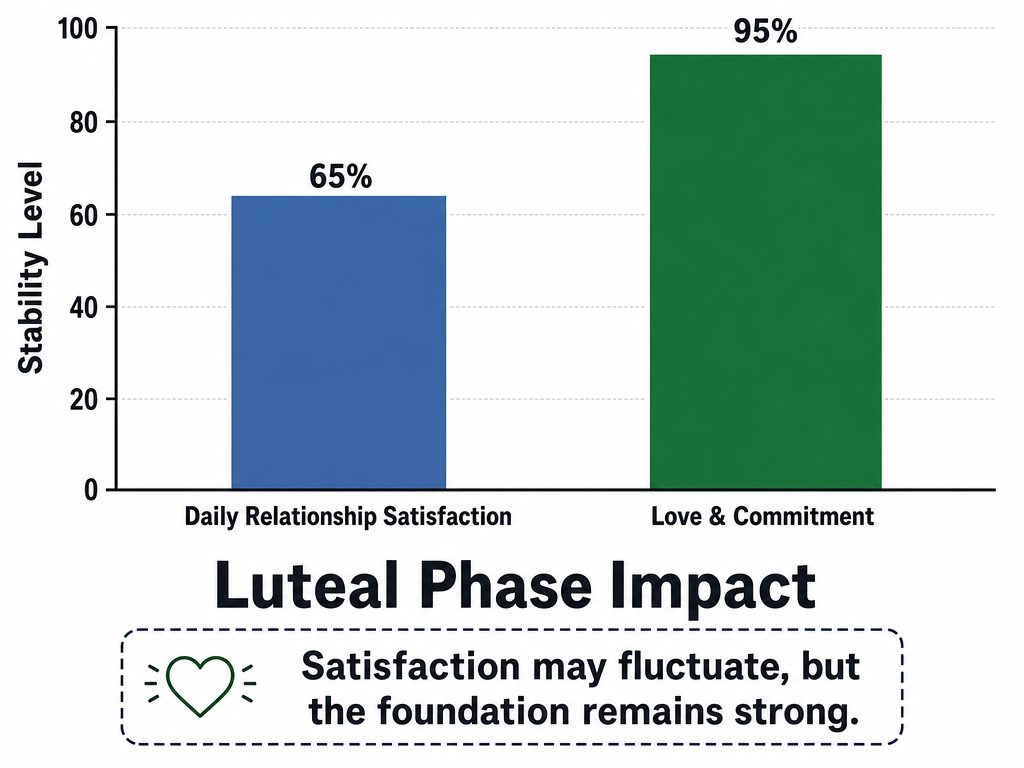
Research indicates that while daily satisfaction may dip during the luteal phase, the underlying levels of love and commitment usually remain stable and high.
This distinction matters. If you judge the health of your relationship based on a random Wednesday during her late luteal phase, you'll get a distorted picture. Her irritability, her need for space, her lack of enthusiasm for plans - those are biological symptoms, not relationship verdicts.
Don't make major relationship decisions during this window. Don't ask "Are we okay?" or "Do you still want to be with me?" Wait until she's out of the Red Zone, and then check in if you still need to.
How to Treat Your Girlfriend During the Luteal Phase
The tactical answer: give her what she needs before she has to ask for it. That means adjusting your support style to match her biological state.
The Triple-A Framework
1. Acknowledge the pattern.
Use a script like this: "I've noticed you're needing a bit more quiet time this week. I'm here if you want to talk, but I'm also happy to give you space."
This does two things. First, it shows you're paying attention. Second, it gives her explicit permission to withdraw without feeling guilty about it.
2. Adjust the environment.
Create a low-stimulation space. Dim the lights. Handle dinner without asking "What do you want?" (decision fatigue is real during this phase). Reduce noise - turn off the TV, skip the group hangout invitations, don't play music unless she asks.
Lifestyle approaches that can help ease PMS symptoms include regular aerobic exercise, smaller/more frequent meals, less salt/caffeine/alcohol, adequate sleep, and stress-reduction practices. You can't force her to do yoga, but you can remove friction from her environment.
3. Act with silent service.
Don't ask for permission to help. Just do the dishes. Handle the laundry. Restock her favorite snacks. The goal is to reduce the number of decisions and tasks she has to manage.
One partner described this as "operating in stealth mode." You're present, you're helpful, but you're not hovering or demanding acknowledgment.
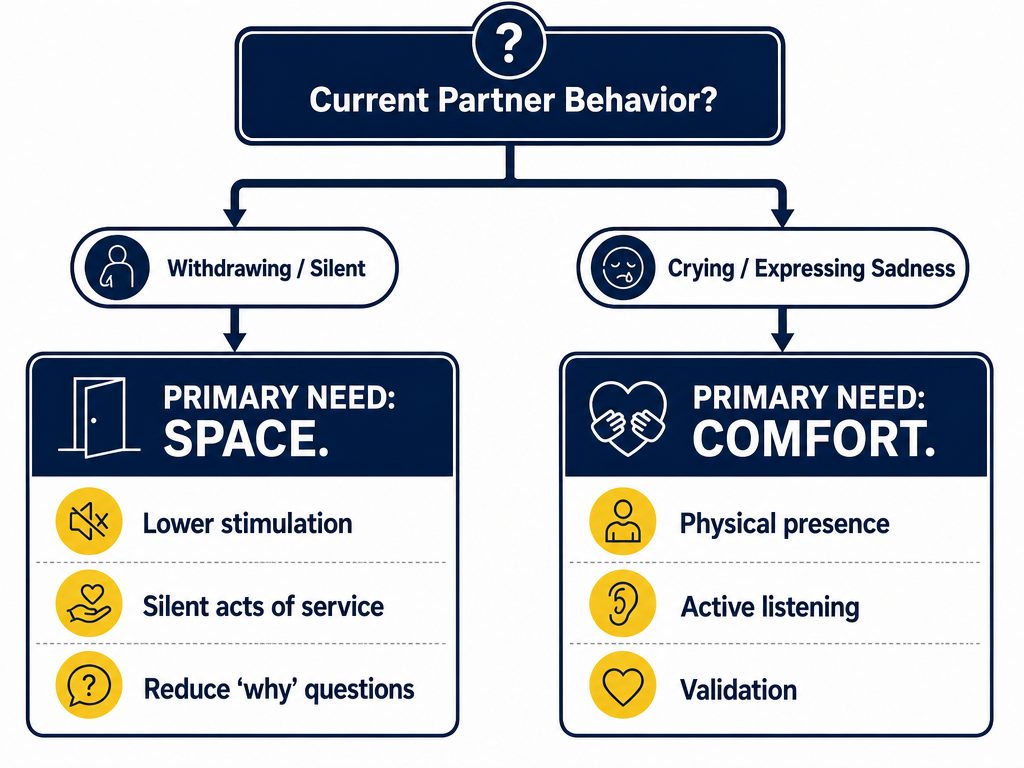
This decision-support framework helps partners navigate the 'Red Zone' by identifying whether her current behavior requires practical space or emotional comfort.
The Space vs. Comfort Protocol
Here's the triage framework:
- If she's withdrawing (quiet, non-responsive, physically distant): give space.
- If she's crying or visibly distressed: offer comfort, but let her set the level of physical contact.
- If she's irritable or snapping: don't take it personally, don't argue back, and don't ask her to explain why she's upset.
Space comes before comfort. If you're unsure which she needs, default to space and let her come to you.
For more on recognizing when she needs distance versus closeness, see our guide on signs your girlfriend needs space during her cycle.
The Red Zone Rules: What Not to Do
Rule 1: No Relationship Autopsies
Never ask "Why are we like this?" or "Are you still happy with us?" during the late luteal phase. You will not get an accurate answer. You'll get a chemically distorted version of how she feels in that exact moment, and it will send you both into a spiral.
If you have a legitimate concern about the relationship, bookmark it. Address it during her follicular phase - the week after her period ends - when serotonin and estrogen are both rising and she has more emotional bandwidth.
Rule 2: Avoid the Logic Trap
If she complains about something that seems objectively minor or factually incorrect, do not correct her. Do not explain why the thing she's upset about isn't actually a big deal.
Instead, validate the feeling: "That sounds really stressful."
You're not agreeing that the complaint is logical. You're acknowledging that she's experiencing stress, which is true regardless of whether the triggering event "should" be stressful.
Rule 3: Don't Hover
Checking in every two hours with "Are you okay?" or "Do you need anything?" can feel suffocating during this phase. She knows you care. Constant check-ins add to her mental load rather than reducing it.
Set a baseline level of support (food handled, environment calm, tasks covered) and then back off unless she signals she needs more.
Our boyfriend guide to the menstrual cycle phases covers these timing principles in more detail if you want a broader understanding of all four phases.
Is It Common to Break Up During the Luteal Phase?
Yes, and the data backs this up. Women with PMDD have a 22% higher risk of relationship disruption - meaning the relationship ends entirely - compared to women without severe premenstrual symptoms.
Why? Because repeated monthly conflict wears down both partners. If you don't understand what's happening biologically, her withdrawal feels like rejection. Your confusion or frustration reads as dismissiveness to her. Small tensions compound into major resentment over time.
But here's the flip side: couples who do understand the pattern and adjust their expectations report significantly less conflict. Tracking symptoms and mood changes across the cycle for a few months is a legitimate, medically endorsed way to identify real patterns and timing.
You're not tracking her to control her. You're tracking to anticipate and prepare.
If you're wondering whether a period tracker can actually help, we've reviewed the best period tracker apps for boyfriends and explain which ones give you actionable guidance instead of just data.
How to Help a Partner with PMDD
PMDD (premenstrual dysphoric disorder) is not just "bad PMS." PMDD is a real, clinically recognized condition - it's listed in the DSM-5 as a depressive disorder. It affects roughly 1 in 10 people who menstruate.
PMDD specifically involves extreme mood symptoms - such as marked irritability, anxiety, or hopelessness - intense enough to disrupt daily life and strain relationships. If your partner's luteal phase includes suicidal thoughts, rage that feels out of control, or a complete inability to function, that's not typical PMS.
The PMDD Checklist
Watch for these patterns:
- Severe mood swings or crying spells that feel disproportionate to triggers
- Marked irritability or anger that leads to conflicts with others
- Depressed mood, feelings of hopelessness, or self-critical thoughts
- Anxiety, tension, or feeling "on edge"
- Difficulty concentrating or a sense of being overwhelmed
- Physical symptoms like joint/muscle pain, bloating, or breast tenderness that interfere with daily activities
If at least five of these symptoms show up consistently in the week before her period and resolve within a few days after it starts, that's the PMDD pattern.
How to Suggest She Get Help
This conversation requires tact. Don't lead with "You need to see a doctor." Lead with quality of life.
Try this script: "I've noticed you're really struggling during this part of your cycle, and I hate seeing you in so much pain. Have you ever talked to a doctor about whether there are options that might make this easier?"
You're framing it as care, not criticism. You're acknowledging her suffering, not labeling her as broken.
Treatment options for PMDD include SSRIs (which can be taken only during the luteal phase for some women), hormonal birth control to stabilize the cycle, and cognitive-behavioral therapy tailored to premenstrual symptoms. A healthcare provider can help determine what's appropriate.
For a deeper breakdown of PMDD versus PMS, read our guide on how to comfort your girlfriend during PMS.
Frequently Asked Questions
Does every woman experience luteal phase withdrawal?
No. As many as 3 in 4 women report experiencing PMS symptoms at some point in their life, though severity varies widely. Some women have minimal symptoms. Others have symptoms that are physically uncomfortable but don't cause emotional distance. And a smaller group experience the kind of withdrawal or mood disruption that strains relationships.
The key is not to assume your partner's experience matches a generic description. Track her specific pattern over at least two cycles before drawing conclusions.
Can stress make luteal phase symptoms worse?
Yes. Cortisol (the stress hormone) interacts with progesterone and can amplify PMS symptoms. If she's dealing with work deadlines, family conflict, or major life changes, her luteal phase symptoms may be noticeably worse than usual.
This is also why lifestyle approaches that can help ease PMS symptoms include adequate sleep and stress-reduction practices like deep breathing or yoga. You can't eliminate her stress, but you can avoid adding to it during this window.
How long does the emotional distance usually last?
Typically five to seven days before her period starts, though this varies. Some women feel the shift as early as day 18 or 19 of their cycle; others don't notice symptoms until two or three days before menstruation.
The distance almost always resolves within the first few days of her period. Once bleeding starts, progesterone and estrogen are both at baseline, and serotonin begins to stabilize.
If the withdrawal persists throughout her entire cycle - not just the luteal phase - that's not hormonal. That's a separate relationship or mental health issue that needs to be addressed directly.
Should I tell her I'm tracking her cycle?
Only if she's already open to the idea. For some women, knowing that their partner is paying attention to their cycle feels supportive and validating. For others, it feels invasive or patronizing.
Start the conversation by asking if she tracks her own cycle and whether she's noticed patterns in how she feels at different times of the month. If she's receptive, you can offer to help by being more aware of timing. If she's uncomfortable with the idea, don't push it.
A period tracker for couples can make this a shared effort rather than something you're doing to her.
What if she says "I'm fine" when I know she's struggling?
Respect her boundary. If she's not ready to talk about what she's feeling, pressing her will make things worse.
Instead, demonstrate through action that you're paying attention. Handle the logistics. Create the low-stimulation environment. Be present without demanding engagement.
Sometimes the best support is just being a calm, predictable presence while her brain chemistry rebalances.
The luteal phase doesn't have to be a minefield. Once you understand the biological mechanics and adjust your expectations, you can move through this window with less friction and more connection. Your girlfriend isn't trying to punish you. Her brain is temporarily wired to perceive threat where none exists, and her serotonin is lower than baseline.
Give her space when she needs it. Provide quiet, practical support. Save the big conversations for the follicular phase. And remember: the withdrawal isn't a referendum on your relationship - it's a recurring biological event that both of you can learn to manage.
For a tactical, day-by-day breakdown of what to expect across her entire cycle, check out our 28-day relationship manual.
Tags

Related Articles
Continue reading to deepen your understanding

The Strategic Partner’s Guide to Ovulation Energy Surge Date Ideas
Is your girlfriend suddenly full of energy and ready for adventure? It’s likely her ovulation surge. Use this guide to plan dates that match her peak confidence and social drive.

How to Plan a Surprise for Your Girlfriend During Her Follicular Phase
Stop fighting her hormones and start working with them. Use this guide to time your surprises perfectly with her biological clock for better reactions and maximum joy.

How to Comfort Your Girlfriend During Ovulation Mood Swings: The Partner’s Tactical Guide
Is your partner suddenly irritable mid-cycle? It is likely an estrogen crash. Use these tactical tips to navigate her ovulation mood swings with empathy.

What to Expect: Understanding Your Girlfriend’s Emotional Changes During Ovulation
Ever wonder why your girlfriend’s energy shifts mid-cycle? Her mood, confidence, and social drive are driven by hormonal surges that you can track to provide better support.

How to Comfort Your Girlfriend During Ovulation Bloating Naturally
Is your partner feeling puffy mid-cycle? Help her feel better with this guide to understanding ovulation discomfort and using gentle, natural remedies to ease her physical symptoms.

How to Comfort Your Girlfriend During Ovulation Cramps
Seeing your partner in pain during the peak of her cycle can be confusing. Use this guide to provide physical relief and emotional support for mid-cycle ovulation cramps.

How to Support Your Girlfriend During Ovulation Energy Changes
Notice her energy shifting from high-performance to a total crash? It’s likely ovulation. Here is how you can understand her cycle and be the supportive partner she needs right now.

How to Plan the Perfect Birthday Surprise Using Your Girlfriend’s Cycle Phases
Stop planning surprises she is too tired to enjoy. Align your girlfriend’s birthday celebration with her natural energy levels and hormonal cycle phases to guarantee a perfect day.