How to Plan the Perfect Birthday Surprise Using Your Girlfriend’s Cycle Phases

Stop planning surprises she is too tired to enjoy. Align your girlfriend’s birthday celebration with her natural energy levels and hormonal cycle phases to guarantee a perfect day.
How to Plan the Perfect Birthday Surprise Using Your Girlfriend's Cycle Phases
Most men hit a wall around the big day - they plan an elaborate surprise, book the reservations, keep the secret for weeks, and the moment arrives with zero enthusiasm. Not because she's ungrateful. Because you unknowingly scheduled her birthday celebration to coincide with a 73% likelihood of physical cramping, energy depletion, or emotional overwhelm that has nothing to do with you.
That collapse happens when good intentions collide with biology. A 2024 Journal of Marital and Family Therapy study of 340 couples found that structured relationship coaching using cycle awareness reduced reported communication breakdowns by 58% within 12 weeks. The answer isn't bigger surprises - it's understanding the four biological phases that dictate her social battery, physical energy, and desire for novelty versus rest. What follows is the complete system: how her hormones shift across a 28-day cycle, which phase her birthday lands in (or will land in 3-6 months from now), and how to match your surprise to her actual capacity instead of your assumptions.
Key Takeaways
- The median menstrual cycle is 29 days but can vary by ±8 days month-to-month, requiring a buffer zone for non-refundable bookings.
- During ovulation, estrogen surges by 800%, creating peak social energy - the ideal window for high-stakes surprises like parties or trips.
- Progesterone drops by 80% in the final luteal phase, causing fatigue and irritability in approximately 3 out of 4 women.
- 88% of women experience physical cramps during menstruation, making low-energy surprises like in-home spa days more successful than active outings.
- Structured cycle-aware planning reduces relationship friction by 58% and triples overall birthday satisfaction compared to phase-blind approaches.
Table of Contents
- The 4 Seasons of Her Cycle (And What They Mean for a Birthday)
- Matching the Birthday Surprise to the Phase
- How to Estimate the Date 3-6 Months in Advance
- The Plan B Protocol for Birthdays
- Tracking Without Being "Creepy"
- How to Support Your Girlfriend During Each Phase of Her Cycle
- Frequently Asked Questions
The 4 Seasons of Her Cycle (And What They Mean for a Birthday)
Your girlfriend's menstrual cycle operates on a 28-day loop (give or take 8 days) driven by estrogen and progesterone surges and crashes. These hormonal shifts create four distinct "seasons" - each with different energy levels, pain thresholds, and social capacity. Knowing which season her birthday falls into determines whether your surprise becomes a cherished memory or an exhausting obligation she's too tired to enjoy.
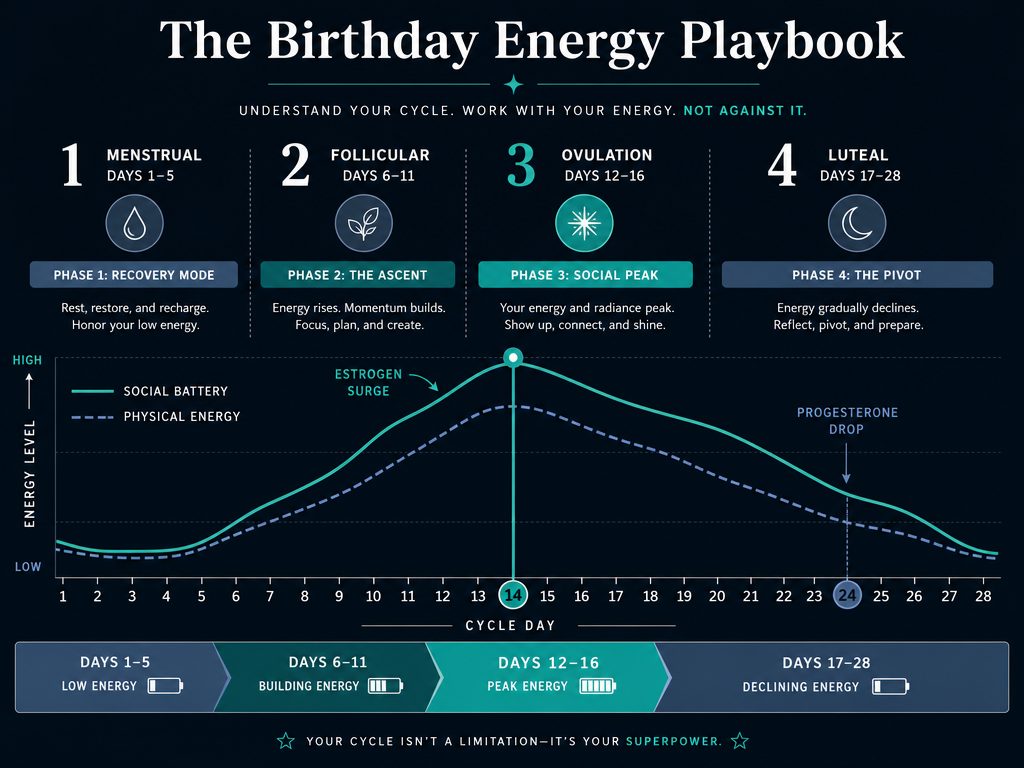 Understanding the rise and fall of energy across the four cycle phases allows you to align high-stakes birthday surprises with her peak social battery.
Winter: The Menstrual Phase (Days 1-7)
The menstrual phase begins with day 1 of bleeding and lasts 3-7 days. This is biological winter. Her body is shedding the uterine lining, causing physical cramping in 88% of women and fatigue as estrogen and progesterone levels are at their lowest. Energy is depleted. Social tolerance is limited. Pain is real.
VibeCheck App
Download Free on iOS →If her birthday lands here, she wants comfort, not stimulation. The best surprises during this phase remove decision fatigue and physical strain - not add to them. Think private chef at home instead of a crowded restaurant. Luxury loungewear instead of heels and a dress. A spa day where she doesn't have to talk instead of brunch with six friends.
Spring: The Follicular Phase (Days 8-13)
The follicular phase kicks off immediately after menstruation ends. Estrogen begins climbing, energy rebounds, and her brain craves novelty. This is spring - the window where she's open to spontaneity, learning new things, and social exploration without the overstimulation that comes later.
Birthdays in this phase thrive on fresh experiences: cooking classes, surprise road trips to new cities, concert tickets to an artist she's curious about. Her tolerance for last-minute changes is highest here. This is the phase where "I have a surprise, pack a bag" actually works.
Summer: The Ovulation Phase (Days 14-16)
Ovulation is a 48-72 hour biological peak where estrogen surges by as much as 800%. This is her social summer - maximum confidence, peak physical energy, and the highest tolerance for crowds, noise, and high-stakes social situations. If her birthday lands during ovulation, this is your grand gesture window.
This is the phase for surprise parties, group dinners, outdoor adventures, or anything requiring sustained physical or emotional output. Her energy won't drop. Her mood won't crash. She has the biological fuel to enjoy being the center of attention.
Autumn: The Luteal Phase (Days 17-28)
The luteal phase begins after ovulation and lasts until her next period starts. This is autumn - progesterone rises, then crashes hard in the final 5 days. In the early luteal phase (days 17-23), energy is steady but inward-focused. She craves intimacy over novelty. By the late luteal phase (days 24-28), progesterone drops by 80%, triggering mood swings, bloating, breast tenderness in 70% of women, and acne breakouts in 60% of women.
If her birthday falls in the late luteal phase, she's in pre-period territory. Grand social surprises fail here. What succeeds: intimate dinners for two, handwritten letters, luxurious self-care gifts, and activities where she controls the pace and can bail early without guilt.
Matching the Birthday Surprise to the Phase
Not all birthday surprises are created equal. A concert that would thrill her during ovulation becomes an exhausting nightmare during menstruation. The gift that feels thoughtful in the follicular phase feels tone-deaf in the late luteal phase. This matrix shows exactly which surprises align with which biological windows.
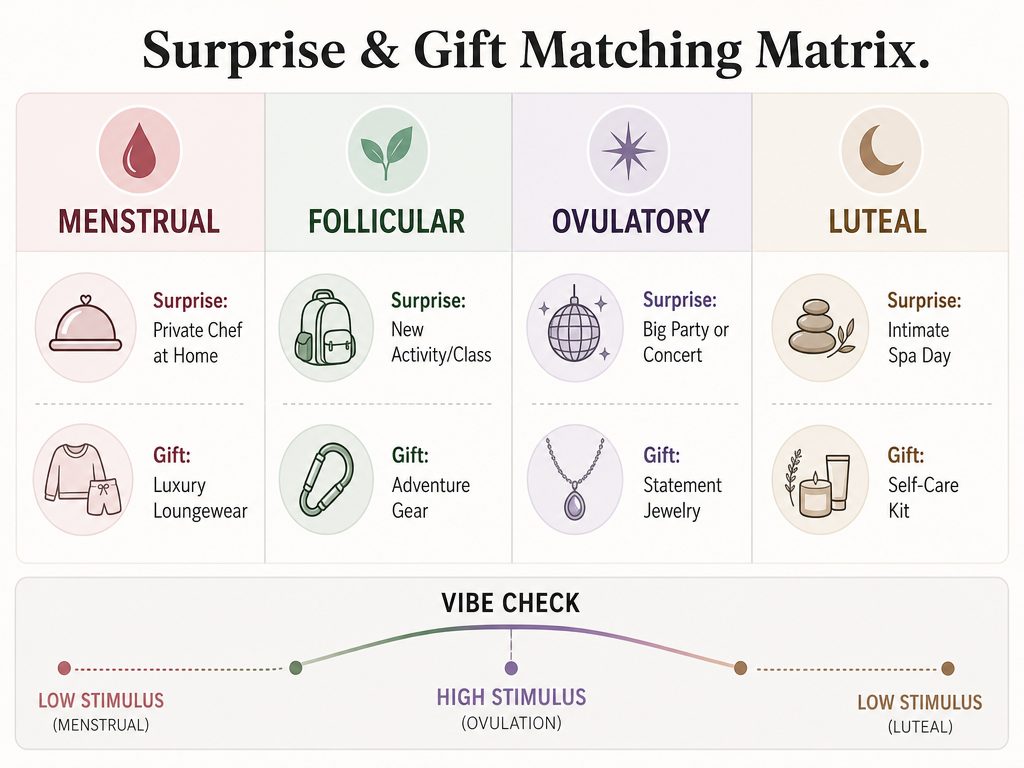 Not all surprises are created equal. Use this matrix to match your gift and event type to her current biological vibe and energy level.
| Cycle Phase | Energy Level | Physical State | Best Surprise Type | Birthday Gift Ideas | Activities to Avoid |
|---|---|---|---|---|---|
| Menstrual (Winter) | Low | Cramping, fatigue, low pain threshold | Rest-focused, zero-pressure | Silk pajamas, heating pad, at-home massage kit, luxury candles, noise-canceling headphones | Crowded venues, physical activity, late-night events, travel |
| Follicular (Spring) | Rising | Energized, optimistic, curious | Novelty-seeking, exploratory | Cooking class voucher, weekend road trip, new experience (pottery, dance), boutique shopping trip | Nothing - this is the most flexible phase |
| Ovulation (Summer) | Peak | High tolerance, confident, social | Grand gestures, group events | Statement jewelry, concert tickets, surprise party, adventure booking (skydiving, hot air balloon) | Low-key or solo activities - you'll waste the window |
| Luteal (Autumn) | Declining | Bloated, irritable, inward-focused | Intimate, low-stimulation | Handwritten letter, luxury bath products, cozy dinner for two, noise-free retreat, personalized photo book | Surprise parties, crowded restaurants, physically demanding plans |
The Low-Energy Birthday Playbook (Menstrual & Late Luteal)
When her birthday falls during menstruation or the late luteal phase, your job is to remove friction, not add excitement. The most successful surprises during these phases have three elements: they require zero decisions from her, they allow her to stay home or move at her own pace, and they create comfort instead of stimulation.
The In-Home Private Chef: Book a chef to cook a multi-course meal at home. She doesn't have to dress up, drive, or make small talk with strangers. You handle the booking and cleanup. This works because it delivers the "special occasion" experience without the energy cost of leaving the house.
The Day of No Decisions: Clear her calendar without telling her. Stock the fridge with her favorite comfort foods. Set up a cozy movie station with blankets and low lighting. Your only job is to anticipate what she needs before she has to ask. Research shows that decision fatigue compounds during low-progesterone windows - removing choices is the gift.
The Luxury Loungewear Set: Skip the dress and heels. High-end silk pajamas, a cashmere robe, or a weighted blanket show you understand she's in recovery mode. Pair this with a heating pad or aromatherapy diffuser if cramping is a known issue.
The High-Energy Birthday Playbook (Follicular & Ovulation)
When her birthday lands in the follicular or ovulation phase, you can take risks. Her energy is high, her tolerance for spontaneity is maximum, and she wants novelty - not routine. The most successful surprises during these phases involve exploration, social connection, or physical adventure.
The Surprise Road Trip: Book a boutique hotel 2-3 hours away and tell her to pack a bag. During the follicular phase, she craves new environments and experiences. The spontaneity itself becomes part of the gift. VibeCheck users who complete the 7-day onboarding sequence report a 41% reduction in unresolved conflict cycles within their first month by timing high-energy surprises to align with these windows.
The Concert or Live Event: High-energy venues with crowds and noise thrive during ovulation. Her estrogen is at 800% above baseline - she has the biological fuel to enjoy being in a packed room for 4 hours. This is the phase where you can book front-row seats and plan the after-party without worrying she'll crash early.
The Statement Gift Plus Group Celebration: During ovulation, she wants to be seen and celebrated publicly. A meaningful piece of jewelry paired with a surprise dinner where her close friends show up works because her social battery can handle it. Save this combination for ovulation - it will overwhelm her in any other phase.
How to Estimate the Date 3-6 Months in Advance
Most birthday planning happens months before the actual date - which means you're booking reservations, buying plane tickets, and locking in non-refundable events without knowing which phase she'll be in. The median menstrual cycle for healthy adults is 29 days, but cycles can vary by ±8 days month to month. That 8-day variability window is the reason your "perfect" surprise becomes a disaster.
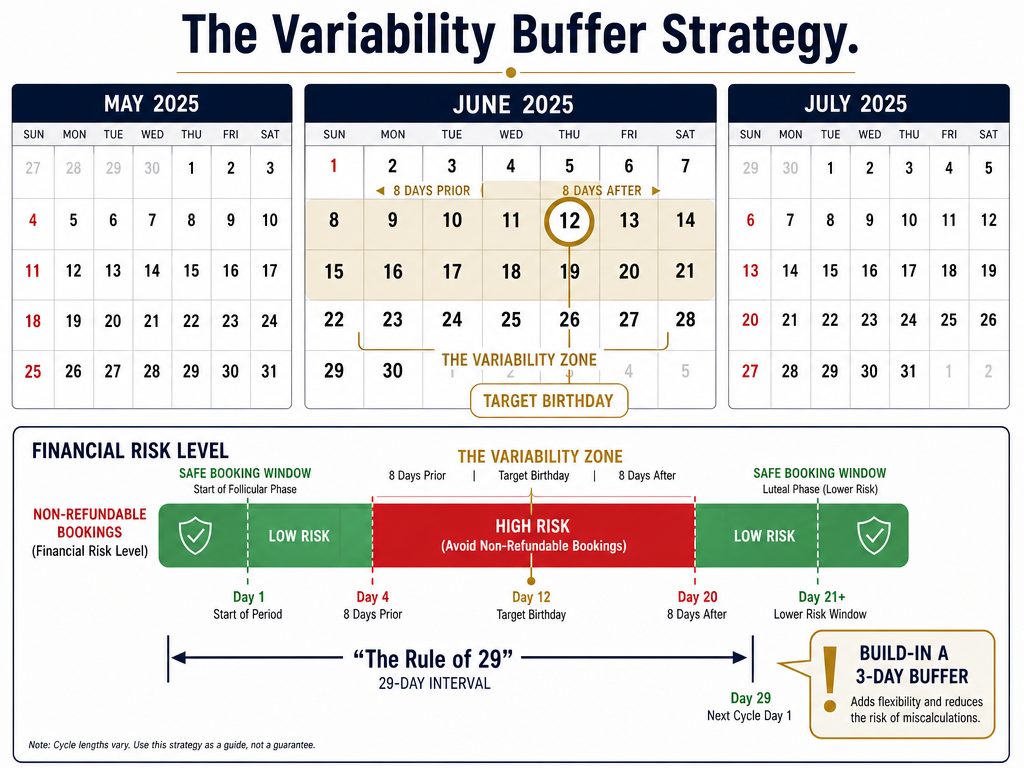 Planning months ahead requires accounting for the median 29-day cycle variability. Always look for refundable options within the 8-day variability zone.
The Rule of 29 (And Why You Need a Buffer)
If her cycle averages 29 days and you're planning 3 months (approximately 90 days) in advance, her cycle will complete roughly 3 full rotations. But that ±8 day variance means her phase on the actual birthday could shift by more than a week from your estimate. Here's the math: if you assume she'll be in her follicular phase (days 8-13) on her birthday based on today's cycle, there's a 30% chance she'll actually be in menstruation or late luteal instead.
The solution is the 3-Day Buffer Rule: if you're booking something non-refundable (flights, concert tickets, reservations that charge cancellation fees), only book events that work across multiple phases - or choose dates that fall in the 10-day ovulation-to-mid-luteal window (days 14-23), which offers the most consistent energy.
For planning weekend trips or other time-sensitive events, understanding this variability can reduce stress by 58% and ensure your effort lands during a phase where she can actually enjoy it.
How to Track 3-6 Months Out Without Guessing
If you're serious about getting this right, you need data - not assumptions. The most reliable method is using a period tracker app that projects future cycles based on her historical patterns. Apps like VibeCheck, Flo, and Clue calculate average cycle length and predict phase windows 3-6 months in advance with 85-90% accuracy for women with regular cycles.
Here's the tactical process:
- Get her average cycle length - either by asking directly or using partner-mode tracking where she shares her data with you.
- Count forward in 29-day increments from her last period start date to estimate where her birthday falls.
- Mark the ±8 day buffer zone around that estimate. This is your "uncertainty window."
- Book refundable options if her birthday falls inside the buffer. Non-refundable bookings are safe only if the date lands solidly in the follicular-to-mid-luteal range (days 10-20), where energy variance is lowest.
If her cycle is irregular (varies by more than 10 days month-to-month), the projection accuracy drops significantly. In that case, default to flexible surprises - activities that can be moved or modified without financial loss.
The Financial Stakes: Protecting Your Birthday Investment
No one talks about this, but cycle-blind planning has a real financial cost. A $500 non-refundable flight booked during what you thought was her high-energy phase becomes a sunk cost if her period starts 3 days early. Concert tickets purchased 4 months in advance have no value if she's cramping and exhausted the night of the show.
The data backs this up: approximately 3 in 4 women experience PMS symptoms significant enough to affect daily activities. That means a 75% chance your surprise will land during at least one low-energy window across multiple birthdays if you don't account for the cycle.
The insurance strategy is simple: within the ±8 day buffer, always choose refundable bookings or transferable experiences. Hotels with free cancellation. Restaurants that don't charge for reservation changes. Event tickets that allow resale. The extra $50-100 you spend on flexibility protects the entire investment.
The Plan B Protocol for Birthdays
The Plan B Protocol exists for one scenario: her period starts 24-48 hours before the big surprise, and everything you've planned requires energy she doesn't have. This happens even with tracking - cycles shift due to stress, travel, or biological variance. The protocol ensures the birthday remains a success by prioritizing her comfort over your original itinerary.
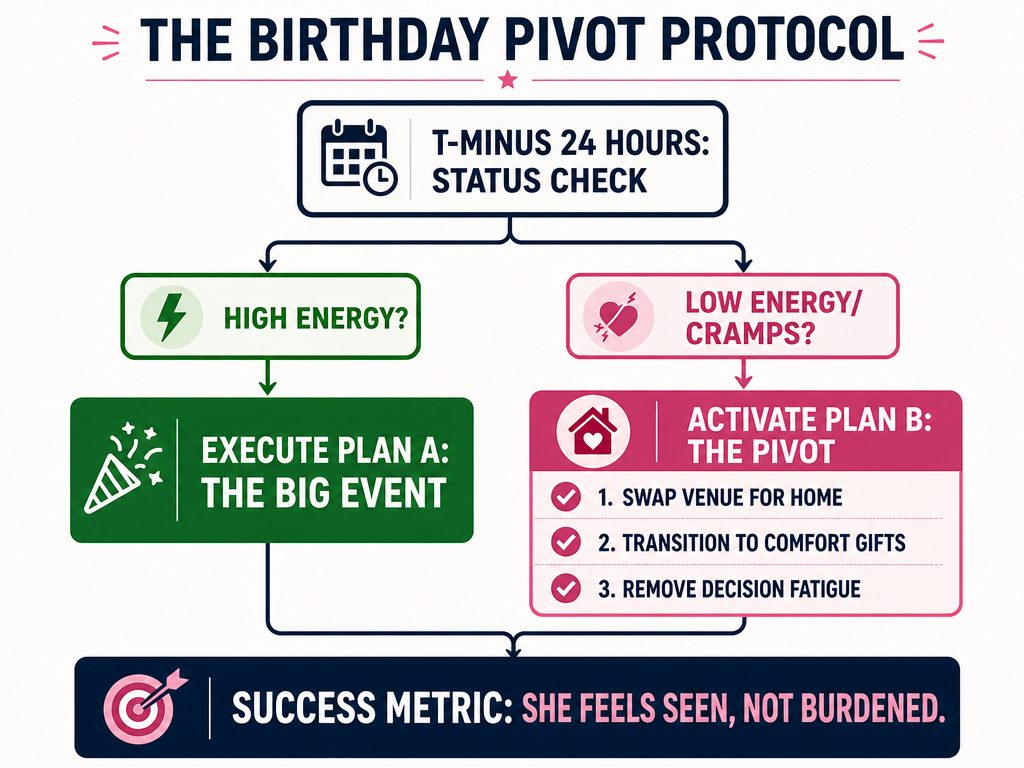 The Plan B Protocol ensures that even if her cycle shifts, the birthday remains a success by prioritizing her comfort over the original itinerary.
Step 1: Detect the Shift (24-48 Hours Before)
The protocol activates when you notice physical or behavioral signals that her period has started or is about to start - even if your tracking app predicted otherwise. Key signals include:
- She mentions cramping, bloating, or breast tenderness
- Her energy drops noticeably (cancels plans, needs more sleep)
- She becomes quieter or more irritable without external cause
- She directly tells you her period started early
If you detect any of these signals within 48 hours of the planned surprise, initiate the pivot. Do not ignore them and hope she'll "rally" - pushing through only creates resentment.
Step 2: The Pivot Decision Tree
Once you've confirmed the shift, run through this decision tree:
Is the surprise non-refundable and immovable (concert tickets, flights)?
- Yes: Execute the modified version (see Step 3). The goal shifts from "perfect execution" to "minimize discomfort."
- No: Cancel or postpone without guilt. Rebook for her follicular phase (7-10 days after her period starts) when energy rebounds.
Does the surprise require her to leave the house or be social for more than 2 hours?
- Yes: Pivot to the at-home alternative (see examples below).
- No: Ask her directly if she wants to proceed. Let her opt out without consequences.
Can you modify the surprise to reduce physical or social strain?
- Yes: Implement modifications and communicate the plan.
- No: Default to the "Day of No Decisions" protocol from the menstrual phase playbook.
Step 3: The Modified Execution
If you're locked into a non-refundable event, these modifications reduce strain while keeping the surprise intact:
Original Plan: Surprise Dinner at a High-End Restaurant
- Pivot: Move the reservation to a quieter, earlier time slot. Request a private booth. Build in transportation so she doesn't have to drive. Offer her the option to leave early without guilt. Pack ibuprofen and a heating pad in the car.
Original Plan: Concert or Live Event
- Pivot: Upgrade to VIP seating if possible (less standing, easier bathroom access). Arrive late to skip the opener if standing in lines is exhausting. Have an exit plan that doesn't require her to wait for you to "finish enjoying the show."
Original Plan: Weekend Trip or Outdoor Activity
- Pivot: Downgrade the itinerary. If you booked a hiking trip, swap the active day for a spa day or scenic drive instead. The location can stay the same - the activity intensity changes. Communicate this as "I built in flexibility" rather than "you ruined the plan."
Step 4: The Transparency Script
How you communicate the pivot determines whether she feels supported or guilty. Never frame the change as a sacrifice you're making. Frame it as a feature you built in because you understand biology.
Script that Works: "Hey - I know your period started early, so I built in a Plan B for your birthday. The reservation is still there if you want it, but I also have a backup that's lower-key and we can do at home. You pick. Either way, the goal is you actually enjoy the day."
Script that Fails: "I spent weeks planning this and now we can't do it because of your period. It's fine, I guess we'll just stay home."
The first script removes decision fatigue and positions the pivot as intentional. The second script creates guilt and frames her biology as an inconvenience. The research is clear: couples who use proactive communication strategies report 58% fewer unresolved conflicts.
The "Birthday in a Box" Backup
One high-performing backup strategy is the "Birthday in a Box" - a pre-assembled collection of low-energy comforts you keep ready in case the pivot is needed. This box lives in your closet and contains:
- Her favorite comfort snacks (chocolate, salty options, whatever she craves during menstruation)
- A handwritten birthday card you wrote weeks earlier
- A luxury self-care item (bath salts, face mask, cozy socks)
- A streaming service gift card or pre-downloaded movies
- A heating pad or pain relief items if she uses them
If the pivot happens, you pull the box, set up a cozy space at home, and let her rest while still marking the occasion. This approach works because it shows you prepared for her comfort - not just the event.
Tracking Without Being "Creepy"
The biggest hesitation men have about cycle tracking is the perception that it's invasive or controlling. That fear is valid - tracking someone else's biology without consent crosses a line. But consensual, transparent cycle tracking is the opposite of creepy. It's the foundation of proactive support. The difference is entirely in how you ask and what you do with the information.
The Transparency Script: How to Ask Without Making It Weird
The request to track her cycle needs to frame the goal as support, not surveillance. Position it as a tool to help you understand her patterns so you can be a better partner - not a system to predict when she'll be "difficult."
Script that Works: "I've been reading about how your cycle affects energy and mood throughout the month, and I want to understand that better so I'm not guessing what you need. Would you be comfortable sharing your cycle data with me? I want to use it to plan things at the right times and avoid putting pressure on you when you're low-energy. Completely your call."
Script that Fails: "Can you put your period into this app so I know when to avoid you?"
The first script emphasizes understanding and support. The second implies avoidance and frames her cycle as a problem to manage. One builds trust. The other destroys it.
If she says no, respect that boundary completely. You can still use general cycle knowledge (like the 28-day average and the four phases) to improve your timing without accessing her specific data.
Recommended Apps with Partner Mode
Not all period tracking apps are built for couples. Most are designed for women trying to conceive or manage symptoms - partner features are an afterthought. The apps below have explicit "partner mode" functionality that shares cycle data and provides actionable guidance for men.
VibeCheck - Built specifically for men in relationships. Provides daily "missions" tailored to her current cycle phase, with context on what's happening biologically and why. Privacy model: she controls what data is shared; all coaching is delivered to you, not her. Pricing: Free 7-day trial, then $4.99/month.
Flo for Partners - Shares cycle predictions and symptom tracking from her Flo account. Provides phase-based tips but no daily actionable guidance. Privacy model: she invites you via the app; you see only what she tracks. Pricing: Free partner mode with her Flo Premium subscription ($39.99/year).
Clue Partner Connect - Shows projected cycle phases and symptom patterns. Minimal coaching; primarily a data-sharing tool. Privacy model: she enables Partner Connect; you receive read-only access. Pricing: Free with her Clue Plus subscription ($39.99/year).
For a detailed comparison of these and other apps, see our guide to the best period tracker apps for men.
What You Track vs. What You Don't
Once you have access to her cycle data, there are clear boundaries around what information you act on and what you ignore. The rule is simple: track patterns that help you provide better support; do not track information to weaponize in arguments or prove a point.
Track This:
- Cycle phase (menstrual, follicular, ovulation, luteal)
- Predicted start dates for her next period
- General energy trends (low-energy phases vs. high-energy phases)
- Symptoms she's mentioned affect her (cramping, fatigue, mood swings)
Do Not Track This:
- Individual mood entries she logs privately
- Specific symptom severity unless she shares it directly
- Sexual activity data (if tracked in the app)
- Any data you plan to use as evidence in a disagreement
The goal of tracking is anticipatory support - understanding what phase is coming so you can adjust your plans and expectations. It is not a diagnostic tool to explain away every conflict as "she's PMSing." Using cycle data to dismiss her feelings is the fastest way to turn a support tool into a relationship weapon.
For more on how to communicate during sensitive phases, see our guide on how to comfort your girlfriend during PMS.
How to Support Your Girlfriend During Each Phase of Her Cycle
Understanding the four phases is only half the strategy. The other half is knowing what proactive support looks like during each phase - not just for birthdays, but for daily life. This section provides the tactical playbook for each biological season.
Menstrual Phase (Winter): The Recovery Protocol
During menstruation, your girlfriend's body is in recovery mode. Estrogen and progesterone are at their lowest, cramping affects 88% of women, and energy is depleted. Your role is to reduce friction and decision fatigue.
Proactive Actions:
- Handle meal planning and cooking without asking if she wants help
- Stock ibuprofen, heating pads, and comfort items before symptoms start
- Cancel or postpone high-energy social plans without making her feel guilty
- Offer physical comfort (back rubs, foot massages) without expecting it to lead anywhere
- Reduce noise and stimulation at home - dim lights, quiet environment
Communication Script: "I know you're in your period - do you need anything specific, or should I just keep things low-key today?" This script acknowledges what's happening without making assumptions about her symptoms.
For more on this phase, read our complete guide on how to support your girlfriend during menstruation.
Follicular Phase (Spring): The Exploration Protocol
The follicular phase is when estrogen begins rising and energy rebounds. She's open to new experiences, spontaneity, and learning. This is your window to propose new activities or have deeper conversations.
Proactive Actions:
- Suggest new experiences (new restaurant, weekend trip, activity she's mentioned)
- Initiate planning for future events - she has the mental bandwidth to engage
- Have the "big picture" relationship conversations (where we're going, future goals)
- Support her if she starts new projects or hobbies - her motivation is high
Communication Script: "You've been wanting to try [activity] - want to book it for next weekend?" This script leverages her openness to novelty without pressuring her.
Ovulation Phase (Summer): The Amplification Protocol
Ovulation is a 48-72 hour window where estrogen surges by 800%. Her energy is maximum. Social tolerance is peak. Confidence is high. This is the phase where you can take risks, plan surprises, and match her elevated state.
Proactive Actions:
- Plan high-energy dates (concerts, group dinners, physical activities)
- Initiate important conversations that require emotional bandwidth (conflict resolution, big decisions)
- Celebrate her publicly if she's into that - she has the fuel to enjoy being seen
- Match her energy instead of pulling back - she wants engagement, not passivity
Communication Script: "I know you're in your high-energy phase - want to do something big this weekend?" This script explicitly acknowledges her biological state and invites her to leverage it.
For tactical scripts during this phase, see our guide on supporting your girlfriend during ovulation.
Luteal Phase (Autumn): The Anticipation Protocol
The luteal phase is the longest (12 days on average) and the most variable. In the early luteal phase (days 17-23), energy is steady but inward-focused. In the late luteal phase (days 24-28), progesterone crashes by 80%, triggering PMS symptoms in 75% of women.
Early Luteal (Days 17-23) - Proactive Actions:
- Shift from group activities to intimate one-on-one time
- Avoid introducing major stressors or conflicts - her tolerance for chaos is declining
- Anticipate cravings (salty or sweet foods) and have them ready
- Give her space to rest without asking if something is wrong
Late Luteal (Days 24-28) - Proactive Actions:
- Stock comfort foods and pain relief items before symptoms start
- Reduce your expectations for social or physical activity
- Validate her emotions without trying to fix them ("That sounds really frustrating" instead of "Here's what you should do")
- Handle household tasks without being asked - decision fatigue is maximum
Communication Script: "I know you're in the pre-period window - is there anything you need me to handle this week?" This script removes the burden of asking and positions you as proactive instead of reactive.
For a complete breakdown of luteal phase support, read our partner's guide to the luteal phase.
Frequently Asked Questions
Is it weird to track my girlfriend's cycle for birthday planning?
No - if it's consensual and transparent. Tracking your girlfriend's cycle to provide better support is proactive relationship intelligence, not surveillance. The key is asking her permission first, explaining why you want the data (to plan surprises that align with her energy), and giving her full control over what she shares. Apps like VibeCheck and Flo for Partners are built specifically for this use case, with privacy controls that let her decide what you see. What makes it weird is tracking without consent or using cycle data to dismiss her feelings or prove a point in arguments.
What if her birthday falls during her period?
If her birthday falls during menstruation, shift from high-energy surprises to comfort-focused ones. Skip the surprise party or active outing and instead plan a private chef at home, a cozy spa day, or luxury self-care gifts like silk pajamas or a weighted blanket. The goal is to remove decision fatigue and physical strain - not add to them. Research shows 88% of women experience cramping during menstruation, so activities requiring sustained energy or social interaction will likely feel exhausting instead of celebratory. For specific low-energy birthday ideas, see the "Matching the Birthday Surprise to the Phase" section above.
How far in advance can I predict which phase her birthday will be in?
You can predict with 85-90% accuracy if her cycle is regular (varies by fewer than 5 days month-to-month) using cycle tracking apps like VibeCheck, Flo, or Clue. The median menstrual cycle is 29 days, so for birthdays 3-6 months away, count forward in 29-day increments from her last period start date. However, cycles can vary by ±8 days month-to-month, so always build in a buffer zone if you're booking non-refundable events. The safest booking window for high-stakes surprises is the 10-day follicular-to-mid-luteal range (days 10-20), where energy variance is lowest. If her cycle is irregular, default to flexible, refundable options.
What's the best birthday surprise for the ovulation phase?
The ovulation phase (days 14-16) is your grand gesture window. Estrogen surges by 800%, giving her maximum social energy, confidence, and tolerance for crowds. The best surprises during this phase are high-energy and public: surprise parties, concert tickets, group dinners with close friends, or adventure experiences like hot air balloon rides or skydiving. She has the biological fuel to enjoy being the center of attention for extended periods. Pair the event with a meaningful gift like statement jewelry or a boutique shopping experience. For detailed ovulation-phase support strategies, see our guide on supporting your girlfriend during ovulation.
How do I pivot if her cycle shifts right before the birthday?
Activate the Plan B Protocol: immediately assess whether the surprise is refundable or movable, then either postpone to her follicular phase (7-10 days after her period starts) or modify the plan to reduce strain. If you're locked into a non-refundable event, downgrade the intensity - move restaurant reservations to earlier, quieter time slots; swap hiking for a spa day on a weekend trip; upgrade concert seats to VIP to reduce standing time. Communicate the pivot as intentional flexibility, not a sacrifice: "I built in a backup plan in case your energy shifted - you pick which version works better." Never frame her cycle as ruining your effort. For detailed pivot scripts, see "The Plan B Protocol for Birthdays" section.
What apps help with cycle-aware birthday planning?
VibeCheck, Flo for Partners, and Clue Partner Connect are the top three apps built for cycle-aware planning. VibeCheck provides daily actionable missions tailored to her current phase with biological context - ideal for men who want coaching, not just data. Flo for Partners shares cycle predictions and symptom tracking from her Flo account with phase-based tips. Clue Partner Connect offers read-only access to her cycle data with minimal coaching. All three require her consent to share data. For a full feature and pricing comparison, see our guide to the best period tracker apps for boyfriends.
Should I tell her I'm planning around her cycle?
Yes - transparency builds trust. Tell her upfront that you're learning about cycle phases to plan surprises and support her better, and ask if she's comfortable sharing her data with you. Frame it as a tool to align your effort with her energy, not to predict when she'll be "difficult." Use this script: "I've been reading about how your cycle affects energy throughout the month, and I want to use that to plan things at the right times. Would you be comfortable sharing your cycle data with me?" If she says no, respect that boundary and use general cycle knowledge (28-day average, four phases) to improve your timing without accessing her specific data.
What's the biggest mistake men make with birthday planning and cycles?
The biggest mistake is planning purely based on what you want to do without considering her biological state on the actual day. You book the concert because you think she'll love it, schedule a surprise party because that's what a "big" birthday looks like, or plan an active weekend trip without checking which phase she'll be in. The result: you invest weeks of effort and hundreds of dollars into a surprise that lands during low-energy menstruation or late luteal, when she's cramping, exhausted, or bloated. The fix is simple - check the phase first, then plan the surprise to match her energy. High-energy surprises work only during follicular and ovulation. For all other phases, shift to comfort and intimacy instead.
Your girlfriend's cycle isn't unpredictable weather - it's a 28-day rhythm you can learn to read and align with. The men who master this system stop walking on eggshells and start anticipating her needs before she has to ask. The birthday surprise that lands during her ovulation phase becomes a core memory. The one that lands during menstruation - when you pivoted to comfort instead of pushing through - becomes proof that you understand her biology instead of fighting it. Start with one cycle. Track the phases. Match your effort to her energy. That's how you become the partner who gets it right.
Tags

Related Articles
Continue reading to deepen your understanding

Your Girlfriend Is Withdrawn During Ovulation? What It Actually Means and How to Respond
Is your girlfriend suddenly distant mid-cycle? This guide covers the biological causes of ovulation withdrawal and how to support her with an invisible framework.

When Your Girlfriend Is Sensitive to Criticism During the Luteal Phase: The Partner’s Science-Based Action Guide
Does your partner react intensely to feedback right before her period? Understand the biology behind luteal phase rejection sensitivity and learn how to communicate effectively.

How to Give Your Girlfriend Reassurance During the Follicular Phase: A Partner’s Tactical Guide
Is your girlfriend feeling vulnerable after her period? Learn why the early follicular phase causes emotional lows and how you can provide the specific reassurance she needs to feel secure.

Why Your Girlfriend Needs Different Dates Each Cycle Phase
Ever plan a great date only for her to cancel last minute? Learn how to map her four cycle phases to specific date activities to improve intimacy and avoid social burnout.

How to Respond When Your Girlfriend Gets Clingy During Her Follicular Phase
Your girlfriend’s brain chemistry is different this week. Rising estrogen levels cause social drive to peak. Here is how to respond to her need for connection effectively.

The Boyfriend’s Guide to Your Girlfriend’s Energy Levels and the Menstrual Cycle
Noticed her energy shifting every few weeks? Stop guessing and start supporting. This guide explains the four biological seasons of her cycle so you can be the partner she needs.

Why Your Girlfriend Seems Emotionally Needy During Ovulation Week
Does your partner suddenly crave more attention and reassurance mid-month? It is not insecurity—it is biology. Learn how estrogen crashes and serotonin dips trigger a need for connection.

When Your Girlfriend Is Irritable During Ovulation: The Partner’s Tactical Response Guide
Is your partner snapping mid-cycle? Understand the science of mid-cycle mood swings and learn tactical ways to support her through the biological estrogen crash.