How to Use Hormonal Intelligence to Anticipate Your Partner’s Needs

Stop guessing why her mood shifts or plans fall through. Use hormonal intelligence to track her cycle, reduce conflict, and provide the support she actually needs.
How to Remember Your Girlfriend's Important Dates Using Hormonal Intelligence
You've probably experienced it: the argument that came out of nowhere, the canceled plans you thought were locked in, or the silence that followed a joke that landed wrong last week. You're not imagining the inconsistency. Your girlfriend's energy, mood, and social capacity shift across a predictable 28-day loop, and missing those shifts creates friction you could avoid.
This isn't about memorizing an anniversary or her birthday. Those are calendar events. This is about understanding the biological rhythm that dictates when she's most receptive to a surprise trip, when she needs space instead of a crowd, and when your timing can make or break a conversation. The men who track this rhythm don't just reduce conflict - research shows spousal education around the menstrual cycle dropped PMS prevalence from 100% to 86% within three months - they become the partner she doesn't have to explain herself to.
Here's how to stop guessing and start anticipating.
Table of Contents
- Why Hormonal Timing Matters More Than You Think
- The Chemistry of Conflict: How Estrogen and Serotonin Drive Her Mood
- The Four-Phase Field Manual: Your Tactical Playbook
- How to Track Without Being Controlling: The Conversation Script
- Tool Recommendations: Apps That Actually Help
- When Tracking Reveals Something Bigger: PMS vs PMDD
- Frequently Asked Questions
Why Hormonal Timing Matters More Than You Think
Most relationship advice treats mood and energy as random variables. Plan a date, hope it lands well, react when it doesn't. That's backward. Your girlfriend's body operates on a hormonal loop that affects everything from her social bandwidth to her pain threshold to her interest in sex. Ignoring that loop means you're constantly surprised by shifts you could have seen coming.
Estrogen affects brain function and the ability to focus, with levels highest in the days leading up to ovulation. When estrogen rises, it increases both the production of serotonin and the number of serotonin receptors in the brain. That's the biological reason she's more energetic, social, and optimistic mid-cycle. When progesterone rises after ovulation and then crashes before her period, serotonin drops with it. She's not being difficult - her brain chemistry just shifted.
72% of women report that PMS negatively affects their relationship. But here's what most men miss: the issue isn't her symptoms. It's the fact that she has to manage them alone while also managing your confusion about why she's "acting different." When you track her cycle, you remove that second burden. You stop asking "What's wrong?" when the answer is predictable biology, and you start providing the exact support she needs before she has to request it.
VibeCheck App
Download Free on iOS →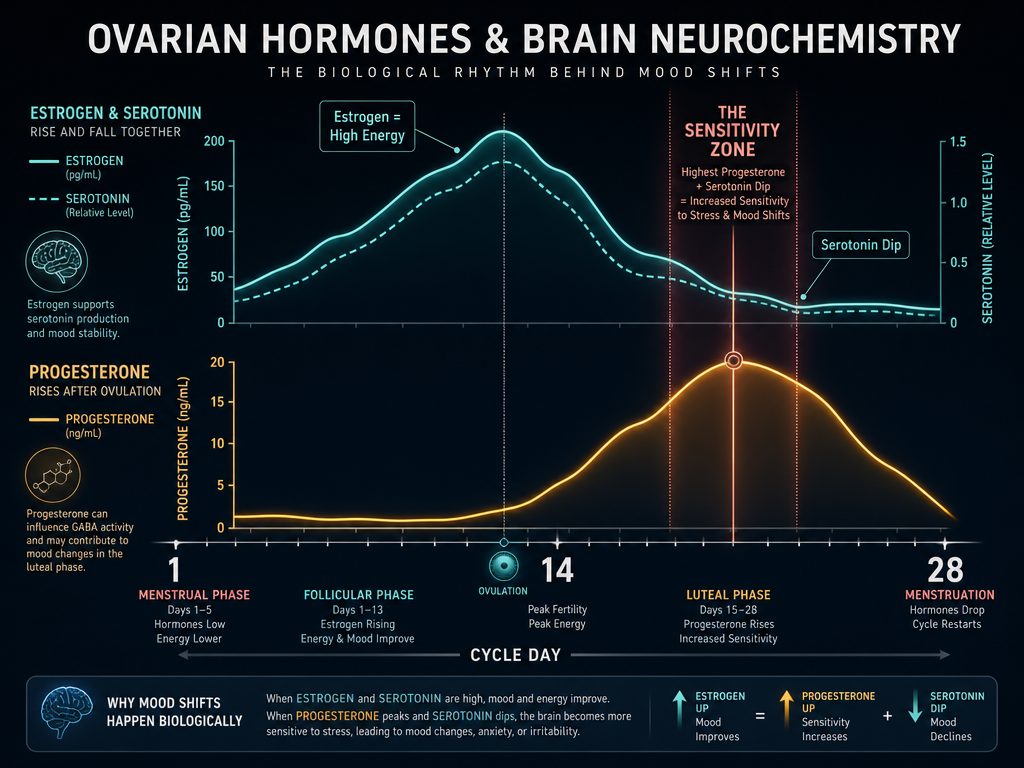
The Chemistry of Conflict: How Estrogen and Serotonin Drive Her Mood
Understanding why her mood shifts starts with two hormones and one neurotransmitter: estrogen, progesterone, and serotonin. These three chemicals create the emotional weather system you're navigating.
Estrogen is the energy hormone. During the follicular phase, estrogen rises as an egg-containing follicle develops in the ovary; this rising estrogen also thickens the uterine lining. As estrogen climbs toward ovulation, it increases both the production of serotonin and the number of serotonin receptors in the brain. Higher serotonin means better mood regulation, more sociability, and greater stress tolerance. This is why mid-cycle (roughly days 8-14) tends to be her biological summer - high energy, high optimism, high capacity for novelty and social plans.
Progesterone is the stabilizing hormone. After ovulation, the luteal phase begins: progesterone rises to help prepare the uterine lining for a possible pregnancy. Progesterone has calming effects through its action on GABA receptors, but it doesn't directly boost serotonin the way estrogen does. When both estrogen and progesterone drop sharply in the days before her period, serotonin levels fall with them. This drop is the chemical explanation for what we call PMS: irritability, low frustration tolerance, fatigue, and emotional sensitivity.
Think of it as a serotonin withdrawal. She's not overreacting to minor stressors - her brain's ability to regulate those reactions just took a hit. PMS symptoms - which can include mood swings, irritability, bloating, breast tenderness, and fatigue - typically show up one to two weeks before a period and resolve within a few days after it starts. The timing is predictable. Your response doesn't have to be reactive.
The Four-Phase Field Manual: Your Tactical Playbook
Her cycle isn't one continuous state. It's four distinct phases, each with its own energy signature, social capacity, and ideal support strategy. Stop treating her as if she operates the same way every day of the month. Start matching your approach to her current phase.
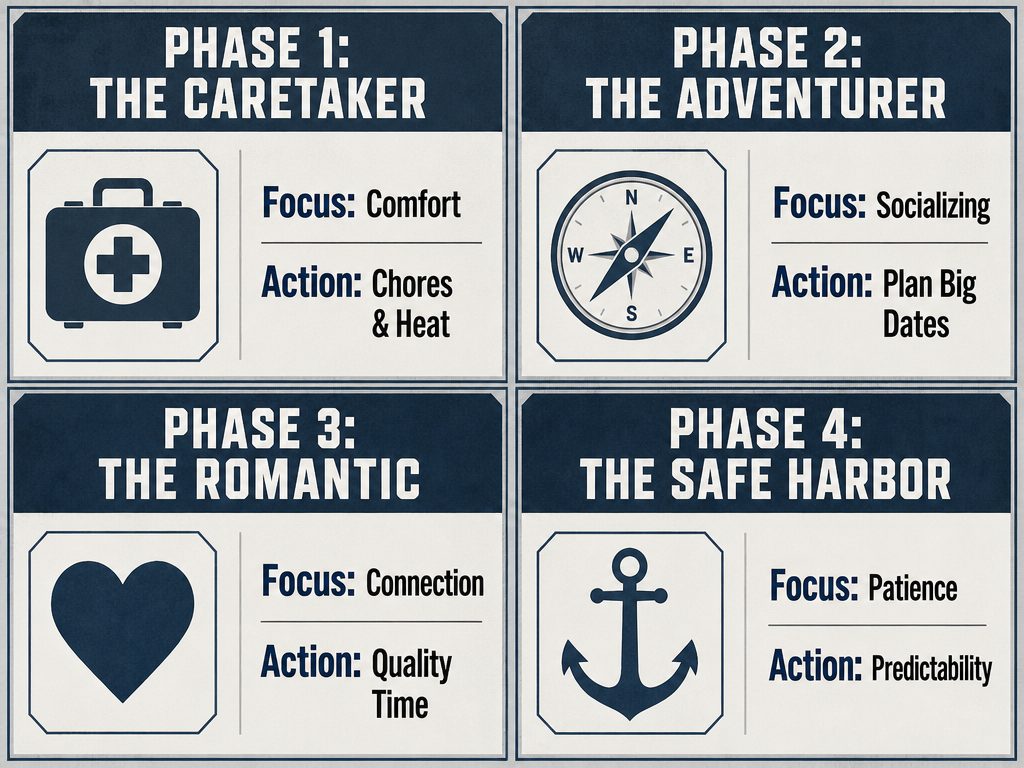
Phase 1 (Days 1-5): The Caretaker
What's happening: The menstrual cycle has four phases - menstrual (bleeding, approximately day 1-5), follicular (day 1 through ovulation, estrogen rising), ovulation (around day 14 in a 28-day cycle, triggered by a surge in luteinizing hormone), and luteal (after ovulation to the next period, progesterone rising then falling). During the menstrual phase, both estrogen and progesterone are at their lowest. Energy is depleted. Pain and discomfort are highest.
Your role: Handle logistics she'd normally manage. Take over meal prep, errands, and any chores requiring sustained physical effort. Offer a heating pad, ibuprofen, or her preferred comfort food without making her ask. This is not the week to suggest a hike or introduce her to your college friends. It's the week to become invisible infrastructure.
What to say: "I picked up dinner. Heating pad is on the couch." Not: "Are you feeling better yet?"
Learn more about how to support your girlfriend during the menstrual phase.
Phase 2 (Days 6-14): The Adventurer
What's happening: During the follicular phase, estrogen rises as an egg-containing follicle develops in the ovary. This is her biological spring and summer. Energy builds, mood improves, and serotonin receptors increase. She's more open to novelty, social plans, and physical activity.
Your role: This is the window for your high-energy plans. Book the weekend trip. Suggest the new restaurant. Introduce her to people. Her capacity for stimulation and social interaction peaks here, and she's more likely to say yes to spontaneous ideas.
What to say: "Want to try that new climbing gym this weekend?" Not: "We never do anything fun anymore."
Understand how to support your girlfriend during the ovulation phase for optimal connection.
Phase 3 (Days 15-17): The Romantic
What's happening: Ovulation is when a surge in luteinizing hormone (LH) causes the ovary to release an egg, typically around day 14 of a 28-day cycle. Around ovulation, many women notice symptoms such as increased sex drive, mild pelvic or abdominal pain, tender breasts, bloating, and mood changes. Estrogen peaks just before ovulation, creating a brief window of maximum social confidence, optimism, and - often - sexual receptivity.
Your role: This is the peak connection window. Plan intimate dates, have the deeper conversations you've been postponing, and prioritize physical closeness. Her body is biologically primed for bonding. Don't waste this phase on logistics or conflict.
What to say: "I want to take you out Friday. Just us." Not: "We need to talk about your spending habits."
Discover when to plan romantic gestures using cycle timing.
Phase 4 (Days 18-28): The Safe Harbor
What's happening: After ovulation, the luteal phase begins: progesterone rises to help prepare the uterine lining for a possible pregnancy. If pregnancy doesn't happen, both progesterone and estrogen drop before the next period. Many women notice PMS-like symptoms in this phase - mood shifts, breast tenderness, bloating, acne, and appetite changes. Serotonin drops with the hormones. Social tolerance decreases. Frustration threshold lowers.
Your role: Reduce novelty. Increase predictability. This is not the week to invite your friends over unannounced or suggest last-minute plans. Offer low-key companionship: movie nights, simple dinners, minimal logistics. When a partner is struggling emotionally, responding with genuine empathy - listening without judgment, focusing on their feelings rather than debating facts, and validating that their reaction makes sense - tends to help more than trying to "fix" the problem.
What to say: "Want me to pick up Thai and put on that show you like?" Not: "Why are you so sensitive lately?"
Learn more about supporting your girlfriend during the luteal phase.
How to Track Without Being Controlling: The Conversation Script
The biggest barrier to cycle tracking isn't the tool - it's the conversation. Most men avoid this topic because they're afraid of sounding controlling or invasive. The solution is framing. You're not asking to monitor her. You're offering to reduce her mental load.
The script:
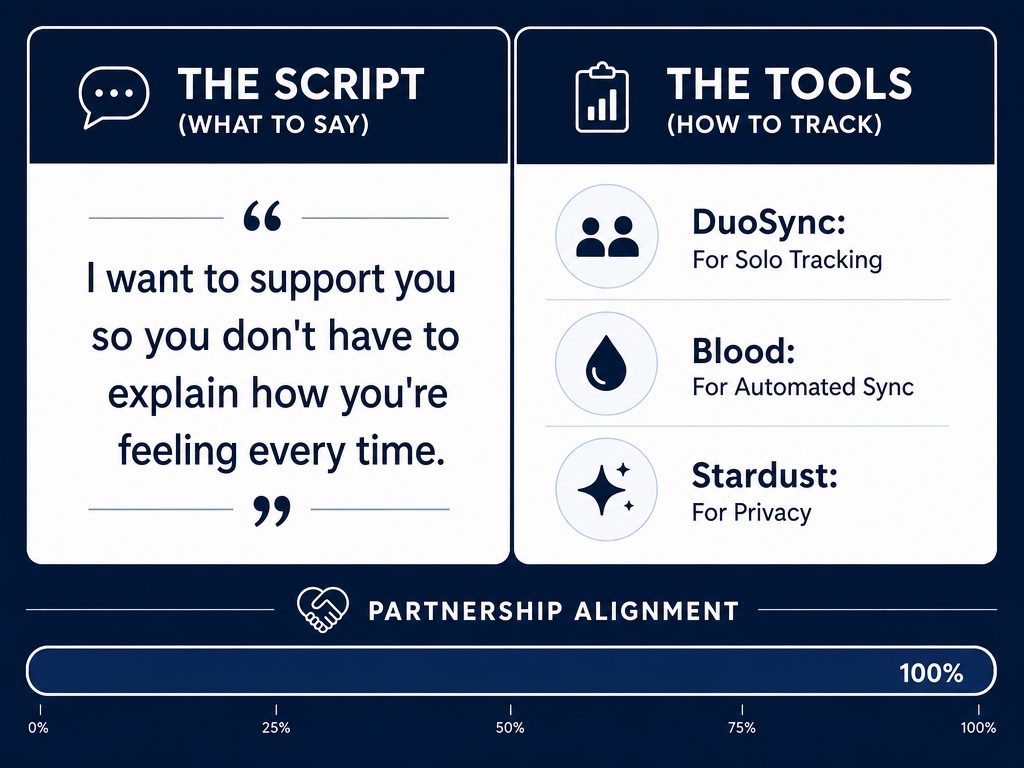
"I've been reading about how the menstrual cycle affects energy and mood, and I realized I've been asking you to explain things I could probably predict if I just tracked the pattern. Would it help if I used an app to keep track of your cycle so I can anticipate when you might need more space or support? I want to stop making you manage my confusion on top of everything else."
Why this works: You're positioning the tool as something that benefits her - not as surveillance. You're acknowledging that she's been carrying the burden of translating her needs into language you understand. And you're offering a concrete action that removes that burden.
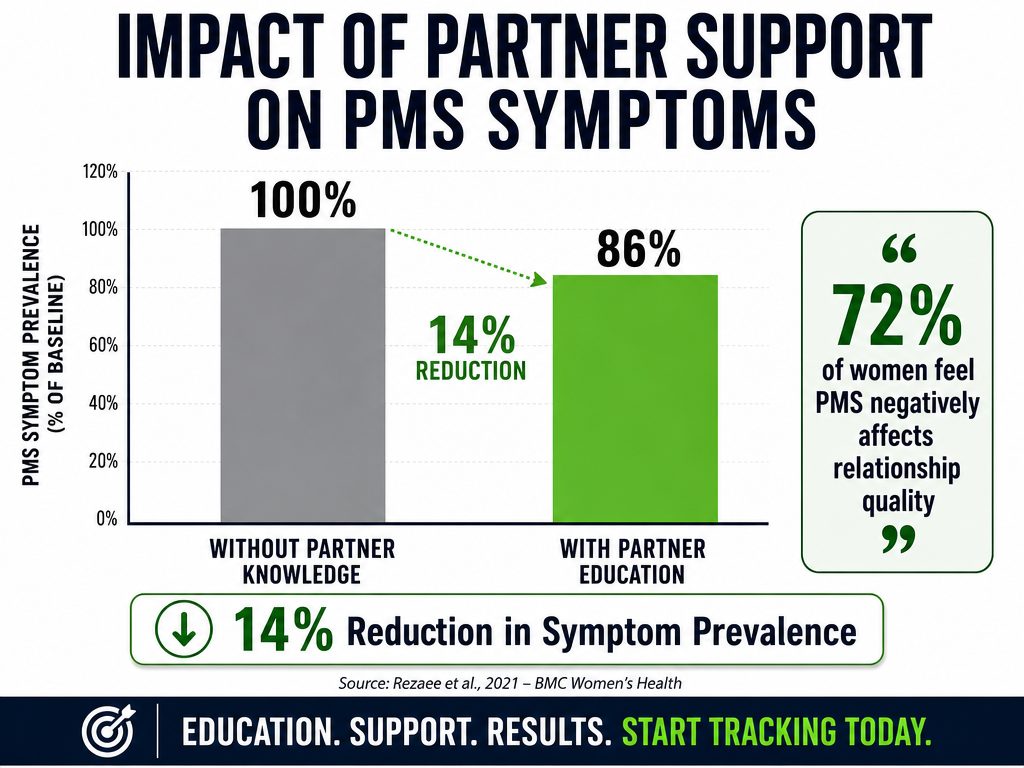
Research backs this up: spouse educational intervention dropped PMS prevalence from 100% to 86% in the intervention group within three months. When men understand the pattern, women experience fewer symptoms - not because the biology changed, but because the relationship stress decreased.
What not to say:
- "I want to track when you're going to be crazy."
- "Is this why you've been so moody?"
- "Can you just tell me when you're PMSing?"
These frames position her cycle as a problem she creates rather than a rhythm you can learn to work with. That distinction matters.
Tool Recommendations: Apps That Actually Help
The best period tracking app for men isn't the one with the most features - it's the one that turns data into actionable guidance. Here's what to look for and which tools deliver.
What You Actually Need
- Phase-based reminders: Not just "period starts in 3 days," but "entering luteal phase - reduce social plans."
- Symptom tracking: Her experience won't match the textbook average. You need a tool that adapts to her specific pattern.
- Partner mode or sharing: The app should give you visibility without requiring her to manually update you.
Top Options
VibeCheck - Built specifically for men who want to support their partners. Instead of generic cycle data, VibeCheck gives you a daily mission tailored to her current phase. "Today: Plan a low-key date" or "Today: Give her space." It removes the guesswork and tells you exactly what to do. Compare VibeCheck to other period trackers.
Clue Partner Connect - A free feature inside the Clue app that lets her share cycle data with you. You'll see predicted period dates and fertile windows, but it doesn't translate that data into specific actions. You're still responsible for interpreting what "Day 23" means for your weekend plans. See how Clue stacks up against VibeCheck.
Flo for Partners - Similar to Clue: she tracks, you get read-only access to the calendar. Useful for basic awareness but minimal tactical guidance. Better than nothing; not as helpful as a tool designed for male users. Compare Flo to VibeCheck here.
Stardust - Privacy-focused and witty, but the astrology angle can feel gimmicky if you're just trying to understand serotonin timing. Good if she's already using it and willing to share.
What to avoid: Apps that require her to do all the work (logging symptoms daily for you to check) or tools that send you notifications like "Your partner is ovulating - time for sex!" Those are tone-deaf and reduce biology to a transactional checklist.
When Tracking Reveals Something Bigger: PMS vs PMDD
Not every woman experiences PMS the same way. Roughly half of people who menstruate report having at least one PMS symptom, but only about 1 in 5 have symptoms severe enough to disrupt their daily life. For most women, PMS is manageable with lifestyle adjustments - regular aerobic exercise, smaller/more frequent meals, less salt/caffeine/alcohol, adequate sleep, and stress-reduction practices like deep breathing or yoga.
But for some, the symptoms cross into a different category entirely.
PMDD (premenstrual dysphoric disorder) is a real, clinically recognized condition - it's listed in the DSM-5 as a depressive disorder, not something people are "making up" or simply failing to cope with. It affects roughly 1 in 10 people who menstruate. PMDD is a more severe, sometimes disabling extension of PMS. Both happen on a similar timeline (about 7-10 days before a period) and can share physical symptoms like bloating and fatigue, but PMDD specifically involves extreme mood symptoms - such as marked irritability, anxiety, or hopelessness - intense enough to disrupt daily life and strain relationships.
If tracking reveals a consistent pattern of severe mood symptoms that interfere with work, relationships, or daily functioning - and those symptoms reliably disappear within a few days after her period starts - that's a signal to talk to a healthcare provider. PMDD is treatable, often with SSRIs or hormonal interventions, but it requires clinical diagnosis. Your role isn't to diagnose; it's to recognize when the pattern suggests something beyond typical PMS and support her in seeking help.
Tracking your own (or a partner's, with her participation) symptoms and mood changes across the cycle for a few months is a legitimate, medically endorsed way to identify real patterns and timing - rather than assuming based on stereotypes or a single cycle. That data becomes useful when talking to a doctor.
Frequently Asked Questions
Is there a male version of the Flo app?
Flo has a "Partner Mode" that allows you to view cycle data if she shares it with you, but it's not built for men as the primary user. If you want an app designed specifically to help men understand and support their partners, VibeCheck gives you daily missions based on her cycle phase rather than just raw data.
How do I explain period hormones to my girlfriend?
You don't need to explain her hormones to her - she's living them. But if you want to discuss what you've learned about the cycle to improve how you support her, keep it collaborative: "I've been reading about how estrogen and progesterone affect energy and mood throughout the month. Would it help if I started tracking your cycle so I can anticipate when you might need more space or support?" Frame it as you doing the work to understand her better, not you teaching her about herself.
What should a boyfriend do when his girlfriend has her period?
Stop treating it like a mystery. Handle logistics she'd normally manage (meal prep, errands, household tasks), offer practical comfort (heating pad, pain relief, her preferred snacks), and give her space without making her ask for it. This isn't the week for high-energy plans or emotionally demanding conversations. Learn exactly what to do when your girlfriend is on her period.
Does progesterone affect serotonin levels?
Yes. While progesterone has calming effects through GABA, it doesn't boost serotonin the way estrogen does. When progesterone rises during the luteal phase and then crashes before menstruation, serotonin levels often drop with it. This is the biological basis for the mood shifts many women experience before their period. It's not "being emotional" - it's neurochemistry.
Can I track my partner's period without her knowing?
No. Don't do that. Tracking her cycle should always involve her consent and participation. The goal is to reduce her mental load, not to surveil her. Use the conversation script above to frame it as a support tool, not a monitoring system. If she's uncomfortable with the idea, respect that boundary and find other ways to be attentive.
How accurate is cycle tracking for predicting mood?
A "normal" cycle varies significantly between women - menstrual bleeding can start anywhere from every 24 to every 38 days and last up to 8 days. There is no single universal 28-day cycle, so exact day-by-day predictions for any specific woman should be treated as approximate. General patterns (low energy during menstruation, high energy mid-cycle, increased irritability before the period) tend to hold for most women, but individual variation is real. Track for several months to identify her specific pattern rather than assuming she matches the textbook average.
What if her cycle is irregular?
Irregular cycles - whether due to stress, PCOS, thyroid issues, or other factors - make prediction harder but don't eliminate the value of tracking. You'll still see patterns in symptom clusters even if the timing shifts month to month. The goal isn't perfect forecasting; it's building awareness so you're not blindsided when mood or energy shifts. If her cycle is consistently irregular or unpredictable, that's worth mentioning to a healthcare provider.
Tracking your girlfriend's cycle isn't about control. It's about competence. The men who understand the four-phase loop reduce friction, avoid mistimed conversations, and provide support before it's requested. They stop asking "What's wrong?" when the answer is predictable biology, and they start offering exactly what she needs in the moment she needs it.
Start with the conversation. Pick a tool. Track for three months. Watch what changes when you stop treating her moods as random and start treating them as information.
Tags

Related Articles
Continue reading to deepen your understanding

Your Girlfriend’s Mood Shifts Throughout the Month, Explained
Ever wonder why her energy and moods change so drastically each week? Understand the four hormonal phases and how to be the partner she needs during every stage of her cycle.

How to Support Your Girlfriend When She’s Crying Because of Hormones
Watching her cry when hormones hit can feel overwhelming. Learn the biological why behind the tears and use these proven scripts to provide the support she actually needs right now.

How to Help Your Girlfriend with Hormonal Mood Swings Without Arguing
Understand her cycle and learn tactical scripts to handle tension. This guide shows you how to support her through hormonal shifts without getting into unnecessary fights.

When to Feed Your Girlfriend: Understanding Hangry Hormones
Does your girlfriend get irritable when she hasn’t eaten? It’s not just in her head. Learn why hormones cause hanger and the specific times her body needs more fuel.

The Boyfriend’s Guide to Supporting Your Partner Through PMS
If your partner is suddenly irritable and exhausted, it’s biology, not you. Learn about the luteal phase and how to provide meaningful support without walking on eggshells.

Why Your Girlfriend Wants Different Things Each Week: The Biological Roadmap
Does your partner seem like a different person every seven days? Understand how her 28-day biological cycle impacts her energy and mood so you can provide the support she actually needs.

How to Help Your Girlfriend When She’s Irritable Before Her Period: The Partner’s Playbook
Is your partner snapping at small things right before her cycle? It’s not you—it’s biology. Learn how to navigate the serotonin crash and provide the support she actually needs.

How to Tell Your Girlfriend Is Overwhelmed by Hormones
Is she snapping or withdrawing for no reason? Identify the behavioral tells of hormonal overwhelm and learn how to support her during the luteal phase without triggering a fight.