How to Know When Your Girlfriend Needs Quality Time (Because Hormones Are Sending Signals)

Understand why her need for closeness shifts on a biological loop. Learn the signs of hormonal changes and how to provide the specific support she needs to feel secure.
How to Know When Your Girlfriend Needs Quality Time (Because Hormones Are Sending Signals)
You're not imagining it. One week she's planning date nights and texting back instantly, the next she's barely leaving the couch and asking "Are we okay?" for the third time today. Before you spiral into "What did I do?" mode, understand this: her need for quality time shifts on a biological loop that repeats every month. The question isn't whether she needs you - it's how she needs you, and that answer changes with her hormonal cycle.
Most men treat their girlfriend's mood like unpredictable weather. But when you understand the four phases of her menstrual cycle, her emotional shifts become as predictable as the seasons. The luteal phase - roughly days 15 through 28 of her cycle - triggers a cascade of neurochemical changes that make her brain more sensitive to perceived threats, including emotional distance from you. 48% of women report that PMS symptoms directly damage their romantic relationships, but most of that damage happens because partners don't recognize the biological signs that she needs a different kind of support.
This guide gives you the framework to recognize when hormones are driving her need for quality time, what that quality time should actually look like (hint: it's not always a date night out), and how to avoid the mistakes that turn a simple hormonal shift into a three-day argument.
Table of Contents
- The Biology Behind the Shift: Why Hormones Change Her Social Needs
- The Three Warning Signs She Needs Quality Time
- What "Quality Time" Actually Means During Different Phases
- The Triple-A Framework: Your Tactical Response System
- The Quality Time Playbook by Phase
- When It's More Than Hormones: Recognizing PMDD
- Frequently Asked Questions
The Biology Behind the Shift: Why Hormones Change Her Social Needs
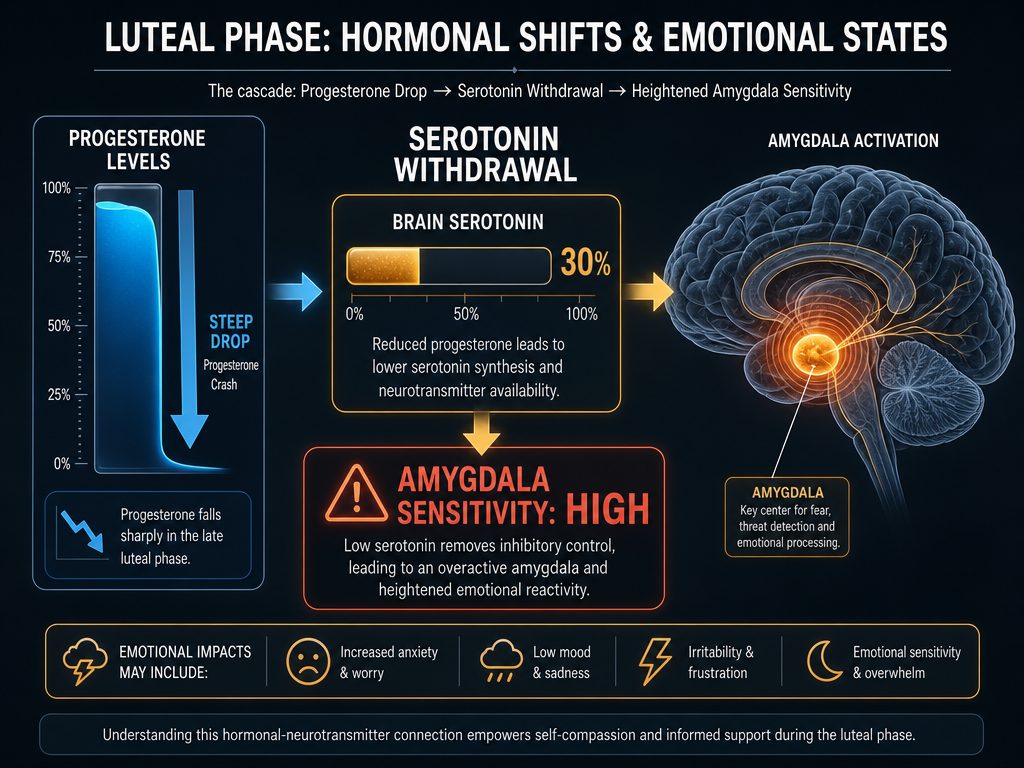 Understanding the biological 'Serotonin Crash' helps partners realize that increased sensitivity is a physiological response to hormone withdrawal, not a personal conflict.
Her brain chemistry shifts dramatically across the month, and those shifts directly affect how much social energy she has and what kind of connection feels supportive versus draining. The menstrual cycle has four distinct phases: menstrual (bleeding, roughly days 1-5), follicular (day 1 through ovulation, when estrogen rises), ovulation (around day 14, triggered by a surge in luteinizing hormone), and luteal (after ovulation to the next period, when progesterone rises then crashes).
During the follicular phase, estrogen rises as an egg-containing follicle develops. That rising estrogen thickens the uterine lining and triggers a surge in luteinizing hormone (LH) near the end of the phase, setting off ovulation. Estrogen affects brain function and the ability to focus, with levels peaking in the days leading up to ovulation. This is her biological summer - social energy is high, she's more likely to initiate plans, and she feels confident and outgoing.
After ovulation, the luteal phase begins. Progesterone can surge up to 80 times its baseline about seven days after ovulation to prepare the uterine lining for a possible pregnancy. If pregnancy doesn't happen, both progesterone and estrogen drop sharply before the next period. This hormonal crash is what triggers PMS symptoms in many women - mood shifts, irritability, breast tenderness, bloating, and fatigue.
VibeCheck App
Download Free on iOS →Here's the critical part most men miss: when progesterone crashes, it takes serotonin with it. Her brain's threat-detection system (the amygdala) becomes hyper-sensitive. She isn't being dramatic when a neutral comment triggers a meltdown - her brain is biologically primed to perceive neutral events as threats. This is when her need for quality time spikes, but the kind of time she needs is very different from what she wanted two weeks ago.
The Three Warning Signs She Needs Quality Time
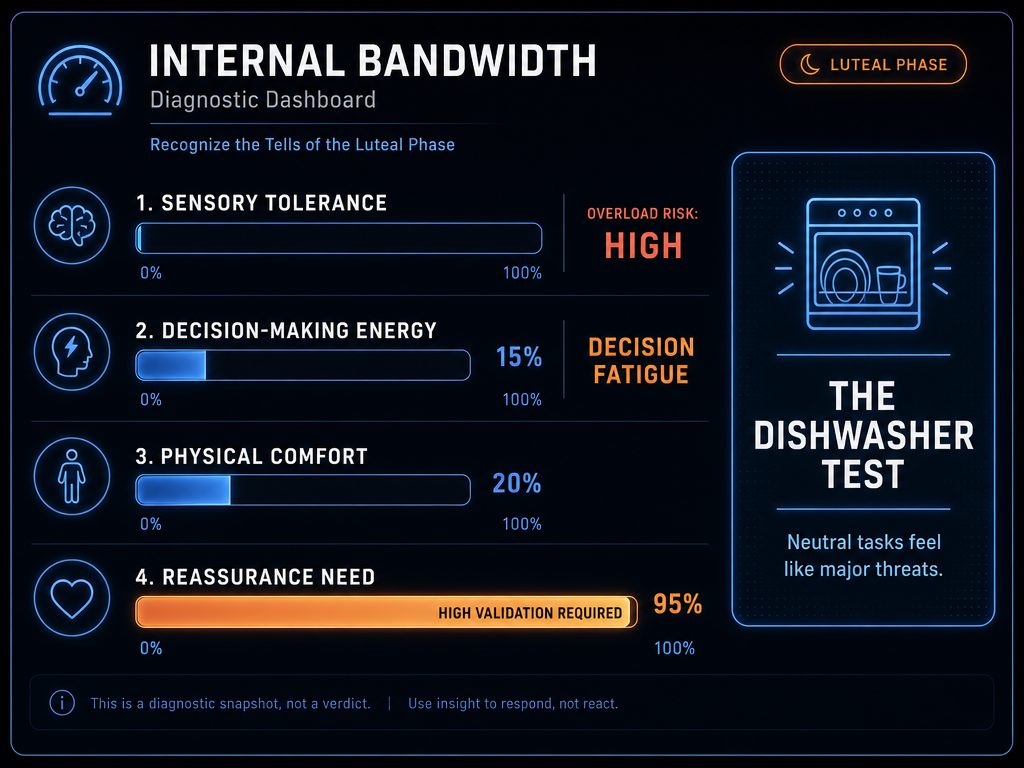 When her internal bandwidth for noise and decisions is low, she isn't being 'dramatic'; she is biologically overstimulated and requires low-pressure quality time.
Most relationship advice tells you to "communicate more" or "ask her what she needs." But when hormones crash during the late luteal phase, her brain has such reduced bandwidth that articulating what she needs becomes nearly impossible. Instead, watch for these three behavioral patterns - they're more reliable than waiting for her to tell you.
The Reassurance Paradox
She pulls away physically but asks "Do you still love me?" or "Are we okay?" multiple times in a single day. This isn't manipulation - it's a neurochemical response. The serotonin drop makes her brain interpret neutral distance as emotional rejection. She's not pulling away because she wants space from you; she's overwhelmed and her nervous system is flooding with stress hormones that make closeness feel simultaneously necessary and impossible to initiate.
The tell: she's physically present but emotionally distant, and small comments like "I'm going out with the guys Saturday" trigger disproportionate worry about whether the relationship is stable.
Sensory Overload
She complains about sounds that didn't bother her last week - your music is too loud, the TV is annoying, she's suddenly irritated by the way you chew. This isn't about you; it's about her nervous system operating at maximum capacity. When progesterone drops, her stress response stays activated, and that makes every stimulus feel more intense.
The tell: she snaps at minor environmental factors (bright lights, background noise, crowds) and requests more time at home instead of going out. She's not being antisocial - her body is genuinely overstimulated.
The Dishwasher Test
Small, previously neutral tasks become sources of significant conflict. You forgot to take out the trash, and suddenly it's a referendum on whether you care about the relationship. This isn't illogical - it's a sign that her emotional bandwidth is depleted. Roughly half of people who menstruate report having at least one PMS symptom, but only about 1 in 5 have symptoms severe enough to disrupt daily life.
The tell: tasks she normally handles without complaint suddenly feel insurmountable, and she's asking you to take over decisions she usually makes herself ("What should we have for dinner?" when she normally just makes something).
What "Quality Time" Actually Means During Different Phases
The biggest mistake men make is assuming "quality time" means the same thing all month long. A candlelit dinner that lands perfectly during her follicular phase might feel exhausting and performative during her luteal phase. Her capacity for stimulation, decision-making, and social interaction shifts with her hormone levels.
High-Energy Quality Time (Follicular and Ovulation Phases)
During the first half of her cycle - roughly days 1 through 14 - estrogen is rising and she has significantly more social and physical energy. Around ovulation, many women notice increased sex drive, though symptoms vary considerably person to person. This is when she's more likely to initiate plans, enjoy crowded environments, and want active date nights.
What works: dinner reservations, concert tickets, hiking trips, meeting up with friends, trying new restaurants. She has the bandwidth for novelty, stimulation, and logistical complexity.
What to watch for: if she's planning weekend trips and suggesting new activities, she's likely in this high-energy window. Match that energy - this is the time to say yes to social plans and introduce variety into your routine.
Low-Stimulation Quality Time (Luteal Phase)
During the second half of her cycle - roughly days 15 through 28 - progesterone rises to prepare the uterine lining, and if pregnancy doesn't happen, both progesterone and estrogen drop sharply. Many women notice mood shifts, bloating, fatigue, and reduced tolerance for stress during this phase. As many as 3 in 4 women report experiencing PMS symptoms at some point in their life, though severity varies widely.
What works: staying in, low-decision activities, physical touch without the pressure of conversation or sex, parallel play (being in the same room doing different things), taking over the mental load without being asked.
What to watch for: she cancels plans she previously made, requests nights in instead of going out, or asks to reschedule social events. This isn't flakiness - it's a biological signal that her nervous system is operating at reduced capacity. Learn to recognize when your girlfriend needs space during her cycle versus when she needs low-pressure closeness.
The Triple-A Framework: Your Tactical Response System
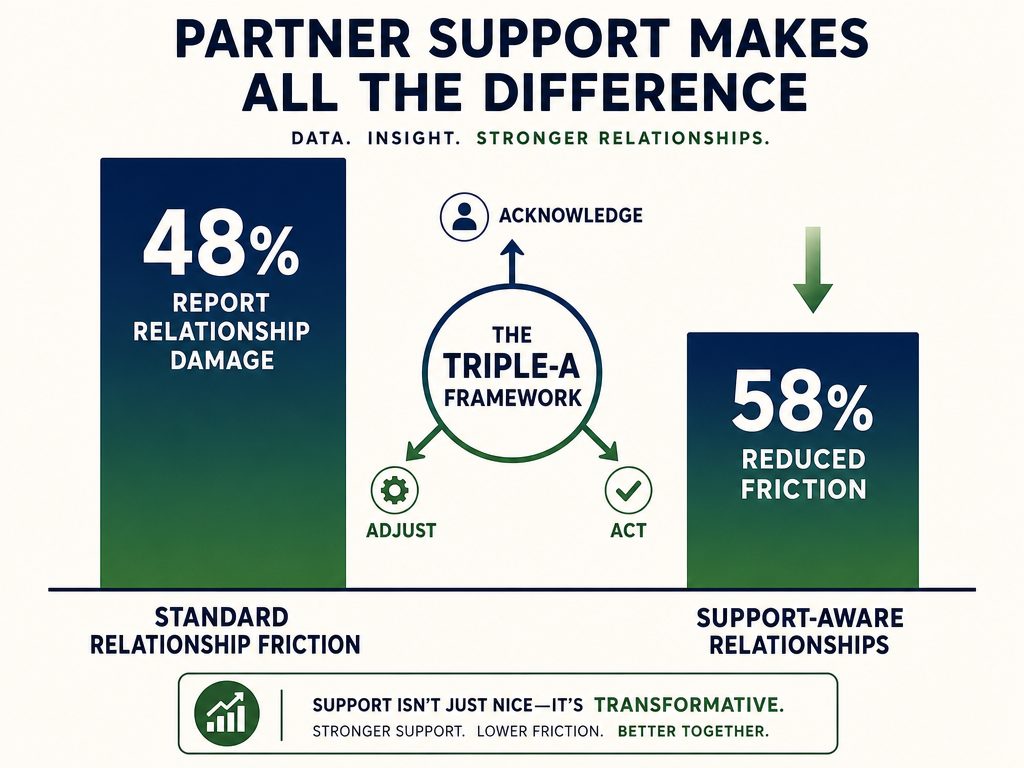 Implementing a structured approach like the Triple-A Framework can significantly reduce relationship friction by anticipating hormonal shifts instead of reacting to them.
When you recognize the signs, you need a system to respond effectively. The Triple-A Framework gives you clear actions instead of vague advice to "be supportive." 58% of couples report reduced relationship friction when the partner uses cycle-tracking tools to anticipate shifts, and this framework is how you operationalize that data.
Acknowledge: Use Validation Scripts
Your first instinct when she's upset will be to fix the problem or explain why she shouldn't feel that way. Resist it. When a partner is struggling emotionally, responding with genuine empathy tends to help more than trying to "fix" the problem or offer silver linings. Feeling understood, not corrected, is what defuses tension.
Validation scripts that work:
- "It sounds like you're feeling overwhelmed. I'm here."
- "That makes sense - you've been dealing with a lot this week."
- "I can see this is hard. What would help right now?"
What not to say:
- "You're overreacting" (even if you think it's true)
- "This isn't a big deal" (it is to her right now)
- "You always get like this" (pointing out the pattern mid-crisis never helps)
Adjust: Shift the Environment to Match Her Capacity
Don't ask "What's for dinner?" when she's already at maximum cognitive load. Don't suggest going out when she's clearly overstimulated. Instead, take initiative based on what phase she's in. For more specific guidance on timing, check out how to tell what phase your girlfriend is in.
The Luteal Kit (keep these items accessible):
- Her favorite comfort food (order it, don't ask her to decide)
- A weighted blanket or heating pad
- Low-stimulation entertainment (comfort TV shows she's seen before, not new complex dramas)
- Dim lighting options
- Her preferred pain relief if she typically experiences cramps
Adjust your expectations: this is not the week to suggest a road trip, introduce her to new friends, or have a complex financial conversation about moving in together.
Act: Take Over the Mental Load Silently
The most underrated form of quality time during the luteal phase is reducing the number of decisions she has to make. Lifestyle approaches that can help ease PMS symptoms include regular aerobic exercise, smaller/more frequent meals, less salt/caffeine/alcohol, adequate sleep, and stress-reduction practices. A partner who understands and supports these approaches is aligned with medically recommended self-care.
What "acting" looks like:
- Clean the kitchen before she asks
- Take the dog out without being reminded
- Handle the grocery run
- Respond to the group text about weekend plans so she doesn't have to
- Reschedule the dinner with your parents to next week
This isn't about treating her like she's incapable - it's about recognizing when her internal resources are genuinely depleted and stepping up without waiting for a request.
The Quality Time Playbook by Phase
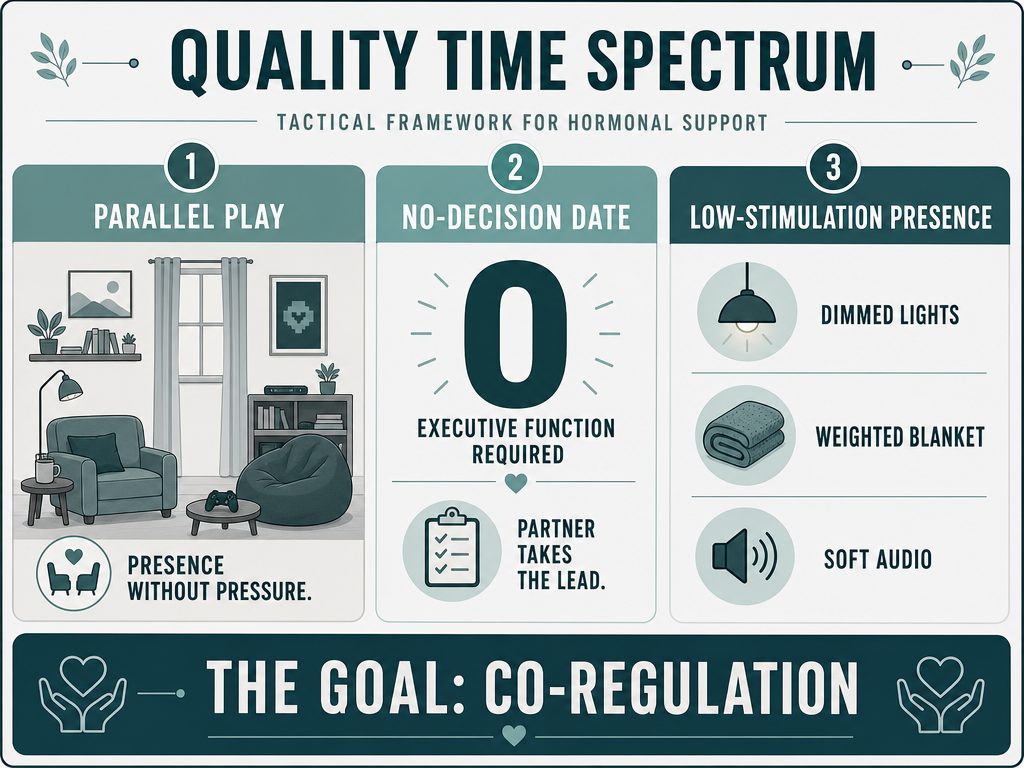 Effective quality time during the luteal phase focuses on co-regulation and reducing sensory input rather than high-energy social outings or complex planning.
Once you understand the biological rhythm, you can plan connection moments that land instead of backfire. Here's what quality time should look like across the cycle, with tactical examples you can implement immediately.
Parallel Play (Days 22-28: Late Luteal Phase)
This is the phase where traditional "date night" advice fails. She doesn't have the bandwidth for conversation-heavy dinners or activities that require sustained focus. Instead, focus on shared physical space without the pressure of interaction.
What it looks like:
- You're reading on the couch while she scrolls her phone, but you're in the same room
- You're cooking while she watches TV nearby
- You're both working on separate tasks at the kitchen table
- You take a walk together but don't force conversation
Why it works: her nervous system gets the regulatory benefit of your calm presence without the added stress of having to perform socially. Physical proximity releases oxytocin (the bonding hormone) even without conversation.
The No-Decision Date (Days 15-21: Early to Mid-Luteal)
She still wants connection but her executive function is starting to decline. Handle all logistics so she doesn't burn energy making choices. For more date planning strategies, see how to plan dates around her hormones.
What it looks like:
- You pick the restaurant, make the reservation, and handle the drive
- You plan a movie night but you choose the film, order the food, and set up the space
- You suggest a specific activity with a defined time: "Let's go for a 20-minute walk at 7" (not "Should we do something tonight?")
Why it works: she gets quality time without depleting her already-limited decision-making capacity. The structure of "you handle everything" is a gift, not a loss of agency.
Presence Without Pressure (Days 22-28: Late Luteal/Early Menstrual)
Physical discomfort is often highest during the late luteal phase and early menstruation. Her body might be dealing with cramps, bloating, headaches, or fatigue. This is when physical closeness without the expectation of sex becomes most valuable.
What it looks like:
- Holding hands while watching TV
- Lying next to her while she rests
- A back rub or foot massage with no sexual undertone
- Cuddling while she reads or naps
Why it works: touch releases oxytocin and reduces cortisol (the stress hormone), but only when it doesn't come with a hidden agenda. If she senses you're initiating physical contact hoping it leads to sex, her stress response activates instead of calming. For more on how to comfort your girlfriend during PMS, prioritize genuine comfort over any other outcome.
When It's More Than Hormones: Recognizing PMDD
Not every woman experiences PMS the same way, and for some, the symptoms are severe enough to constitute a clinical disorder. PMDD (premenstrual dysphoric disorder) is a real, clinically recognized condition listed in the DSM-5 as a depressive disorder, affecting roughly 1 in 10 people who menstruate. Between 5% and 8% of women experience PMDD, which requires medical intervention rather than just behavioral support.
PMDD is a more severe, sometimes disabling extension of PMS. Both happen on a similar timeline (about 7-10 days before a period) and can share physical symptoms like bloating and fatigue, but PMDD specifically involves extreme mood symptoms - such as marked irritability, anxiety, or hopelessness - intense enough to disrupt daily life and strain relationships.
PMDD Warning Signs
- Suicidal thoughts or self-harm ideation during the week before her period
- Rage episodes or aggressive outbursts that are completely out of character
- Panic attacks that occur only in the luteal phase
- Inability to function at work or in relationships during the premenstrual window
- Symptoms that resolve completely within a few days after menstruation starts
If you're seeing these patterns, this is beyond what cycle awareness and supportive partnership can address. She needs medical support, not just a more understanding boyfriend.
How to Start That Conversation
Script for bringing up PMDD: "I've noticed the week before your period is really hard on you - more than just typical PMS. I've been reading about PMDD, which is a clinical condition, and some of what you're experiencing sounds similar. Would you be open to talking to a doctor to see if there's a way to make you feel better? This isn't because you're doing anything wrong - it's because you shouldn't have to suffer like this every month."
What not to say:
- "You need help" (positions her as broken)
- "This is affecting our relationship" (makes it about you, not her wellbeing)
- "You should just go on birth control" (medical decisions are hers to make)
Frequently Asked Questions
How do I know if her mood shift is hormonal or about something I actually did?
Look at timing and pattern. If the shift happens in the second half of her cycle (roughly days 15-28) and resolves within a few days after her period starts, it's likely hormonal. If it persists across the entire month or gets worse rather than better with her period, it's probably relational and you need to have a conversation. Tracking symptoms and mood changes across the cycle for a few months is a medically endorsed way to identify real patterns rather than assuming based on a single cycle. Consider using a period tracker for partners to build pattern recognition.
Should I tell her I'm tracking her cycle?
Only if she's comfortable with it. Some women find it supportive and appreciate that you're trying to understand their biology; others feel surveilled or reduced to their hormones. The right approach: ask permission. "I've been reading about how the menstrual cycle affects mood and energy. Would it be helpful if I learned more about your cycle so I can be more supportive?" If she says no, respect that boundary and focus on responding to behavioral cues instead of calendar days.
What if she says she doesn't want me blaming everything on her period?
She's right to push back if you're using her cycle as a way to dismiss her feelings or avoid accountability. "You're just on your period" is never an acceptable response to a legitimate complaint. The point of understanding her cycle isn't to invalidate her emotions - it's to recognize when she needs a different kind of support and when pushing for a complex conversation will backfire. If she brings up a real issue during her luteal phase, acknowledge it seriously: "This sounds important. Can we talk about it more this weekend when we both have more energy?" That honors both the validity of her concern and the reality that her bandwidth is reduced.
How long does the luteal phase last?
The luteal phase typically lasts about 10-16 days, though cycle length varies considerably between women - periods can start anywhere from every 24 to every 38 days. There's no single universal 28-day cycle, so exact day-by-day predictions should be treated as approximate. PMS symptoms usually show up one to two weeks before a period and resolve within a few days after it starts. The late luteal phase - roughly the 3-5 days before bleeding begins - is when symptoms peak for most women. If you're trying to anticipate her needs, focus on that final week before her period rather than trying to track exact day counts.
What should boyfriends do during the luteal phase?
Reduce decision load, lower stimulation, validate emotions without trying to fix them, and don't take irritability personally. Specific tactics: handle meal planning without asking what she wants, cancel or postpone high-energy social plans, increase physical touch that doesn't lead to sex, and take over household tasks before she asks. Avoid: suggesting she's overreacting, initiating serious relationship conversations, planning surprise activities that require her to make quick decisions, or pointing out that "you're always like this before your period." For more specific support strategies, read our complete guide on how to support your girlfriend's luteal phase.
Can stress cause her period to come early?
Yes. Stress can disrupt the hypothalamic-pituitary-ovarian axis, which regulates the menstrual cycle, potentially causing periods to arrive earlier than expected. High cortisol levels from sustained stress can interfere with hormone production and throw off her usual cycle timing. If she's dealing with work stress, family issues, or relationship conflict, her period might arrive several days early - which can make her PMS symptoms feel like they came out of nowhere. If her cycle becomes highly irregular or unpredictable, that's worth mentioning to a healthcare provider.
What is the 7-2-1 rule for menstruation?
There is no established medical or scientific rule called "the 7-2-1 rule for menstruation" that we could verify through clinical sources. This phrase appears in some online content but isn't a recognized framework in gynecological or relationship medicine. If someone references it, ask them to clarify what they mean rather than assuming it's an official guideline.
What are the ten most important emotional needs in a relationship?
While various relationship models list different needs, research-supported essentials include feeling heard and understood, physical and emotional safety, trust and honesty, appreciation and respect, quality time and attention, affection and intimacy, shared values and goals, personal autonomy, emotional validation, and reliable support during stress. For men specifically, understanding how to support your partner through cycle-related mood changes addresses multiple needs simultaneously - it demonstrates attentiveness, provides emotional validation, and builds trust through consistent support.
Her need for quality time isn't random - it's running on a biological loop that you can learn to anticipate. When you stop treating her mood shifts as unpredictable and start recognizing them as phases you can prepare for, you transform from a reactive partner who's always catching up to a proactive one who knows what she needs before she has to ask.
The men who build lasting relationships aren't the ones with grand romantic gestures - they're the ones who understand that sometimes the most powerful form of love is taking out the trash without being asked, sitting quietly in the same room, and not making her explain why she needs to cancel Saturday's plans. Match your support to her biology, and you'll stop walking on eggshells and start building the kind of partnership where she feels genuinely understood.
Want to stop guessing and start anticipating? VibeCheck turns cycle data into daily action plans so you know exactly how to show up for your girlfriend every day of the month.
Tags

Related Articles
Continue reading to deepen your understanding

Your Girlfriend’s Mood Shifts Throughout the Month, Explained
Ever wonder why her energy and moods change so drastically each week? Understand the four hormonal phases and how to be the partner she needs during every stage of her cycle.

How to Support Your Girlfriend When She’s Crying Because of Hormones
Watching her cry when hormones hit can feel overwhelming. Learn the biological why behind the tears and use these proven scripts to provide the support she actually needs right now.

How to Help Your Girlfriend with Hormonal Mood Swings Without Arguing
Understand her cycle and learn tactical scripts to handle tension. This guide shows you how to support her through hormonal shifts without getting into unnecessary fights.

When to Feed Your Girlfriend: Understanding Hangry Hormones
Does your girlfriend get irritable when she hasn’t eaten? It’s not just in her head. Learn why hormones cause hanger and the specific times her body needs more fuel.

The Boyfriend’s Guide to Supporting Your Partner Through PMS
If your partner is suddenly irritable and exhausted, it’s biology, not you. Learn about the luteal phase and how to provide meaningful support without walking on eggshells.

Why Your Girlfriend Wants Different Things Each Week: The Biological Roadmap
Does your partner seem like a different person every seven days? Understand how her 28-day biological cycle impacts her energy and mood so you can provide the support she actually needs.

How to Help Your Girlfriend When She’s Irritable Before Her Period: The Partner’s Playbook
Is your partner snapping at small things right before her cycle? It’s not you—it’s biology. Learn how to navigate the serotonin crash and provide the support she actually needs.

How to Tell Your Girlfriend Is Overwhelmed by Hormones
Is she snapping or withdrawing for no reason? Identify the behavioral tells of hormonal overwhelm and learn how to support her during the luteal phase without triggering a fight.